Showing posts with label safegrowth. Show all posts

Wednesday, September 17, 2025

An Odyssey - Searching for the cause of crime


Ancient Greek vase (480 BC) of legendary King Odysseus hearing the Sirens whose songs lure sailors to shipwreck - self-mastery and constraint led his ship to safety.
Similarily, in criminology, theories of social and situational control can lead us safely away from crime - photo Wiki Commons

By Gregory Saville

Note: To theory-averse readers – I apologize. We usually do not write long blogs. We offer real-life examples, stories of people doing great things, and ideas for change. We don’t delve deeply into theory. Now and then, however, I am reminded that theory is the foundation for good practice and that sometimes stories take time. This blog explains why.

Last year I re-read Homer’s Odyssey and thought: perfect blog arc. I drafted an outline—but life intervened. Last week, thumbing through notes from my first crime-theory classes in graduate school many moons ago, it hit me: these weren’t lecture summaries—they were maps of an odyssey —a long voyage across generations, full of rival schools, wrong turns, and breakthroughs. 

Like Odysseus, criminologists kept sailing from one island of ideas to the next, each promising an answer to why crime happens and how to prevent it. And, like Odysseus, each landfall changed the quest.

Class #1 Individual Pathology — “Look inside the person”

The theory voyage in criminology was launched inside the human brain in the 1800s. Italian physician-criminologist Cesare Lombroso hunted for the “born criminal”. Early-1900s eugenicists chased ‘feeblemindedness’ and eugenics boards forced sterilizations on the “unfit” — grim policy on flimsy claims.


Some tried to pin crime on IQ. Ultimately criminologist Edwin Sutherland wrote intelligence was not an important cause of delinquency, and more recent studies suggest any existing IQ/crime link reflects school struggles and social frustrations.

Today the spotlight has shifted again. Trauma, psychopathy, sociopathy, and malignant narcissism are the buzzwords. In our field, third-generation CPTED captures this emerging research. New studies by Indian psychologist Meenakshi Shukla
and Australian psychologist Natalija Djakovic
dig into the Dark Triad —narcissism/Machiavellianism/psychopathy—showing deficits in both cognitive and emotional empathy.

Socio-biology theories remain a viable explanation for at least some crimes, especially neurological research on aggression and the amygdala. Trauma-based prevention programs capture this research.

Other theory captains took new routes. German/British researcher Hans Eysenck’s Crime and Personality (1964) mapped “criminal personalities.” Neurological researchers explored aggression and the amygdala; endocrinologists tested chemical castration for sex offenders. And yet, research indicates that most people with risk factors don’t offend. None of these pathologies are silver bullets. 

The emerging field of sociobiology has rebooted with wiser tools—twin studies, behavioral genetics, brain imaging—pointing to a gene–environment duet. Biology matters; context decides. Whether biomarkers become crime depends on the social world where predispositions meet opportunity. Neighborhoods matter.

Class #2 Social Psychology — “We learn our way into crime”

By mid-century, the odyssey turned outward. Instead of asking what’s wrong in the brain, we asked how people learn morals and rules. Lawrence Kohlberg 
mapped moral development, and Albert Bandura showed we lean toward rewards and away from punishment—kids learn kindness or bravado from caregivers, from TV like Sesame Street, and from crime-glorifying media. 

In the 1970s, my old friend C. Ray Jeffery argued these learning “environments” should be woven into one integrated theory—a thread that fed CPTED thinking.

Much of that evolved from Chicago’s Edwin Sutherland who said it plainly: crime is learned from others—differential association. His students Sykes & Matza added techniques of neutralization, the justifications offenders use: “nobody really got hurt” or “the system is corrupt.” Culture-conflict and subcultural theories showed why immigrant and lower-status youth might reject mainstream rules: remove status and respect, and people build their own codes. In prison, a single “diss” can trigger violence.

Which begs the question: if crime is learned, why don’t more people do it? I once attended Professor Travis Hirschi's criminology class years ago where he answered that question: strong social bonds in families and school hold people back. Later, in A General Theory of Crime with Michael Gottfredson, he argued that low self-control—impulsivity and present-mindedness—explains much deviance across life.

A few decades earlier, in the1960s, radical criminology had flipped the script. Howard Becker
and labeling theorists asked who gets to define crime. Being from “across the tracks” or “the bad side of town” are labels we still see in SafeGrowth work. Stigma can create careers in deviance; diversion programs try to interrupt that path. Modern restorative justice pushes further: repair harm, include victims, reintegrate people, and rebuild relationships so communities can heal. Vancouver, Canada is the latest city to scale this up as a Restorative City.

Restorative Vancouver - photo courtesy of the peacemaking group Peace of the Circle led by Dr. Evelyn Zellerer

Class #3 Structure & Ecology — “Place shapes possibility”

The third cluster steered theory into bigger waters: neighborhoods, cities, the social fabric. In the 19th century, French sociologist Émile Durkheim called it anomie when shared expectations fray and meaning is lost. Working in Boston and New York, Robert Merton wrote “Social Structure and Anomie” (1938), turning that into strain theory: if we celebrate success but block lawful means, people will innovate—sometimes illegally.

Chicago researchers Clifford Shaw & Henry McKay mapped delinquency across the city. Crime radiated in zones from the core; neighborhood conditions mattered more than individual traits—a theme that still resonates in SafeGrowth work. In the 1930s, they launched the Chicago Area Project to build cohesion and youth capacity; decades later a RAND corporation evaluation confirmed that it worked—delinquency fell and community organizing improved.

Neighborhood conditions affect social cohesion, collective efficacy, and crime

Richard Cloward & Lloyd Ohlin’s book, Delinquency and Opportunity, 
saw gangs as the street’s answer when legitimate paths are closed. Robert F. Kennedy read their work and helped channel it into Great Society programs to unblock pathways—jobs, training, education.

Conflict theorists added sharper edges: law can reflect the push-and-pull of groups; others, leaning on Marx, tied crime to class domination and surplus labor. These theories led to stormy seas—often more political than operational—but a needed reminder that power, inequality, and law are braided together.

Then came a three-point compass: Routine Activities Theory. Felson and Cohen argued crime happens when a motivated offender, a suitable target, and no capable guardian converge in space and time. Paired with British criminologists Clarke and Mayhew’s situational prevention, that changed practice: reduce temptations, harden targets, add guardianship, design better settings. In 1981, Canadian criminologists, Patricia and Paul Brantingham's environmental criminology, put crime theories into geography. 

In the mid-1980s, British criminologists Ronald V. Clarke and Derek B. Cornish crafted their prevention studies into a new twist on a very old idea - many offenders make rational decisions to commit crimes - the Rational Choice Theory.  I recently wrote a blog memorial to my friend, the late Ron Clarke (and his co-author Patricia Mayhew) for their tremendous theoretical contribution to the field. SafeGrowth taps into some of these ideas in early phases of prevention; and then extends them in later phases by using community capacity-building.

From the 1960s, Jane Jacobs’s ‘eyes on the street’ in urban planning and architect Oscar Newman’s defensible space in the 1970s, through to Robert Sampson’s collective efficacy in the late 1990s, the through-line is clear: urban design + neighborhood trust + willingness to act = effective prevention. SafeGrowth broadens this ecology of crime into long-term neighborhood capacity and livability.

According to legend, King Odysseus left Troy on a voyage home to Ithica following the Trojan War. Crime theory over the decades resembles that journey - photo courtesy of Tungsten, Wiki Commons

Final Class – Coming Home

Looking back, criminology’s odyssey isn’t about crowning one victor; it’s about integrating what each island on the Odyssey taught us. C. Ray Jeffery's desire for an integrative theory was right all along - albeit in a more expansive form. Pathology showed that bodies and brains matter—in context. Social psychology showed how we learn, belong, and are labeled—and how restoration can replace stigma. Structure and ecology mapped how inequality, environmental opportunity, urban design, and cohesion set the neighborhood stage where all those human stories play out.

That synthesis is where prevention lives. Biology supplies tendencies; peers teach habits; place turns risk up or down. This is the true ecology of crime—not a buzzword, but a practical way to braid the human, the social, and the spatial into strategies that work.

Odysseus doesn’t return the same man who left Ithaca. Neither do we. The destination isn’t a single, final theory. It’s a way of working together—scholars, residents, planners, cops, and city builders—to make safer, more livable neighborhoods that grow and flourish. That is our Ithaca: not a port where the voyage ends, but a place strong enough to launch new journeys and welcome people safely home.

Sunday, March 30, 2025

Innovating Transit Safety - What one city might learn from another

In 2024, New York deployed the National Guard to patrol subways
 - photo courtesy of Flickr via Creative Commons

by Gregory Saville

Comparing crime between cities is always a challenge. Crime rates, cultures, and demographics vary widely. This is especially the case with different transit systems where light rail station designs and social environments differ. 

With these caveats in mind, looking at the safety strategies in the public transit systems of Portland’s TriMet and Calgary Transit provides a unique opportunity to explore how transit security evolves and how Calgary (and other cities) might learn from a unique program in Portland: the Safety Response Team (SRT). 

(Editorial Rant: I am mindful of the recent US/Canada tariff war. I have my own opinions on that fiasco that will remain out of this blog. But now, perhaps more than ever, it is important to acknowledge how different cities can share important lessons from each other to make places safer for all our citizens! Rant done!) 


Different Cities, Different Systems

I have seen security footage of recent violent incidents on both the Calgary and Portland light rail systems. Clearly, neither system is immune from crime, even though overall rates of violence on public transit, compared to other areas in the city, are exceedingly low. 


Calgary Transit light rail - photo Greenwood714, CC BY-SA 3.0, via Wikimedia Commons


I have also spent time on both transit systems, having taught SafeGrowth in both cities. I love spending time in both cities! 

Calgary and Portland are distinct in many ways. Calgary’s metropolitan area has about 1.4 million residents, while Portland’s metro population is closer to 2.5 million. Portland’s TriMet system covers 59 miles of light rail with 149 stations, compared to Calgary’s CTrain, which spans 27 miles with 42 stations. Calgary Transit moves about 106 million riders annually, whereas TriMet serves 67 million riders. 


Portland's TriMet light rail Tilikum Crossing
Photo Steve Morgan, CC BY-SA 4.0, via Wikimedia Commons


Portland also has a higher murder rate than Calgary (and more handguns in the US). Other types of crime rates, however, are not so different and since last year Calgary has seen an increase in the proportion of gun-related homicides

Calgary Transit employs about 140 peace officers, giving it a ratio of 3.11 officers per station. TriMet’s system, by contrast, has a much lower security/police officer-to-station ratio—approximately 1.06 per station (Portland uses a combination of security officers and law enforcement officers who respond when called). 

Despite these differences, Portland’s Safety Response Team (SRT) represents an innovation that Calgary could benefit from, even within its own distinct system.


The Portland SRT: A Social Response to Transit Safety

As we learned from Beth Dufek’s three-part blogs on TriMet’s SRT - the Safety Response Team (November 2023, January 2024, and March, 2024), it was a response to increasing safety concerns on the system. Rather than focusing purely on enforcement, SRT members take a different approach: they are unarmed, patrol in teams of 4, trained in conflict resolution and first aid skills. They use a Smartsheet on their phones to carefully track all interactions (in 2023, SRT had 11,354 interactions and provided 8,022 people with services).


TriMet's SRT group - January 2023 
Photo courtesy of TriMet


They discourage inappropriate and illegal behavior through engagement and, where possible, not enforcement. They also conduct social service outreach, providing referrals for housing, mental health support, and addiction treatment. The team even carries Narcan to intervene in opioid overdoses.

This program has gained national recognition. In 2023, the American Public Transportation Association awarded TriMet its highest honor for security and safety innovations, largely due to the impact of the SRT.

In contrast, Calgary Transit relies more on traditional enforcement. Its peace officers are sworn officers who can issue fines, make arrests, and carry batons and handcuffs. While effective in crime deterrence, this approach does not inherently offer a similar social service outreach that the SRT offers. Calgary does have an “ambassador program” with transit employees who help customers with route information and inquiries, but that is a far cry from the SRT. 


Conducting safety audits of a TriMet station in Portland
during SafeGrowth training


SafeGrowth and the Future of Transit Safety

Over the past few years, we conducted SafeGrowth Training with TriMet’s security team and the SRT. By applying SafeGrowth principles, the TriMet security team, along with their SRT, is equipped to create safer transit spaces not just through security, but through 1st and 2nd Generation CPTED, proactive engagement, and problem-solving.

Calgary Transit has taken steps to address safety, including increasing peace officers by 25% in 2023 and deploying security guards at select stations. However, the question remains: could a model like the SRT, rooted in social outreach and engagement, provide an additional layer of safety beyond enforcement? Given that nearly half of Calgarians still avoid transit due to safety concerns, it may be time to explore such an approach.


Moving Forward

The challenges of transit safety won’t be solved by enforcement alone. Transit systems across Canada and the US face challenges from declining ridership, public fears, and crime. For example, last year, New York deployed 1,000 National Guard troops on the subway system in response to some high-profile crimes and increasing fears. This was despite questions about their ill-preparedness for policing tasks and public concerns that, instead of feeling reassured, some citizens feel more uncomfortable about soldiers with machine guns on subway platforms. 

Portland at night - SafeGrowth training with public transportation   


There are better ways forward. Portland’s TriMet SRT offers a glimpse into what a different model can look like—one that combines security with social outreach. 

Calgary Transit has made strides in bolstering its security presence, but adding a program similar to the SRT could help address safety concerns in a way that enforcement alone cannot. As transit agencies worldwide explore new models of safety, it may be time for Calgary and other cities to take a closer look at what’s working in Portland.


Friday, October 11, 2024

The "nudge" factor in CPTED


by Larry Leach

Larry is Executive Director of Calgary’s 12 Community Safety Initiative – a non-profit crime prevention collaborative. He was awarded the Queens Diamond and Platinum Jubilee medals for his contributions to community-building. He is a member of the SafeGrowth Network and now joins our blogging team.

In 2021 a book was published called Nudge: The Final Edition. Prior to that, there are several videos and TedTalks on the topic going back over a decade. Prof. Richard Thaler won the Nobel prize in 2017 for the theory. Nudge has become popular in behavioral economics studies. The concept is simple: Most people want to do the right thing, but instinctively take the path of least resistance. A reminder or nudge can put us all on a path towards doing the right thing. 

For example, after a sporting event or concert, I have often left garbage behind under the seat (like everyone else). My thinking: 'We all know they have cleaners coming in after, so no guilt'. One day after leaving a game, my friend picked up his beer can and plastic cup. I turned back and did the same. We then waited while many others put their recycling in one bin (the beer can) and the plastic cups in another. Simple, yes, but ultimately, we must be the change we want to see in the world. We can’t expect (or guilt) others to join us, but we can nudge them.


WHAT IS A NUDGE?


When translated, the sign in the above photo in Helsingborg, Sweden reads “A hello can save lives”. Mateja Mihinjac from our SafeGrowth team came across this yellow-painted bench in a downtown park. It was part of Helsingborg's "Friendship Benches Project" and it was an attempt to nudge those feeling alone and alienated seeking conversation to sit at the yellow part of the bench to encourage empathetic passersby to have a friendly conversation.  

According to research from the National Center for Suicide Research,“talking is one of the ways to prevent someone from actually attempting suicide”. It is a classic example of "nudge" design to encourage positive behaviour. And Swedish research suggests it is working.

When I hear behavioral economists and behavioral scientists talk about this topic I can’t help my mind wandering over to the CPTED space. Both CPTED and Safegrowth have behavioral elements. Designing a space to nudge others into doing what is best for the environment around them, not what is the most immediate personal win. Spaces to encourage gathering and community building will be activated by someone and followed by others to create a critical mass.


Research suggests that certain colours at night might trigger less violent behaviour


For example, an experiment was described during a TedTalk where a speaker put up signs that said, “Your mother doesn’t work here, clean up your own mess”. The result was a mess left everywhere. 

A successful example was putting three garbage receptacles on a beach in a high visibility area with different colours and signs above with examples of what to put in each colour bag. The latter was FAR more successful. A Nudge (subtle) is greater than an order or ultimatum. It gives the individual the agency to make their own decision to do the right thing. Do you ever hear anyone boast that they did the right thing because a sign told them? Rather do you hear “I always do that”? It can become a big part of someone’s personal brand or narrative. 


Prior SafeGrowth blogs have described the subtle impact of
coloured lighting and crime


HOW DO YOU NUDGE A SPACE? 

Nudging and CPTED take time to change people’s behavior and for most people, it will work. We all need to be patient to see the results over time. In Safegrowth the goal is stated on the website “If Neighborhoods had the skills, tools, and resources to remove, wherever possible, the motives and opportunity for crime.” A lofty goal, but certainly worth the time it takes to understand who and what assets your community has and what assets are needed to accomplish this.

One might think that a survey asking behavioural questions is a good idea, but the problem goes back to the YouTube nudge example above. Putting instructional signs up sounds like a good idea. People would likely answer 'put up a sign' in response to irresponsible behavior. That notion comes from the premise that we all want to do the right thing, but when we see others not do the right thing, we all follow. 


The Thaler and Suntein book "Nudge" revolutionized
how urban designers think about space


Therefore, it is not simply asking the question but instead, it is understanding what behavior needs a nudge. How often have you heard someone explaining bad behaviour by saying, "others do it, so why can’t I?" In criminology, this is known as the techniques of neutralization.

It is not enough to hope for good intentions. In SafeGrowth and in intelligent CPTED, when we look at designing spaces and activating spaces to create community, we always must keep in mind human behavior. For people to comply, they might need a little nudge or two.


Monday, September 30, 2024

Here's to our students - a life of purpose


Baltimore's Penn train station during our class night-time safety audits

by Gregory Saville

I taught my first CPTED seminar at my home university in Toronto while in graduate school when I was still a police officer in 1986. It launched my teaching, researching, planning, and consulting career. Since then we have modernized and expanded the CPTED program far beyond lights, locks, territorial controls, and target hardening. 

In recent years, with the help of the many smart and experienced members of our SafeGrowth Network, along with some leading academics, practitioners, community residents, researchers, and police officers, the SafeGrowth method has flourished as a powerful way to transform places. But today, after all these years and all this progress, I remain powerfully impressed by our students.

Landing home at the Denver International Airport - reflecting on past training

Landing in Denver last week after a flurry of training projects it struck me that I still revere the intelligence and tenacity brought to our crime prevention classes by the residents, police, city organizations, and community associations. Our recent courses in Madison, Vancouver, Baltimore, Palm Springs, Saskatoon, and New York City again reaffirmed my faith in our students. They have the most to gain and lose because they live in neighborhoods afflicted by crime. We affectionately call them SafeGrowthers, and they are remarkable.

They hold a mix of professional and personal skills and they bring a wealth of experience to the table, often with humor and passion. 

Reading, talking, walking, and thinking
- they engage the SafeGrowth material with full attention

Our students are an impressive bunch

Fighting crime and building neighborhood livability is a massive undertaking with many obstacles. And yet, even when faced with the miracle stupidity of government red tape, jumbled media distortions, and political manipulators, they still somehow manage to stay the course and get the job done. 

Outdoor Safety Audits are a popular part of the training

This year, once again, I listened to the obscene wickedness they face in the crime, drugs, and violence plaguing their neighborhoods. They tell us our training offers them tools and methods to succeed, and for that we are grateful. Yet their stories cause goosebumps:

  • In one city, residents and police tackled a high-crime city-owned parking structure and presented the results to the city council, hoping for action to improve safety. A year later, after no action, a resident was robbed and murdered in exactly the way they predicted. Crime prevention is not always easy! 
  • In one New York neighborhood, students came to class the day after a shooting homicide of one of their neighbors. 

Some of our students are already engaged in incredible prevention work, such as the Bronx Rises Against Gun Violence organization

  • In a Baltimore class, one group tackled school violence in a high school where school administrators refused to collaborate with them. 
  • In another city, residents were asked by some managers not to deliver their findings at final community presentations regarding violence at a homeless shelter. They did so anyway and, in doing so, they learned how to speak with diplomacy and candor. They ended up with a positive reaction from the shelter and charted out practical steps forward.
  • In some cities, police shone as stellar leaders who engaged with the residents. In others, police never bothered to attend or participate (this being a free class in proven methods of preventing crime). 
  • Some students themselves were victims of violence in their own neighborhoods. Others had once been incarcerated for violence, had reformed their lives, and were now community leaders. 

In New York, training occurred in multiple neighborhoods in different parts of the city 

When we speak to our students in class, online, or during virtual office hours, we work to provide the best resources and the latest research findings on preventing crime. Usually, we end up providing emotional support and encouragement. 

During this election season, I know who deserves our vote and whose cause we should ensure politicians support. It should be these peace warriors who do this magnificent work. To all our students from your instructors and from everyone in the SafeGrowth network... Thank you! Thank you! 


Wednesday, August 7, 2024

Announcing the 2024 Problem-Oriented Policing Conference - SafeGrowth and POP working together


Baltimore's Inner Harbor Skyline
- photo courtesy of Wiki Creative Commons

by Gregory Saville 

This year, for the first time, SafeGrowth project teams from cities across the U.S. and Canada will attend an international policing conference to showcase their crime prevention and neighborhood safety work to hundreds of police delegates from around the world. The meeting will be held in Baltimore’s Inner Harbor. 

The Baltimore Inner Harbor is not only famous for being the site of one of the most dramatic, urban post-industrial waterfront redevelopments, but it also gave birth to the lyrics of the American national anthem during the War of 1812 (technically that happened at nearby Northwest Harbor).

Now the Inner Harbor features another breakthrough event. From September 12-14 this year, Baltimore’s Sheraton Inner Harbor Hotel hosts the 2024 International Problem-Oriented Policing Conference (the POP Conference).


The Center for Problem-Oriented Policing at Arizona State University runs the annual International POP Conference - this year it features SafeGrowth project teams

THE POP CONFERENCE 

Each year the POP Conference reminds the police community, and the community at large, about a powerful problem-solving strategy where police cut crime and increase safety. The problem-oriented policing method has been around for decades showing, in project after project, how effective policing can build community respect, enhance officer safety, and turn crime hotspots back from the brink of crime. 

The conference is run by the Center for Problem-Oriented Policing under the direction of Michael Scott. He not only leads the POP Center, but he has authored many police guidebooks on how to address everything from assaults around bars and dealing with clandestine meth labs, to speeding in residential areas and how to deter high-risk individuals from crime. 

This year’s conference will feature topics such as 

  • Preventing People with Dementia from Going Missing
  • Homelessness and Public Safety in Palm Springs
  • Reducing Racial Disparities through Problem-Oriented Policing
  • Reducing Gun Violence in Baltimore

It will also highlight the prestigious Goldstein problem-oriented policing award projects throughout the conference with the winner announced at a final presentation.


Baltimore's Greater Baybrook Alliance SafeGrowth team presentations earlier this year - teams will unveil their projects also to the 2024 POP Conference delegates


SAFEGROWTH AT POP

The SafeGrowth teams have been invited to this year’s conference to illustrate how community members use the SafeGrowth program to create safety plans and how it can work alongside POP projects. Like the POP method, SafeGrowth employs a similar step-by-step process, but the SafeGrowth program is based in urban planning and employs both 1st Generation CPTED and 2nd Generation CPTED

The SafeGrowth teams attenting this year’s conference will bring their project results on problems such as homelessness, illicit drug dealing, vacant properties and blight, and street violence. The projects are primarily led by neighbors and community associations, in collaboration with police problem-solvers. They illustrate another model of what effective POP and crime prevention might look like in the years ahead. 

SafeGrowth students have been invited from classes in Madison, WI, Vancouver, BC, Palm Springs, CA, Baltimore, MD, San Jose, CA, and Saskatoon, SK and they will present their work in informal poster sessions. 

If you want to learn about powerful crime prevention methods where police and community work together, conference registration is available at the POP website.


Tuesday, January 24, 2023

The return of broken windows and other stopgaps


Broken windows theory, often confused with CPTED, is a police strategy to cut crime
- photo by Smallbones, Creative Commons

by Gregory Saville

Last year, in frustration over increasing incidents of violence, the NYPD returned to their broken window theory to cut crime, a much-criticized program from the past.

Can cops really prevent crime? There is a big difference between responding to emergencies and apprehending offenders, versus preventing crime. They are not the same. 

If you ask the Frustrated or the Cynical, they say no! Crime goes up and down regardless of police actions. Even people like urban writer Jane Jacobs said that police, while important, are not the main way to prevent crime – people in the community are. 

If you ask the Supporters or the Optimistic, they say yes! Problem-oriented policing seems to cut crime, at least in some cases. But it is a rare strategy in policing nowadays.

What of other strategies? Consider predictive policing and especially hotspot policing, a tactic that goes back decades. When I was a cop we called this showing-the-flag in troubled areas. Flag showing put cops into high crime areas at just the right time.

Some researchers, like criminologist David Weisburd, are big hotspot policing advocates. He points to research that shows early success. Still, there are plenty of questions. When Denver police tried it, they cut gun crime in 3 of 5 hotspots, but citywide gun crime increased anyway.


POLICE CRIME PREVENTION

What about crime prevention officers? Crime prevention specialists do some good work, but they are a tiny fragment of the total police roster. They split their time between a myriad of disconnected programs and they seldom work within the operational goals of a neighborhood-based safety plan. 

What about technology? The research is not convincing. CCTV in public places, for example, has a spotty record with dubious results. We have blogged on CCTV before. We've also blogged on the problems with Shotspotter Acoustic Gun Detection technology. The NYPD domain awareness system is the latest technology in this regard. Unfortunately, crime in NY is still increasing.

What about tough-on-crime like zero-tolerance enforcement, stop-and-frisk tactics, and broken windows policing? Does it work? The research is inconclusive. In fact, parts of the NYPD stop-and-frisk strategy were ruled unconstitutional by the US Supreme Court. 


TOUGH ON CRIME? 

Tough-on-crime programs rely on what criminologists call deterrence theory – strict prison sentences, mandatory sentencing, and other punishments. Deterrence theory has one of the longest research histories in criminology. It shows that deterrence does not prevent much crime! It might work on minor infractions like speeding. But for hardcore criminals, substance addicts, gang members, and others, it does little. 

Jail is also part of deterrence theory and while it may incapacitate an offender for the duration of the sentence, without intensive programming (like Colorado’s horse whisper program) and post-release supports, results are discouraging. If a convict exits prison and returns to the same blight, poverty, and desperate conditions that led him or her to prison in the first place, not much will change. 

Great programs exist but they are too few and too underfunded. 


Fire prevention...not the same as crime prevention. But close enough!
- photo Hungryogrephotos Creative Commons


FIRE PREVENTION

In the final analysis, stop-and-frisk, hotspot policing, CCTV, tough-on-crime, and many others are little more than stopgaps. They calm the winds, but the hurricane continues. 

Fire prevention takes a whole different approach. Fire officials learned long ago that driving around blindly on random patrol waiting for the fire was futile. They might send fire specialists to places where fires often break out – fire hotspots (pardon the pun), and then dispatch the engines. But those are nothing but stopgap measures.

Instead, they learned about the root causes of fire, the materials, and the types of situations where fire was likely. They developed preventive education about risky situations, like smoking in bed. They created building codes with fire-resistant materials and regulations requiring extinguishers in new construction. That is how they prevent fire. They dug at the roots and used scientific knowledge about the causes.


Paradox: noun - par.a.dox [a statement that is self-contradictory or logically untenable] 


THE CRIME PREVENTION PARADOX 

It may not be exactly the same as crime, but it is close enough! And that leads to the conclusion that all the stopgap measures above have one simple paradox: In order to work, those measures need already-committed crimes. There can be no crime hotspot unless existing crime already makes a place hot. Crime prediction is impossible unless you already have an existing pattern of crime from which to make your predictions.

The paradox gets even worse when you deploy stop-and-frisk, showing the flag, or tough-on-crime, all of which show up in the hotspots where poverty, inequities, blight, and fear already exist. Stopgap programs are unlikely to prevent those things that have existed for decades. You cannot prevent something that already exists. You can mitigate it once you discover it and stop it from recurring. That is all fine and good. But it is not prevention, per se. 

The fire people are right that to prevent something, you must understand and diagnose it. You must have a local, long-term plan with specific goals. 

This deeper and more comprehensive fire prevention method is more difficult with crime because the causes of crime are complex and multi-faceted. Of course, that is no excuse to stay confined within the walls of stopgap measures. There are more collaborative ways to build communities out of crime. 


WHAT NOW?

One answer is to get the police to collaborate with neighborhoods on the kind of community-building we describe in SafeGrowth: Building Neighborhoods of Safety and Livability. This method has been well-established and previous books have outlined early versions, such as Paul Grogan and Tony Proscio’s Comeback Cities: A Blueprint for Urban Neighborhood Revival.

Another answer, also linked to SafeGrowth, is Bill Geller and Lisa Belsky’s Building Our Way Out of Crime. That too describes deeper ways out of stopgaps and towards more comprehensive prevention. 


Bill Geller and Lisa Belsky published their summary of community transformation. An abbreviated summary is at POP Center Library. The full book is available online


All this points toward one particular answer to the question: Can police prevent crime? There are ways for police to prevent crime and all of them start and end with collaborations directly with the community. 


Friday, December 31, 2021

Do the right thing - It will satisfy some and astonish the rest


Walkable, carless, pro-social, and safe. What do future neighborhoods look like?

by Gregory Saville

With apologies to Mark Twain, that quote above is what came to mind as 2021 ends. Such a turbulent year with so many distractions – Covid, mass shootings, increasing crime, social unrest! It’s hard to look back through the lens of the 24-hour news cycle and social media and not conclude that we are going to hell in a handbasket.

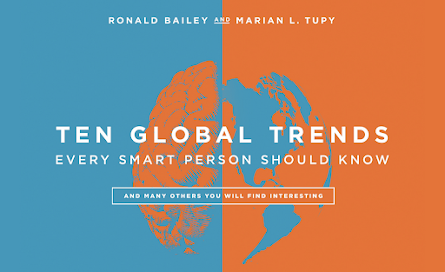
Do yourself a solid and have a read of Bailey and Tupy’s exceptional book Ten Global Trends Every Smart Person Should Know. They use those increasingly rare things called facts to soundly debunk the doom-and-gloom-is-everywhere theory.

Bailey and Tupey's book Ten Global Trends - using research and facts to tell the truth. 


When you've read Global Trends, (and after you mask up, vaccinate, and elect better politicians with better policies), then give a thought to doing the right thing for safety in 2022 and learn some state-of-the-art theories in neighborhood crime prevention. There are a few good ones to pick from, but be careful - some only go halfway. 

Here are a few to watch:


SITUATIONAL PREVENTION 

In the 1970s they created electric car alarms to cut auto theft. You know, those pulsing lights and blaring horn alarms (BLEEP...BLEEP...BLEEP) that, nowadays, most people just ignore.

Around the 1980s, they created The Club to lock a steering wheel so thieves could not drive the car. Unfortunately, thieves adapted and learned to hacksaw the steering wheel and slide The Club off. One thief said: “So if it takes 60 seconds to steal a car, it now takes 90.”


The Club auto theft prevention device - photo Wiki Creative Commons

In the 1990s auto manufacturers adopted another situational crime prevention approach to harden the target. They created vehicle immobilizers, electronic devices that prevent a car engine from starting until a proper key transponder is present. Immobilizers prevent hot wiring and also eliminate that annoying BLEEP...BLEEP...BLEEP.

What is the result of situational crime prevention?

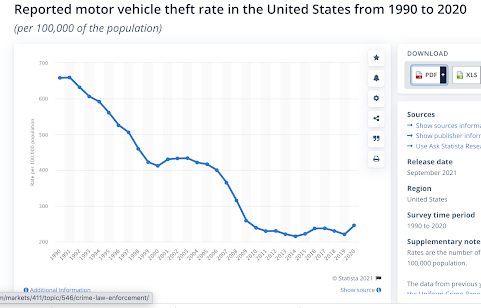
Some criminologists say the increasing adoption of security technologies has cut crime opportunities all over the world. Crime everywhere has decreased and auto theft has plummeted, as you can see on the graph.


Auto theft rates sunk as theft devices were adopted...

Except, there are a few glaring problems with this theory. First, not all crime rates around the world have declined in spite of more security technology! (Latin America comes to mind). 

Second, consider this...

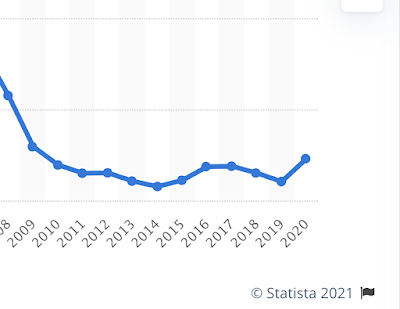
...up until the past decade when rates began increasing.


Even with improvements to auto theft prevention, decade after decade, in the past ten years auto theft rates have NOT declined. In fact, they have started to increase! Look at the reality in the chart above of the past 10 years! How can this be? Security technologies have not vanished.  

Why are auto theft rates increasing? Perhaps the situational prevention theory spends so much time hacking at the branches of crime opportunity, it missed digging at the roots of crime causation?


FOCUSED DETERRENCE

Consider another recent prevention theory - focused deterrence, also known as CVI (community violence interrupters). I blogged on this promising strategy a few weeks ago.


Most modern crime prevention strategies zoom down from the level of the
entire city into specific areas (SafeGrowth), specific situations (situational prevention), or specific offenders (focused deterrence)


In a 2019 article, "There is no such thing as a dangerous neighborhood",  Stephen Lurie says we should not fix broken neighborhoods but rather target the small group of chronic offenders in those neighborhoods who cause most problems. That is how CVI intervenes in the cycle of violence. Says Lurie:

"The notion that public disorder drives criminality can seem an intuitive approach to public safety. But if people understand that most serious violence circles specific interpersonal group dynamics in structurally disadvantaged communities, order maintenance policing seems more like what study after study shows it is: an unnecessary evil."

Regrettably, permanently resolving a complex crime problem is not as simple as intervening with the offender before they rob or shoot. As the late Desmond Tutu warned, "There comes a point where we need to stop just pulling people out of the river. We need to go upstream and find out why they're falling in."  

No doubt we need to do something fast when violence threatens and that is something at which situational prevention and focused deterrence both excel. But there is no hiding the fact that they both hack at the branches - neither one alters structurally disadvantaged communities in any meaningful way. 

Criminologists will tell you there are many seeds to crime causation. But over a half-century of criminological research amply demonstrates that the dysfunction, trauma, substance abuse, and blight in disadvantaged communities provide the breeding ground from where most chronic offenders emerge in the first place. Severely disadvantaged places create an endless supply of chronic offenders and if we want to dig at the roots of crime, and not hack at the branches, we must face those structural disadvantages. That is from where hope emerges and that is how we do the right thing.  


ANOTHER WAY - SAFEGROWTH

Some criminologists and law enforcement officials will complain that it is exceedingly difficult, (and takes a long time) to deal with deep structural problems in neighborhoods. Part of that is because the expertise and professions that deal with such problems are not found within criminology or law enforcement. They are found in economic development, urban planning, neuropsychology, cognitive science, and education. 

That is why SafeGrowth practitioners collaborate with experts in all those different fields and then work with residents to co-develop prevention plans. This kind of deep-dive capacity-building is neither simple nor fast. Ultimately, SafeGrowth marries community development and social prevention with 1st, 2nd, and 3rd Generation CPTED. The method has been successful for decades. Our SafeGrowth book describes how we keep our eyes on the real prize. 

A few other recent examples:

These are only a few of many ways forward. In 2022 let’s do the right thing and not lose sight of the fact that, if we want to build a better society, we actually have to build a better neighborhood.

Happy New Year. 


Sunday, December 26, 2021

"It takes the whole village to raise this community"

Philadelphia's Benjamin Franklin Bridge
Skyline views at night mask the reality of neighbourhood life 
- photo Jeffrey Phillips Freeman Creative Commons Wiki

by Mateja Mihinjac

At a time when a rising tide of violent crime infects Philadelphia and so many other American cities, one small pocket in that city has discovered a different way forward. A few weeks ago, community teams from the HACE Livability Academy presented preliminary plans for improving livability in their neighborhood. It was like an early holiday gift to their city and their neighborhoods and I was enormously impressed with their plans. 

The HACE SafeGrowth Livability Academy has been underway in the Fairhill and Kensington neighborhoods for a few years and – although applied only to these two neighborhoods and severely challenged by the COVID pandemic – academy classes continued unabated thanks to the amazing work of HACE, the non-profit community development organization.

COVID has made life miserable for community development work. In 2020, we were forced to suddenly transition to a virtual environment that was not conducive to collaborative workshops. But a year later we’ve managed to better adapt to this new reality. Training from afar is not ideal, but the virtual environment does have advantages and we can now reach a wider audience.


WHAT IS THE LIVABILITY ACADEMY?

Over the past two months, I had the pleasure of co-facilitating the latest online cohort of HACE Livability Academy participants. 

HACE has been successfully running Livability Academies twice a year since 2018. Last year, the HACE team modified the curriculum to run virtual-only sessions. This year we were able to offer both face-to-face and virtual modalities. 

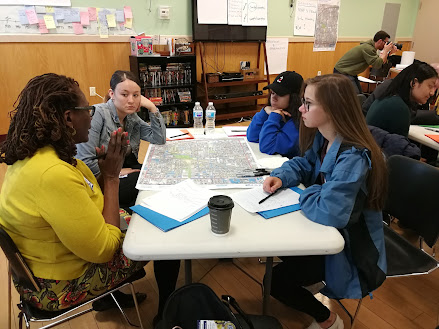
The Livability Academy is a 6–8-week program developed by AlterNation LLC  – the company behind SafeGrowth® – in which local residents and community representatives learn skills in community leadership, SafeGrowth and CPTED, community organizing, and project management.

The Livability Academy is an integral part of the SafeGrowth philosophy and it provides a constant flow of community leaders into neighbourhood problem-solving teams to address local issues. I found it empowering to see the kinds of complex issues that the latest cohort decided to tackle in their project work. 


Team project planning from a previous Philadelphia Livability Academy class


2021 PROJECTS

During training, participants identify an issue and in work teams they tackle a small-scale, real-life project in their neighbourhood. In this training, the in-person, face-to-face team produced one project proposal while the online virtual team chose to divide into two project teams. 

This past week all three teams presented their preliminary plans of the work they’ve done over the past few months. All three teams created inspiring projects directly within their neighborhood and they tackled persistent problems that were made worse during COVID.


Cover of the project report from the Fairhill United for Livability team

Fairhill United for Livability 

The first team’s project focused on activating the neighbourhood park to create a space for people to come together and build connections. They envisioned a more united neighbourhood that fosters community pride, strengthens connections between residents, and partners with neighbourhood groups, schools, and businesses to promote livability. 

They divided their plan into 3 phases over the next year: outreach, clean-ups, and community celebrations. The goal is to create a movement of people to fix broken social connections, a problem made far worse by COVID. The team concluded with their slogan: “No one can do alone what we can do together”.


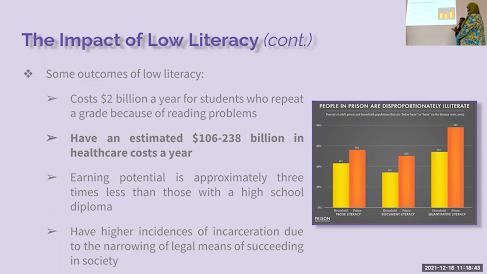
Literally Literacy (Increasing Adult Literacy)

This team chose adult literacy as a key liveability issue. They identified low levels of literacy as a key barrier to job access, high earning potential, and access to better healthcare. Illiteracy is one of the major contributors to overrepresentation in the criminal justice system. Illiteracy is an obstacle to personal growth and this team decided to do something. The main objective of the project is to empower adults to seek assistance with reading and increase their self-esteem while eliminating the stigma associated with illiteracy. 


Data from the Literacy team's research project


The highlight of this team’s presentation was their inspirational personal stories. 

  • One member shared how her aunt learned to read late in life because she was unable to visit school as she had to prioritise caring for her family. 
  • Another member shared the experience of returning to college in her senior years and helped her expand her knowledge and reading capabilities. 
  • Another member recollected how it was once illegal for African Americans to read and she had to self-learn how to read. 
  • Finally, one member shared a story about how she remained a single young mother when she left her illiterate partner who was unable to provide for the family aside from selling drugs. 

They summarized their stories with the phrase: “You can be all that you can be; all you have to do is take the first step.”


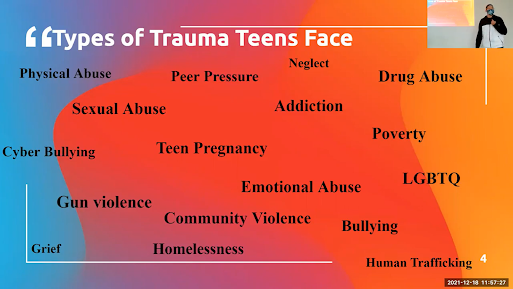
Teen Trauma

This team focused on the struggles of youth that (if not addressed early) can cause long-term damage to a young person’s life and the neighbourhood quality of life. They outlined multiple consequences of trauma such as emotional and behavioural issues, internalised stress, engaging in unsafe behaviours, substance abuse, and mental illness. 

They proposed a 6-week program with various topics to address traumatic events. They also proposed creating a safe space with a support group for teens experiencing trauma. Two young team members, who themselves went through traumatic events, were especially inspiring in their quest to help their peers turn a new leaf. The team summarised the objective of their program: “To go from dysfunction to function.”


Research chart on trauma from the Teen Trauma team


A HOLIDAY GIFT 

I was extremely proud of all three teams for the work they completed within this short time. It is amazing how a group of people who know little, if anything, about each other, were able to take steps together and share the common purpose of improving life in their neighbourhood. 

This is the true spirit of SafeGrowth and the Livability Academy. There is no better holiday gift to Philadelphia, to their community, and to themselves.

As one Livability Academy participant concluded: “It takes the whole village to raise this community.”


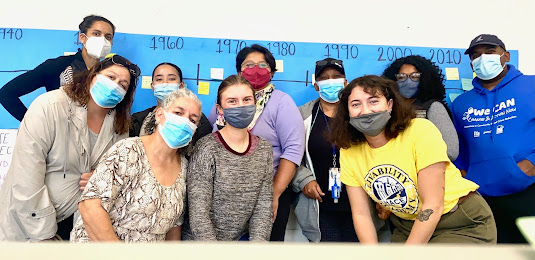
Congrats to Philadelphia's 2021 HACE Livability Academy grads!
(photo courtesy of Sierra Cuellar)