Showing posts with label Baltimore. Show all posts

Monday, September 30, 2024

Here's to our students - a life of purpose


Baltimore's Penn train station during our class night-time safety audits

by Gregory Saville

I taught my first CPTED seminar at my home university in Toronto while in graduate school when I was still a police officer in 1986. It launched my teaching, researching, planning, and consulting career. Since then we have modernized and expanded the CPTED program far beyond lights, locks, territorial controls, and target hardening. 

In recent years, with the help of the many smart and experienced members of our SafeGrowth Network, along with some leading academics, practitioners, community residents, researchers, and police officers, the SafeGrowth method has flourished as a powerful way to transform places. But today, after all these years and all this progress, I remain powerfully impressed by our students.

Landing home at the Denver International Airport - reflecting on past training

Landing in Denver last week after a flurry of training projects it struck me that I still revere the intelligence and tenacity brought to our crime prevention classes by the residents, police, city organizations, and community associations. Our recent courses in Madison, Vancouver, Baltimore, Palm Springs, Saskatoon, and New York City again reaffirmed my faith in our students. They have the most to gain and lose because they live in neighborhoods afflicted by crime. We affectionately call them SafeGrowthers, and they are remarkable.

They hold a mix of professional and personal skills and they bring a wealth of experience to the table, often with humor and passion. 

Reading, talking, walking, and thinking
- they engage the SafeGrowth material with full attention

Our students are an impressive bunch

Fighting crime and building neighborhood livability is a massive undertaking with many obstacles. And yet, even when faced with the miracle stupidity of government red tape, jumbled media distortions, and political manipulators, they still somehow manage to stay the course and get the job done. 

Outdoor Safety Audits are a popular part of the training

This year, once again, I listened to the obscene wickedness they face in the crime, drugs, and violence plaguing their neighborhoods. They tell us our training offers them tools and methods to succeed, and for that we are grateful. Yet their stories cause goosebumps:

  • In one city, residents and police tackled a high-crime city-owned parking structure and presented the results to the city council, hoping for action to improve safety. A year later, after no action, a resident was robbed and murdered in exactly the way they predicted. Crime prevention is not always easy! 
  • In one New York neighborhood, students came to class the day after a shooting homicide of one of their neighbors. 

Some of our students are already engaged in incredible prevention work, such as the Bronx Rises Against Gun Violence organization

  • In a Baltimore class, one group tackled school violence in a high school where school administrators refused to collaborate with them. 
  • In another city, residents were asked by some managers not to deliver their findings at final community presentations regarding violence at a homeless shelter. They did so anyway and, in doing so, they learned how to speak with diplomacy and candor. They ended up with a positive reaction from the shelter and charted out practical steps forward.
  • In some cities, police shone as stellar leaders who engaged with the residents. In others, police never bothered to attend or participate (this being a free class in proven methods of preventing crime). 
  • Some students themselves were victims of violence in their own neighborhoods. Others had once been incarcerated for violence, had reformed their lives, and were now community leaders. 

In New York, training occurred in multiple neighborhoods in different parts of the city 

When we speak to our students in class, online, or during virtual office hours, we work to provide the best resources and the latest research findings on preventing crime. Usually, we end up providing emotional support and encouragement. 

During this election season, I know who deserves our vote and whose cause we should ensure politicians support. It should be these peace warriors who do this magnificent work. To all our students from your instructors and from everyone in the SafeGrowth network... Thank you! Thank you! 


Wednesday, August 7, 2024

Announcing the 2024 Problem-Oriented Policing Conference - SafeGrowth and POP working together


Baltimore's Inner Harbor Skyline
- photo courtesy of Wiki Creative Commons

by Gregory Saville 

This year, for the first time, SafeGrowth project teams from cities across the U.S. and Canada will attend an international policing conference to showcase their crime prevention and neighborhood safety work to hundreds of police delegates from around the world. The meeting will be held in Baltimore’s Inner Harbor. 

The Baltimore Inner Harbor is not only famous for being the site of one of the most dramatic, urban post-industrial waterfront redevelopments, but it also gave birth to the lyrics of the American national anthem during the War of 1812 (technically that happened at nearby Northwest Harbor).

Now the Inner Harbor features another breakthrough event. From September 12-14 this year, Baltimore’s Sheraton Inner Harbor Hotel hosts the 2024 International Problem-Oriented Policing Conference (the POP Conference).


The Center for Problem-Oriented Policing at Arizona State University runs the annual International POP Conference - this year it features SafeGrowth project teams

THE POP CONFERENCE 

Each year the POP Conference reminds the police community, and the community at large, about a powerful problem-solving strategy where police cut crime and increase safety. The problem-oriented policing method has been around for decades showing, in project after project, how effective policing can build community respect, enhance officer safety, and turn crime hotspots back from the brink of crime. 

The conference is run by the Center for Problem-Oriented Policing under the direction of Michael Scott. He not only leads the POP Center, but he has authored many police guidebooks on how to address everything from assaults around bars and dealing with clandestine meth labs, to speeding in residential areas and how to deter high-risk individuals from crime. 

This year’s conference will feature topics such as 

  • Preventing People with Dementia from Going Missing
  • Homelessness and Public Safety in Palm Springs
  • Reducing Racial Disparities through Problem-Oriented Policing
  • Reducing Gun Violence in Baltimore

It will also highlight the prestigious Goldstein problem-oriented policing award projects throughout the conference with the winner announced at a final presentation.


Baltimore's Greater Baybrook Alliance SafeGrowth team presentations earlier this year - teams will unveil their projects also to the 2024 POP Conference delegates


SAFEGROWTH AT POP

The SafeGrowth teams have been invited to this year’s conference to illustrate how community members use the SafeGrowth program to create safety plans and how it can work alongside POP projects. Like the POP method, SafeGrowth employs a similar step-by-step process, but the SafeGrowth program is based in urban planning and employs both 1st Generation CPTED and 2nd Generation CPTED

The SafeGrowth teams attenting this year’s conference will bring their project results on problems such as homelessness, illicit drug dealing, vacant properties and blight, and street violence. The projects are primarily led by neighbors and community associations, in collaboration with police problem-solvers. They illustrate another model of what effective POP and crime prevention might look like in the years ahead. 

SafeGrowth students have been invited from classes in Madison, WI, Vancouver, BC, Palm Springs, CA, Baltimore, MD, San Jose, CA, and Saskatoon, SK and they will present their work in informal poster sessions. 

If you want to learn about powerful crime prevention methods where police and community work together, conference registration is available at the POP website.


Monday, April 22, 2024

"Charm City" - SafeGrowth in Baltimore

Baltimore skyline and harbor - photo by Patrick Gillespie, own work, CC BY-SA 4.0

by Mateja Mihinjac

Only two weeks after a tragic Baltimore bridge accident, we returned to Charm City for the second part of the SafeGrowth training workshop. 

Like in most of our training workshops, students formed teams to work on problems in their own neighborhoods and this week they ended their 2-month training with some outstanding presentations to the public. The presentation day celebrated their successes, dedication, and commitment to bettering their neighbourhood. 


THE FIVE TEAMS

In this SafeGrowth training workshop, we partnered with the Greater Baybrook Alliance (GBA), a truly excellent non-profit community development corporation responsible for improving liveability in three Baltimore neighbourhoods: Brooklyn, Curtis Bay, and Brooklyn Park. 

Thirty participants were divided into five teams. They followed the 5-step SafeGrowth process where they identified and analysed their chosen problems, diagnosed harms, crimes, and the underlying causes, and then formulated solutions. 

Just like in the Charm City documentary trailer, the teams identified violence and drug-related issues that have a devastating impact. Most importantly, they understood that they, as community members, play a crucial role in tackling issues together with the police, organizations like schools and businesses, and other partners. 


One of the training venues in Baltimore county


Team 1: Hanover Street (commercial street)

This team identified overlapping issues affecting safety and the feelings of safety. Those issues in turn led to major economic impacts and traffic problems in this culturally diverse commercial street: loitering, drug selling, littering, underlit areas, and several vacant properties. The team discovered how the vacant properties and lack of ownership contributed to street problems, including crime. This was easily observed by anyone walking along that street, especially after dark. They are in the process of formulating some practical responses.


One of the classroom design exercises 


Team 2: Brooklyn Homes Basketball Court

This team referred to their project area as “the forgotten place” due to the lack of desirable activity and increased fear of the area ever since a mass shooting at this location in July 2023. In their first training workshop two months ago, the team learned about the thesis of Jane Jacobs who described the crime risks in empty and vacated areas with no “eyes on the street”. This fits the situation at the basketball court. 

The team first examined how youth congregated and what they did, and then examined problems with vehicle thefts, robberies, and aggravated assaults. This basketball court will undergo a redevelopment shortly and the team will ensure that they work closely with the partners and stakeholders in charge of the rebuild. Their goal is to ensure the basketball court becomes an activated space that fosters community engagement and social cohesion and thus regains its prominence in the neighbourhood as a positive gathering space.


Participants partnered with city and county police on problem-solving
during project work

Team 3: Team Landlord

Team Landlord choose to investigate a major problem of illegal renting and slumlord activity on neglected and vacant properties. This is a Baltimore-wide problem and it is often seen as a contributor to illicit drug activity and violence. The team confirmed this hypothesis and – because their analysis allowed them to associate problem properties directly to issues like drug use and drug dealing, prostitution, trafficking, loitering, and squatting – they were able to identify specific vacant properties as a major threat to safety and livability. 

The team was excited to confer with some local legal experts regarding legal and regulatory strategies to mitigate the problem. They now have intentions to formulate a systematic solution that can influence the slumlord issue throughout the entire city. 


The Greater Baybrook Alliance community organization was an outstanding facilitator of the SafeGrowth work in the three neighborhoods

Team 4: Riverside Road Park - Brooklyn Park Champions

The Champions chose to tackle an empty lot on the city/county line that has also been forgotten and neglected. Consequently, as discovered by Team 2 on a different project, Jane Jacob's "eyes on the street" theory was also a factor in this property - it now attracted undesirable activity. In addition to speeding and trash dumping, the team uncovered petty crime, drug-related incidents, vandalism, assaults, and thefts from autos. 

The team also pointedly recognised that all these issues visible on the surface are symptoms of underlying problems with poor social cohesion in the neighbourhood and lack of care or activation in the park. Their detailed analysis led to some initial strategies which, during their public presentations, allowed them to receive public feedback and narrow their responses even further. 


Spanish speakers tackled school-related violence with considerable
commitment to safety - they had children attending the schools

Team 5: Ben Franklin High School

This Spanish-speaking team of vibrant residents chose to address the issue of school kids’ fights spilling over from Ben Franklin High School onto an adjacent alleyway. The fighting outside the school was worrying, but they were also concerned that the fights might worsen without some coordinated intervention. A few of the team members were mothers of young children, some attending the school, and they were concerned about the well-being and the future of their children. 

The team conducted site visits to the property and received input from others in the area. Their crime analysis is still underway. This preliminary research reaffirmed their need for further study into the underlying issues for more comprehensive strategies. They have their homework to do! Foremost in their next steps was to develop partnerships with key stakeholders such as school officials and a nearby church adjacent to the alleyway. Equipped with more detailed research and data, this will be their next step. 


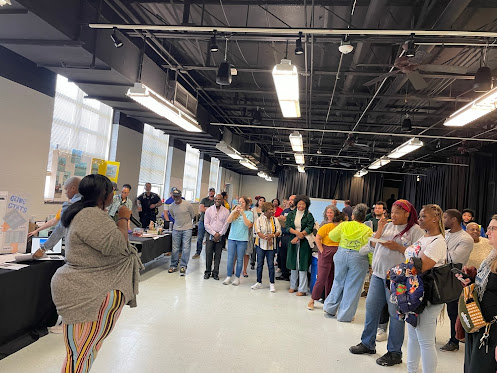
Presentations during the poster sessions with about 70 members of the public. The community response was excellent


GBA executive director, Meredith Chaiken, addresses the audience. GBA staff were outstanding, particularly director of public safety, Daisy Heartberg, & neighborhood safety coordinator, Yvette Bailey-Emberson


INITIAL STEPS TO MOVE FORWARD 

The teams have now made the initial steps towards solutions for their different problems through comprehensive SafeGrowth projects. But there is much yet to do. They will continue to build their projects in the coming months and then create partnerships along the way. As they finalize their partnerships and project schedule, they will then start implementing strategies. 

The Greater Baybrook Alliance is examining a more permanent problem-solving process to address neighbourhood problems with their partners, such as businesses and police, and formulate a long-term plan for safety. 

We are proud of the hard work of these teams of committed residents, business people, police, and others in the class. In a very short time, they accomplished an incredible amount of work as they applied the SafeGrowth philosophy, CPTED, planning concepts, crime analysis techniques, and project management. Their work is the mark of high-quality community leaders. The Greater Baybrook Alliance has launched an incredible community capacity-building process. This part of the “Charming City”, it seems, has a bright future! 


Monday, March 25, 2024

Nihilism nixed - hope as a way forward

In crime prevention and community-building, perspective is everything! 

by Gregory Saville

I am struck by the optimism in the cases described in recent blogs – Beth’s story about the Portland TriMet community safety team; my blog on answers to homelessness, especially the miracle underway today in Finland; the numerous examples of successful solidarity in Mateja’s blog about how we have witnessed communities come together to rebuild after natural disasters.

And yet I am also struck by the political blindness people choose to accept when it comes to difficult situations, like high crime neighborhoods, and how hopeless things seem. I was told, before our recent training in Baltimore, that there are unsurmountable obstacles in that city with drugs, shootings, fiscal chaos, and hopelessness (said by people not from Baltimore). 

Yet, on the ground during training, residents and community-builders who live there had a different view. Yes, there were problems, but they dedicated themselves to doing something positive. Currently, they are doing just that. (We return to Baltimore next month to review the results).

It is easy to be distracted by news stories of wickedness around the world

GLOBAL TRENDS

In the middle of news stories about the doom and gloom around us, and the very real terror of nuclear war and environmental collapse, I often remind myself how easy it is to fall into a nihilistic, hell-in-a-handbasket funk. 

Then I read Ronald Bailey and Marian Tupey’s book Ten Global Trends Every Smart Person Should Know and dozens of charts, graphs, and data showing inexorable positive directions for dozens of social, economic, and crime trends around the world. Life expectancy, poverty, health, food resources… all getting better, not worse! How can this be so? So many people believe the doom and gloom story! 

Maybe, I thought, these authors got it wrong. Did they get caught in a confirmation bias trap and cherry-picked rosy data and ignored the rest. To answer that, I went on a deep dive into data on global trends to see if they were right. 

Here is what I found:

Life expectancy… going up. Even a downward blip during the global pandemic does not offset the enormous improvements over the decades.


Global access to technology like electricity, even in the poorest countries, has markedly improved.


Child mortality around the world has been plummeting for decades. Bailey and Tupey were right.


For over 500 years, global literacy rates have grown every century and continue to improve today.

And there it was, from one source after another, chart after chart, the list of positive trends goes on and on. 

NIHILISM NIXED

But you'd never know it! You’d never know so many trends are improving if you only watched the miracle of stupidity that is the 24-hour news cycle spitting out, as it does, tragedy after tragedy! With billions around the world, and cell phones in every nook, it is not difficult for news machines to find one “exclusive” horror after another. It may not be the full truth – and it is certainly not investigative journalism – but it sells!

In SafeGrowth, we teach neighborhood dwellers how to do basic field research, how to collect a wide variety of stats, and how to observe carefully. That is how they can get a complete picture before they devise a plan to make things better. You cannot fix something if you drink the noxious elixir of political ideology or popular nihilism. The truth emerges as we dig for ourselves, suspend our biases, and, as Jane Jacobs once described, cultivate the art of seeing clearly

Seeing clearly, beyond the opinions and biases,
means learning how to do research and conduct careful observations

I met a student during the Baltimore training with a family member who, once upon a time, was a famous drug dealer back in the day. Now out of prison, this person turned away from gangs and violence and is now committed to speaking publicly about other ways forward for wayward teens. It is an inspiring story.

There are many challenges facing us both globally and locally. We cannot fix them with doom-and-gloom shades or with rosy glasses. We must retain optimism and hope, but only with clear eyesight. Threats are real, but so too are solutions. Inspiration, as I found out in Baltimore, can come from unlikely places if you learn to see and listen clearly.


Tuesday, May 23, 2017

A Baltimore trailblazer (Part 2)

Baltimore tot lot in need of community/city attention
by Kallan Lyons

Kallan is a journalist who has blogged for Journalists for Human Rights and has contributed to the Kingston Whig-Standard newspaper. In 2013 she spent 6 months as media trainer in Ghana at the African College of Communications. She wrote this guest blog after attending the last part of the Baltimore SafeGrowth course.
**** 

“I had an overall instinctual sense that I was not safe.” 
Community member who uses the Tot Lot,
Pigtown, Baltimore

When the SafeGrowth Tot Lot team in Baltimore met Edith Nelson, they knew they had found an ally.

Tasked with transforming the park in Pigtown into a safe space for families, they consulted with Ms. Nelson. As reported in the last blog, A Baltimore trailblazer - Part 1, Ms. Edith has played an integral part in the process.

Now with her support, the team plans to clean up the lot and capitalize on community partnerships in an effort to decrease criminal behavior in the area. The team brought new energy to the project with representatives from the community, the Mayor’s Office, and the police.

STEPS FOR CHANGE

Here are just a couple of the recommendations put forward by the Safegrowth team members who are determined to build on the foundation laid by Ms. Nelson.


Perfect location for movie-night screen or possibly community murals

Throughout the Baltimore SafeGrowth training, the team addressed potential factors inhibiting locals from using the space. Surrounding the park are several abandoned homes and a liquor store; in addition, the tot lot is poorly lit in the evenings. Instead of people gathering in the park for block parties and barbecues, frequent activities include drug use and drinking.

While Ms. Nelson often peruses the park for trash, picking up empty bottles and other items left behind, the job is becoming too big for just one person.

That’s where the SafeGrowth team stepped in. The team’s vision includes volunteer clean-up crews and regular outdoor programs led by community groups. They plan to contact owners of abandoned homes to negotiate improvements. Other strategies included:

  • building social connections by contacting the nearby school and church to involve them in activities such as mural painting
  • increased police attention to the tot lot
  • community events such as movies-in-the-park to build social cohesion
  • better signage, installing LED lighting, reinstalling benches and adding play equipment.

Prior installation of tot lot equipment needs regular community support and city maintenance 
The goal is to restore the Tot Lot to its original use:  a welcoming, family-oriented environment where parents and their children feel safe.  Now that the wheels are in motion, and with Ms. Nelson on their side, a possibility is being turned into a promise.

The Tot Lot transformation started with one woman, and thanks to the SafeGrowth team, it will resume with the community.

Thursday, May 4, 2017

Ms. Edith and the tot lot - a Baltimore trailblazer (Part 1)

Tot lot in Pigtown - All photos by the Archer/Carroll Street SafeGrowth Team
By Kallan Lyons 

Kallan is a journalist who has blogged for Journalists for Human Rights and has contributed to the Kingston Whig-Standard newspaper. In 2013 she spent 6 months as media trainer in Ghana at the African College of Communications. She wrote this guest blog after attending the last part of the Baltimore SafeGrowth course.

****

At the corner of Carroll and Archer Streets in Southwest Baltimore sits the Pigtown Tot Lot, a park complete with a playground and plenty of space for a community gathering. This Tot Lot was one of four projects chosen by one of the community problem-solving teams during the latest Baltimore SafeGrowth course (another project appeared in this blog earlier).

The brightly colored jungle gym is surrounded by an iridescent wall, and would never allude to the ominous ambiance: just under a year ago, four people were injured in a shootout next to the park. To many, the Tot Lot is anything but inviting.

Sidewalk conditions around the tot lot
Nicknamed ‘Charm City’, Baltimore’s beautiful row houses, Inner Harbor, and historical attractions have been overshadowed by its drug culture and rampant crime. The city of just over 600,000 has one of the highest homicide rates in the United States. Abandoned homes, poor neighborhood lighting, and a lack of community spaces are just a few of the contributing factors. In Pigtown, kids who grew up playing at the Tot Lot have gone on to become drug dealers on the park corner.

When you hear Baltimore, you may think of Freddie Gray or even the fictitious Omar Little from The Wire. One name you likely haven’t heard is Edith Nelson. Affectionately referred to by her community as Ms. Edith, the 76-year-old has lived in Pigtown since 1989, across the street from the Tot Lot. When she moved in, the park was nothing but weeds.

“For me, it was an eyesore,” says Ms. Nelson. “From that very day [that I moved in] I said I will not live here all my life and see an eyesore like this. That’s when I began to work on the playground, on the Pigtown Tot Lot.”

MAKING A DIFFERENCE 

In Pigtown, people came together to make a difference. Ms. Nelson began by collecting money door-to-door, selling pies and cupcakes at the local Credit Union, and calling on anyone she could to help with the project. She and her small group of supporters successfully raised the $15,000 required to redesign the space. Inspired by her enthusiasm, people latched on to her vision, first through financial contributions, then by coming out to plant trees, paint the playground and rejuvenate the park.

“I have albums from the very day that it happened and we had lots of children that really came out: we had a wheelbarrow and wood chips; our playground was wood - now it’s metal. We had a lot of people getting together back then.” Young and old gathered to reclaim their neighborhood and in the process, rediscovered their community.

Nearby housing in Baltimore's Pigtown
Decades later, as neighbors moved away, many of those early successes lost momentum and crime returned. But despite recent events, her contributions are still standing strong and that is what the SafeGrowth team could see. Ms. Nelson has remained the trailblazer: with the help of a local organization Paul’s Place, her community renamed one of the streets Edith Way.

Ms. Nelson says although there are fewer children around, she and several others continue to clean up the area, hauling dirt and planting flowers, and holding an annual cookout that’s free to anyone in the neighborhood.

The SafeGrowth team asked Ms. Nelson to attend their presentation at the course workshop. They knew her commitment is a reminder of the importance of building community. Though there have been some setbacks, she feels doing so is about volunteerism, friendship, and people working together to accomplish a purpose.

Colorful statement at Carroll/Archer street
If there is such thing as having a purpose in life, I believe Ms. Nelson has found one. Her kids have moved to other neighborhoods, but she says she’s not going anywhere.

“When I bought this house and moved into this community, despite all I saw, I still loved it and said I will live here forever. The Tot Lot has been my project, and as long as I am alive, and I have strength, I will never ever see it go back to where it was.”

Next Blog: The Tot Lot’s transformation started with Ms. Nelson. In part 2 - How the SafeGrowth team plans to move that forward. 

Friday, April 21, 2017

Baltimore's Pigtown launches SafeGrowth

Abandoned lot in Pigtown tackled by SafeGrowth team
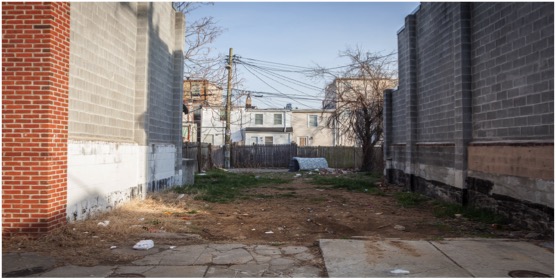
There were 2 murders, 3 shootings, 17 assaults, and 14 property crimes over the past 5 years at, and near, an abandoned lot on Ward Street in southwest Baltimore. One murder cost the life of a friend of a member in our latest SafeGrowth class.

Ward Street is in Pigtown, an up-and-coming area with Baltimore-style row houses, a reinvigorated commercial street, and a historic museum for the first American railway, the B&O Railroad (in the 1870s they unloaded pigs onto the streets for herding to nearby slaughterhouses – hence, Pigtown).

Over the years the area suffered a higher than average crime rate, numerous abandoned homes, and vacant lots like the one on Ward Street. But in recent years the area has started revitalizing and things are improving! Led by Ben Hyman, executive director of the nonprofit Pigtown Main Street association, the neighborhood hosted the first SafeGrowth training in the city of Baltimore.

Dark areas and poor lighting - SafeGrowth teams recommended improvements
The response to the training was outstanding. Participants in four SafeGrowth teams included residents of the community, Baltimore police, planners, local shop owners, university students, representatives from city hall, crime analysts, and others. One of those teams tackled the Ward Street vacant lot mentioned above.

TRANSFORMATION PLAN

During final presentations to the wider community, each team described their plans for improvement.

The Ward Street group was particularly impressive with their SafeGrowth Analysis and Transformational Plan. They recommended community engagement meetings, linking community groups to others across the city, and expanding programming within the lot itself. They plan to use community cleanup days to clean the lot, better activation with murals, signage, and improved lighting.

The SafeGrowth team provided a vision for changes to the abandoned lot - photo PPS
Integrating the police and the business association into their plan ensured a more sustainable way to cut crime at the lot and in the surrounding neighborhood. Their long-term vision was to create a community hub for local social and recreational activities.

As their instructor I was most impressed by the fact that, like the other three groups, they did this entire project in only 5 weeks, they fought time constraints and they battled a classic north-eastern winter snowstorm during their site visits and safety audits. How’s that for commitment!