Showing posts with label third generation cpted. Show all posts

Thursday, November 30, 2023

The case for walkable neighbourhoods


Fun outdoor activities and safe walkability - keys for liveability

by Mateja Mihinjac

As I was going about my midday nature walk this week I was listening to a podcast on the importance of everyday movement and physical activity. In that podcast, walking was presented as a basic form of activity that humans have evolved to do. This resonated with a number of recent consulting projects in our SafeGrowth Network related to unwalkable streets, pedestrian fatalities, and unhealthy outdoor environments.

I am lucky to live in an area where I can access a nearby forest or complete my errands within a 15-minute walk. Many people in other places do not have this opportunity and this drawback has serious physical and mental health implications.


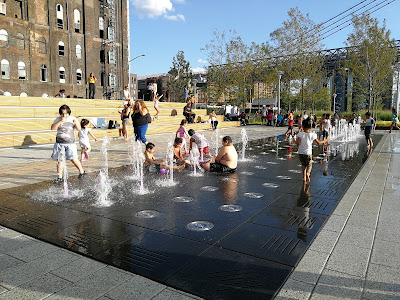
Playful design encourages playful outdoors

PUBLIC HEALTH 

Many studies over the past decade have shown a connection between walkability and health. For example, a Belgian study showed how more walkable neighbourhoods promoted better health outcomes for older adults than those lacking walking infrastructure.

A Canadian study demonstrated the importance of built environment that supports walkability for promoting fitness activity and consequently health outcomes. In Japan, researchers found a link between cardiovascular mortality and neighbourhood walkability. One Malaysian study showed how living in a walkable neighbourhood contributes to higher levels of perceived quality of liveability compared to those living in less walkable neighbourhoods.

As we describe in our 3rd Generation CPTED theory, with easy access to green infrastructure, walkable neighbourhoods also create positive mental health effects. One such example is the Japanese practice of deep relaxation in the forest or forest bathing, especially welcome in hectic city environments. 


Physical health is related to positive mental health


In this era when we are so concerned about mental health and crime triggered by mental illness, we must build cities that encourage walkability and movement. Humans are meant to move and be active and motivation for movement needs to be clearly integrated into urban design.

Fortunately, some cities have attempted to encourage movement by gamifying physical activity – consider the famous example of the piano stairs in Sweden. Additionally, new city-wide initiatives have emerged for redesigning cities, that build on this movement concept, such as the Parisian “15-Minute City” concept.


Walkability takes place above and below ground


“15-MINUTE CITY” – A CASE FOR WALKABILITY?

Carlos Moreno, the main author behind the “15-Minute City” suggests that cities need restructuring so that they offer access to amenities within easily accessible distance. He suggests achieving this through increasing the density of people and services, close proximity to activities, diverse populations and land uses, and digitalization in line with Smart City developments.

The steps recognise the importance that the built infrastructure plays in promoting walkability and physical activity. These steps also closely relate to the principles of holistic and integrated neighbourhoods in Third Generation CPTED and SafeGrowth.

Yet, despite the difficult-to-refute importance of integrated, dense and walkable neighbourhoods, the 15-Minute City has met resistance. Some criticize the concept as a conspiracy to prevent people from moving freely beyond their neighbourhoods. Others claim it is a socialist concept with an intent to restrict personal freedoms and to control the population.


Positive outdoor activities at night - sometimes colourful lighting helps


Many of these conspiracy claims were conflated with COVID restrictions that coincided with the popularisation of the 15-minute city and it remains a sore point for many. 

Another criticism of neighbourhood walkability is voiced by those who claim that walkable and liveable neighbourhoods are elitist and promote displacement and gentrification.

It may equally be true that those who voice such concerns are more worried about increases in housing prices and land values. 


Street furniture, too, plays a role in walkable cities

MOVING FORWARD WITH WALKABILITY

While these concerns should not be disregarded, they should not dissuade us from moving forward towards walkable, integrated and liveable cities. It is irresponsible to ignore walkability options given all the evidence related to public health, mental health, and environmental sustainability.

If we are to enhance public health and reduce mental stress, city planning must be part of the answer. It should be well thought out and tailored to specific neighbourhoods to integrate walkability. 

In SafeGrowth we strongly believe the pathway to do this successfully resides in partnerships with residents during the planning process. After all, it is in their neighbourhoods where they are walking. 


Sunday, July 3, 2022

Social amnesia in CPTED? For goodness sakes, read the science!

With the 1996 formation of the International CPTED Association, and the newly
formed ICA Canadian chapter, CPTED is now a global phenomenon


by Gregory Saville

Happy birthday to Canada (July 1) and to the USA (July 4). Why mention this? Because the US, and to a lesser extent Canada, are the birthplace countries of CPTED – Crime Prevention Through Environmental Design.

Some say CPTED began with my old friend Professor C. Ray Jeffery’s 1971 CPTED book. Some credit Canadian-born architect Oscar Newman’s 1972 book on American architecture - Defensible Space. But CPTED truly began with American/Canadian journalist Jane Jacobs’ 1961 book about American planning – The Death and Life of Great American Cities

A decade after Jacobs’ book, CPTED began in Canada when it was presented at a University of Toronto criminology workshop in 1975. One criminologist at that event, Professor Gwyn Nettler, challenged CPTED to do the necessary scientific research to prove the theory. How, he asked, was it possible to do crime prevention with such poor quality social science of the 1970s? In other words, don’t just make stuff up. 

I first studied defensible space and CPTED at university in the late 1970s. Many years later I spoke to Lew Haines, director of the Westinghouse CPTED studies in the 1970s, and urban planner Richard Schneider who implemented CPTED planning in Hartford in the 1970s. Those were the first-ever tests of CPTED. They used a principle called “motive reinforcement” for community-building tactics. They did not describe target hardening as a CPTED principle. 


Target hardening, a legitimate tactic in technical security,
was never intended as a CPTED strategy


Eventually, traditional CPTED removed the social aspects of motive reinforcement from the theory. Traditional CPTED now includes target hardening, a concept Jeffery and Jacobs could not care one whit about.

In CPTED books of the 1990s, traditional CPTED bore little resemblance to what Jeffery was recommending at the beginning. The truth is so-called traditional CPTED is nothing like the social ecology and interdisciplinary model in Jeffery’s writing. THAT was his point at a keynote address at the 1998 ICA CPTED conference in Mississauga, Canada. 


Both social and human ecology have a long tradition in the social sciences
- Jeffery mentioned them in his theories

How can we know the difference in CPTED between fluff and the right stuff? Based on Nettler’s principles, and as Carl Sagan once said, here are some basic theory-building steps: 

  • go to the research; 
  • check the logic; and 
  • read original scientific publications.

Attempts to rewrite CPTED theory did not use these principles and ended up with ‘crime opportunity’ (aka, target hardening). Check the logic. Traditional CPTED – aka 1st Generation CPTED – became devoid of social factors. The largest bibliography on CPTED lists over 700 studies. For goodness sake, read at least some of the publications. 


A C. RAY JEFFERY MOMENT

That brings me to a recent blog of Tom McKay, a CPTED leader from Ontario. Tom is a former Peel Regional Police constable and he did CPTED duties after I retired from Peel Police having done the same thing. Tom is truly an exceptional fellow and went on to co-found CPTED Ontario. He was one of the original board members of the International CPTED Association. I have great respect for Tom McKay and his passion for CPTED.

Thus, it was with great disappointment I read a recent blog by him suggesting that both 2nd and 3rd Generation CPTED “run the real danger of confusing the utility of traditional concepts… and trivializing and or burying traditional concepts in an increasingly unwieldy model that bears little resemblance to the traditional CPTED flowchart”

Huh? 

Traditional CPTED, as it is now understood, was never promoted by C. Ray Jeffery. None of Jeffery’s ideas made it into the 1990s, only Newman’s. As criminologists Mateja Mihinjac and Danielle Reynald point out in a 2017 study, “contemporary CPTED is, owing to its practical  applicability, largely based upon Newman’s original conceptualization.”

That is what Jeffery was getting at. 


Originally intended for residential and mixed residential neighborhoods, today CPTED shows up in a wide range of urban environments such as parking lots


Tom recounts the opening address of C. Ray Jeffery at the Mississauga ICA CPTED conference. I was the one who brought Jeffery to that conference and published his remarks in the ICA Newsletter. I was teaching at Florida State University’s school of criminology and Professor Jeffery’s office was nearby. He was my colleague, my mentor, and my friend. I know his dictum that CPTED should “study crime in terms of the science of ecology and call for interdisciplinary research”. Jeffery’s point was that Newman’s defensible space (aka “traditional CPTED principles”) was the problem. 

In fact, 2nd and 3rd Generation CPTED were created to better align CPTED with the actual theory described by Jeffery. They are enhancements to the original theory and they are expansive and interdisciplinary – precisely what Jeffery was demanding. 


THE SECOND-GENERATION ANTIDOTE 

Second Generation CPTED has been around for two decades and has numerous scientific research studies published by members of the International CPTED Association.

Second Generation CPTED is neither new nor unproven. In fact it is now formally incorporated into the new ISO (International Standards Organization) CPTED standard, published worldwide last month, in part developed by members of the International CPTED Association. There is also the upcoming School CPTED Guidebook published by the ICA. It is the first formal document describing steps toward 1st, 2nd and 3rd Generation CPTED to prevent violence in schools. 


The ICA is about to publish another CPTED guidebook, this one on School Safety - the first ever to incorporate 1st, 2nd and 3rd Generation CPTED

You do not automatically do 2nd Generation CPTED if you teach 1st Generation CPTED “correctly” – an absurd idea I recently heard from a confused practitioner applying for CPTED certification. That is not how it works.

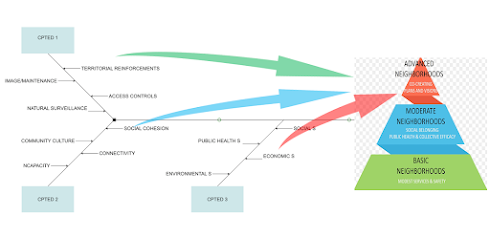
Second Generation CPTED builds on decades of research demonstrating some very precise principles such as social cohesion, community culture, and neighborhood capacity issues like blighted housing.

Tom cites an article by Sally Merry in her attempt to categorize early CPTED. Ironically, Merry bases her ideas partly on British criminologist R. Mawby. Unfortunately, Mawby makes the opposite conclusion to Merry. He criticized Defensible Space for its lack of attention to factors such as social class and income. In other words, traditional CPTED of that time, as now, was silent on the social ecology of a neighborhood. That is the point Jeffery made in Mississauga.

CPTED in this “traditional” form is NOT about the social fabric in a community. If social programs are intentionally incorporated into this form of CPTED training, they are done so in spite of this early writing, not because of it. 

With a few notable exceptions, social factors were washed out of early CPTED before the 1990s. In the so-called traditional CPTED, social fabric of crime is subsumed into fun-to-add artifacts of a CPTED program (neighborhood watch to enhance natural surveillance is not 2nd Generation CPTED). That is not the social ecology described by Jeffery.


SOCIAL AMNESIA IN TRADITIONAL CPTED

Jacobs was about healthy neighborhoods – places where people had plenty of pro-social behaviors and fewer exposures to crime. She described the crime prevention power of such activities as “tree planting, traffic calming, and community events.”

Newman realized his mistake in describing Defensible Space in physical terms that downplayed social factors. He restated his theory in his 1980 book “Community of Interest”


Newman's 1980 attempt to redefine defensible space in Community of Interest

But by then the traditional CPTED die was cast. CPTED courses far and wide taught territorial and access controls, natural surveillance, target hardening, landscaping, lighting, and so on. Go and research CPTED lesson plans on Google (basic or “advanced”… no matter). See for yourself. 

As for 2nd Generation CPTED, that has been taught for over a decade. We’ve taught it to residents, police officers, urban designers, community groups, and many others – like those in a New Orleans high-crime neighborhood – and they love it. They do not find these models confusing or unwieldy. They find them logical, and scientific, and they get positive results. They use 1st Generation CPTED, but they no longer stop with physical modifications. They build the capacity of their neighborhood so they have some say in their own safety. We argue this is the kind of CPTED that addresses Jeffery’s true concepts. 

In the free marketplace of ideas, all are welcome. Let scientific methods, logic, and original research guide the way.


The creation, modification, and expansion of theory happens through
scientific examination, checking the logic and building on prior research 


THE THIRD-GENERATION BREAKTHROUGH

A few years ago Mateja Mihinjac and I launched the most Jefferyesque version of CPTED since Mississauga – 3rd Generation CPTED. We spent years carefully examining the original CPTED theory. Mateja is completing her doctorate in CPTED and I have published prevention theories and studies for 35 years. We were careful to follow theory-building principles, and, true to Nettler and Sagan, our propositions and hypotheses aligned with the logic of theory-building and recent supporting research. We did not just make it up.

Third Generation CPTED is the newest kid on the theoretical CPTED block. Its scientific development is still underway. But make no mistake - there is already a significant body of evidence supporting 3rd Generation CPTED. It represents an exciting way to help our 21st Century city residents figure out how to build more inclusive, ethical, and sustainable communities as we grow into the future.

That is the Jeffery moment I am having.


Sunday, December 12, 2021

New era for neighbourhoods - The latest in 3rd Generation CPTED


Cities in the future need safe, liveable and thriving neighbourhoods -
3rd Generation CPTED provides the roadmap

by Mateja Mihinjac 

The birth of a new theory is not a straightforward matter, especially in social science or urban planning. A few years ago, when my co-author Greg Saville and I published our proposal for a Third Generation CPTED in the research journal, Social Sciences, we built on a decade of theories in crime prevention, including our own work in SafeGrowth. We described how, for over 60 years, theoreticians and practitioners learned how to prevent crime using the natural and built physical environment (1st Generation CPTED), and then in the late 1990s added social strategies to that local prescription (2nd Generation CPTED). 

Over the past decade, our cities and neighbourhoods faced new and unprecedented challenges that demand that we think in a much more integrated way about safety. 

In 2019 we presented Third Generation CPTED as that new integrated approach. 

We built this theory on the premise that it is not sufficient to consider CPTED apart from the idea of liveability if we want a better quality of life within neighbourhoods. Our neighbourhoods – our core units of life, work and play – must offer opportunities for satisfying not only our basic needs (what psychologist Abraham Maslow called our physiological and safety needs) but also our needs at the medium and higher levels – needs of self-esteem and self-actualization. This is known as Maslow’s human needs hierarchy pyramid. 

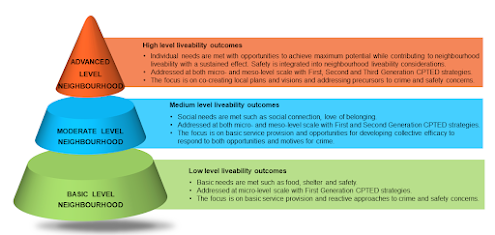
Our theory translated that pyramid into a hierarchy of liveable neighbourhoods, and our 3rd Generation CPTED was the key to elevating our quality of life. 


Neighbourhood liveability hierarchy and corresponding liveability outcomes


After the past few years of additional development, we presented the full model at the recent International CPTED Association international conference. This latest version of the theory will also appear in a forthcoming academic publication. 

The most recent advances in this theory include the following 4 S strategies for achieving those liveability outcomes.


THE 4 S STRATEGIES 

I first introduced the 4 S strategies in a blog several months ago. Here I will describe some specifics for practitioners.

Liveability and sustainability are intrinsically linked. Some scholars say that communities cannot be sustainable unless people want to live in them and people need to have a say in identifying their preferences to ensure long-term environmental, economic and social impacts. This is the whole point to sustainability and so within 3rd Generation CPTED, we have four sustainability strategies. 


Environmental sustainability

Environmental sustainability is the most frequent topic discussed in relation to urban development, safety, and liveability. Evidence shows a strong link between environmental stressors (heat islands, lack of greenery, long-distance travel) and crime. Third Generation CPTED practitioners will apply tactics that help improve environmental liveability, such as the greening of neighbourhoods, greening of vacant lots to reduce crime, and building on local assets.


Social sustainability

Social sustainability points to people-focused design and it promotes opportunities for social interaction and collaboration, such as pedestrian infrastructure, gathering places, and Third Places.

It includes building a physical “command centre” – or neighbourhood hub – for local decision-making. An early version of neighbourhood hubs was described in an earlier SafeGrowth blog.

The goal of social sustainability is social cohesion and resilience through grassroots urban design where the residents have direct influence and stewardship over the local neighbourhood. Social sustainability can help prevent the seeds of criminality from taking root before they become unmanageable. SafeGrowth offers one such approach. 


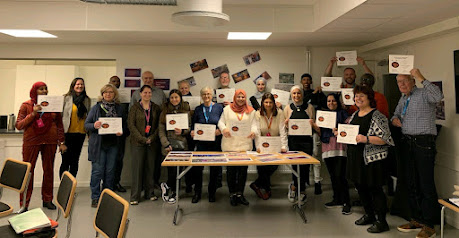
Graduates from SafeGrowth - local residents, police and others learning in Helsingborg.
Projects included a youth activity centre and intercultural gathering places for fostering cohesion. 

Economic sustainability

Research continually shows the indisputable relationship between income inequality, disadvantage and crime. Focusing on the immediate economy through investment in neighbourhood infrastructure and economic development is one antidote to some of the issues that are endemic to crime. Third Generation practitioners, residents and business partners can use tactics such as local partnerships, a focus on local creativity, and business incubation.

Practitioners can also implement tailored employment transition and reintegration programs for those with a criminal history so they don’t fall back into habits of gang membership, violence, and drug abuse. Neighbourhood economic sustainability has a direct impact on breaking the cycle of criminal recidivism.

From our ICA conference presentation - all styles of CPTED and urban development should move toward advanced neighbourhoods of a high quality-of-life 


Public health sustainability

Public health sustainability refers to enduring physical and emotional health. At a time of Covid, it seems redundant to make this point, but the fact is that urban design and social cohesion are correlated with outdoor pedestrian movements, the use of physical infrastructure, the perception of safety and trust among neighbourhood residents. Those are not only part of public health but they are part of the psychology that can trigger, or mitigate, crime motives. 

Residents should have opportunities to co-create neighbourhood plans for amenities to promote health. In particular, these include amenities such as testing facilities and counselling to monitor unchecked trauma experienced by children during their formative years. Neighbourhood and family trauma, such as substance abuse, violence, and social dysfunction, have a direct impact on offending behaviour and violence, especially in later years.  We have written about similar issues such as suicide prevention in prior blogs. 

Emotional intelligence programs, perhaps offered at neighbourhood hubs, offer a great tool for assisting both young people and adults to learn self-awareness tactics, mindfulness skills and pro-social behaviours. Third Generation provides CPTED with a way to remove some of the breeding grounds for future criminal behaviour in a way that better lighting and access controls cannot accomplish.


Physical infrastructure and urban design should be conducive to fun physical opportunities


EXTENDING THE DISCOURSE

Third Generation CPTED is obviously much more complex than basic CPTED tactics. Practitioners need a wider set of competencies and collaborative methods and forums for discussing and deploying such an integrated approach. 

It extends beyond simple opportunities for crime - not that there is anything wrong with cutting crime opportunities! Rather, and more to the point, 1st Generation CPTED is simply insufficient in the contemporary 21st Century neighbourhood if we want a higher quality of life in the long term.

The 4 S strategies amalgamate crime prevention, safety with neighbourhood liveability. Third Generation CPTED offers strategies so that we can realise many of our long-term, highest level, personal needs within our own neighbourhoods. Most importantly, by extending the discourse of public safety and crime prevention beyond the focus on crime, we can create opportunities for a different kind of neighbourhood in which residents will not only survive but thrive. 


Thursday, April 8, 2021

Third-Generation CPTED in post-pandemic cities

What will cities look like and how will neighbourhoods function in the 21st Century?


by Mateja Mihinjac

A couple of weeks ago Greg Saville and I presented an online masterclass for the International CPTED Association in which we talked about the evolution of CPTED. We described the journey from the early urbanist and architectural influences in the Jacobs/Newman CPTED era through to the criminological, psychological and sociological research that informed our development of Third-Generation CPTED, a theory we introduced in 2019. 

We described some of our most recent advancements to the theory and we presented four principles that inform liveable neighbourhoods – we call them the 4S of Third-Generation CPTED.

From the beginning of the CPTED movement, Florida State University’s Professor C. Ray Jeffery called for interconnections between all sorts of environments - from psychological and biological to urban and social - in order to create a truly “environmental” crime prevention. 

Twenty years ago, South African researcher Chrisna Du Plessis made a similar connection between sustainable urban development, quality of life, and crime prevention. In 2014, Paul Cozens in Australia made the point that CPTED needed a much broader view of wider environments, specifically public health and urban sustainability. These authors, and others, laid the foundation for what we later developed into Third-Generation CPTED.

The story below describes how we consolidated that early work into a new, coherent theory of crime prevention. 

Hanging gardens and building greenery contribute to environmental sustainability
- photo by bobarc, Creative Commons

AN INTEGRATED THEORY

One of the main characteristics of Third-Generation CPTED lies in the amalgamation of safety with neighbourhood liveability. The theory says that highly liveable neighbourhoods should offer opportunities to satisfy the basic, moderate, and also the highest-level human needs at the same time – a process that psychologist Abraham Maslow described as a hierarchy-of-human-needs. 

This means that advanced neighbourhoods will have already addressed basic physiological, psychological, and social needs. When crime and safety risks emerge, that neighbourhood will have the capacity to proactively address them through collaborative local plans. In such places, residents themselves will have resources for pro-social activities, to engage in activities that satisfy what Maslow called self-actualization or access to activities that allow them to positively contribute to the lives of others beyond one’s self (Maslow describes this as self-transcendence). 


Maslow's hierarchy and neighbourhood liveability


When a neighbourhood has that kind of capacity, it becomes a thriving and collaborative place of joy, contentment, safety, and sustainability. For many, if not most, such neighbourhoods help children socialize and thrive, and adults gain personal fulfillment from the urban design, cultural excitement, and pro-social opportunities that flourish there. Opportunities for crime are minimized and opportunities for personal satisfaction are maximized. The key is to extend public safety and crime prevention beyond the simple focus on crime and onto the liveability and sustainability of neighbourhoods. 


Future cities must learn from, not repeat, ancient cities. Third-Generation CPTED
helps us use new discoveries in neighbourhood liveability


In Third-Generation CPTED we built neighbourhood liveability around four principles emerging directly from Maslow’s hierarchy of human needs. These principles act as the framework for this integrated theory of crime prevention and they are centred around sustainability: environmental, economic, social, and public health sustainability. We call them 4S (sustainability x 4).


THE 4S AND THE LINK TO CRIME 

There is research support for the preventive mechanisms in each of these four sustainability principles. For example, public health research demonstrates how physical exercise through neighbourhood walking enhances safety from crime.

The presence of those afflicted with mental health problems in a neighbourhood has long been known to contribute to conflict and suffering. Accordingly, there are many strategies that contribute to building the mental health of a neighbourhood, such as emotional intelligence training, self-awareness and meditation training, or dealing with risk factors from early childhood personal trauma.

Third-Generation CPTED employs 4S


Similarly, environmental factors can also provide a preventive shield, such as the greening of vacant lots to decrease gun assaults or enhancing overhead tree canopies to reduce street crime.


Autumn in the Bornste Hamlet, Germany. Tree canopies in urban areas need maintenance but provide beauty and connection to nature - photo by Deitmar Rabish, Creative Commons 


Investment in local infrastructure enhances economic sustainability and attention to social sustainability through grassroots community-based developments enhances the quality of life for local residents and can help reduce crime. 

Our proposition is that high-performing neighbourhoods designed around each of these four sustainability principles offer a more long-term solution to prevent crime and improve the quality of life. 

These four sustainability principles provide a powerful new integrated model for planning safer and resilient neighbourhoods in post-pandemic, 21st Century cities.


Monday, September 28, 2020

Happy trails

Groomed nature walkway in Singapore

by Gregory Saville

Many years ago I spoke to Paolo Soleri, the visionary (and apparently flawed) architect who created arcology, the marrying of architecture and ecology into a new type of city.

I met him at Arcosanti, his experimental city lab in the Arizona desert, and asked him where, among his artistic walls, curved roof apses, and dense architecture, did he plan to include greenery, parks and nature trails? He replied that arcologies attempt to build high density in every direction, including vertically, but do so by leaving nature alone as much as possible. However, Soleri assured me, access to nature will be easier in an arcology because no arcology dweller will ever be more than a kilometer from nature, untouched and pure – parks, streams, and forests. 

That was an inspiring vision, one that seems far away today. I’m unsure how realistic, or desirable, it is to remove nature from within cities, especially given the many environmental and psychological reasons for walkable green space as Stephen Mouzon reports in his book The Original Green


Path and pedestrian bridge along a Denver creek

As we describe in Third Generation CPTED, nature, parks, trails and greenways have a deep psychological role in creating safe places and they will remain an important asset within large cities – whether it's New York’s Central Park or the massive Stanley Park in Vancouver. This is especially true in a time of COVID when everyone wants to get out from cabin fever. 

What about crime along those trails? Park pathways, greenways and nature trails are known in the CPTED business as “movement predictors”, sometimes called architectural desire lines. It is possible to design movement predictors safely or otherwise (unintentionally), depending on where and how designers construct them. 

A few years ago, we were asked to help design a Rails to Trails bikeway from a California train station through some very high crime neighborhoods. The project never happened, but it became clear to me that the single most important method for designing safe movement predictors is insuring users of those spaces are part of the design process. That's why it is such a central feature of all SafeGrowth programming. 

California rail-to-trail bikeway - never built, still scary

Collaborative design far surpasses the landscape architect’s penchant to: 1) look for published design guidelines; 2) design the trail; 3) show residents the results afterward; and 4) hope for the best. 

Our COVID world is creating a powerful impetus for city dwellers all over the world to take to the trails and experience nature. That is a good thing. Let’s ensure those trails are shared and safe.