Showing posts with label problem-oriented policing. Show all posts

Saturday, August 30, 2025

Cutting crime with knowledge and power - A doorway to effective policing

 
The 2025 Problem-Oriented Policing Conference returns 
to Madison, Wisconsin

By Gregory Saville

A few decades ago, television entered what critics call the Second Golden Age. Gone were the tidy cop shows of the 1970s. In their place came gritty realism. Among them was NYPD Blue, where Detective Andy Sipowicz embodied the flawed but dedicated street cop.

In one memorable episode, Sipowicz points to three hoodlums owning a downtown corner as he mentors a rookie about what it really means to police the streets: “Them three are bad and right now they own that corner. A good cop is gonna take that corner back so that people walking by don’t have to fear for their life.”

Today, that line may sound dated. Yet in its time, the sentiment rang true. As a young police officer, I too heard versions of that same lesson: your beat is your responsibility - protect it with pride. It reflected the enduring myth of the warrior in blue—the guardian who takes back the street.

NYPD Blue - the 1990s police procedural TV drama won 20 primetime Emmy Awards and 80 nominations over its 12-year run

Of course, reality was always messier. Crime is rarely solved by a lone act of heroism. Yet the drive to bring safety and dignity to a community remains. The difference today is that we know far smarter ways to do it.


FROM WARRIOR MYTH TO SMART STRATEGIES 

Despite what the skeptics say, police can and do stop crime— but only when they use the right tools. Sometimes that involves an arrest. More often, it means creative strategies that reduce harm without relying only on force.

This is the world of Problem-Oriented Policing (POP). Conceived by the late Professor Herman Goldstein, POP has become one of the most effective, research-backed models in modern policing. Instead of reacting case by case, POP asks: why is this crime happening here and how can we change the conditions that allow it?

Over decades, POP has built a proven track record: tackling robberies, drug markets, intimate partner violence, carjackings, and more. Its philosophy is simple: don’t just respond to symptoms— use crime analysis, community partnerships, crime prevention through environmental design, and many other inventive strategies to actually solve the problems.


Madison Wisconsin, site of the 2025 POP Conference
- photo Wiki Creative Commons

THE POP CONFERENCE 

The annual Problem-Oriented Policing Conference is the gathering place for this work. Previous conferences introduced new strategies and concepts, such as the SafeGrowth model presented for the first time last year.

In 2025, the conference will once again return to Madison, Wisconsin after having been there in 2015. This year it will bring together practitioners, researchers, and community partners to share cutting-edge strategies and real-world results.

At the conference, you’ll learn practical tactics, such as:

  • Cutting gun crime through place-based prevention and community partnerships.
  • Reducing school bullying by reshaping school climates and peer norms.
  • Preventing robberies by focusing on repeat victims, and situational vulnerabilities.
  • Applying CPTED and SafeGrowth to redesign public spaces and reduce fear.

The conference is about equipping police and city leaders with the evidence and tools to reduce crime in meaningful, lasting ways. You can register here

The conference is run by the Center for Problem-Oriented Police headed by Michael Scott - the nexus for innovative and effective policing

FROM SIPOWICZ TO POP HEROES

Sipowicz’s message—take back the corner—was once the rallying cry of police culture. It symbolized toughness and control. But today, real heroism looks different. It’s the officer who asks why the corner became dangerous, and then works with residents to change it. It’s the leader who measures success not in arrests, but in safer neighborhoods and stronger trust.

The Sipowicz era imagined the cop as a lone warrior. POP reimagines the cop as a problem-solver, a partner, and a guardian of community well-being.

That is the spirit of the 2025 POP Conference: to give practitioners the strategies, partnerships, and confidence to reclaim not just a street corner, but the whole city and, along with it, the legitimacy and trust that sustain safe communities.

And in that sense, Sipowicz’s line still resonates. Good cops do take back the corner—but today, they do it with insight, compassion, and strategy. Those are the true heroes who guard the community.


Friday, November 29, 2024

Opportunity Lost? The RCMP and the future


The Royal Canadian Mounted Police - the Mounties and their worldwide famous musical ride. The RCMP is the national police force of Canada - photo Andrea_44, Leamington, Ontario. CC BY 2.0 via Wiki Commons

by John Lyons

John Lyons spent many years as a patrol officer living and working in northern Canadian communities. A member of the Royal Canadian Mounted Police for 28 years, he served as a major crime investigator. For 10 years he was an international crime analyst with Interpol Ottawa. Post policing he consulted government on health care fraud. Now he brings his extensive experience to SafeGrowth, particularly in conducting search conferences to prevent crime and build collaborative networks.

Sometimes it is worth opening a door into the past to see how things repeat themselves.

Over the years, this blog has written about problem-oriented policing, like the 2002 project to cut street drug dealing by the Royal Canadian Mounted Police in Burnaby, British Columbia. We have also described the street disorder and tragedy of homelessness and street drugs plaguing so many cities, especially in my last blog on Prince George, BC 

What does a look back in history teach us?

LOOKING BACK

Some of us remember how economic stagflation and increasing crime rates decimated police resources in the 1970s. Like today, police leaders were told to do more with less, despite increases in crime. Then, as now, there were studies on how police services ought to be improved when officers were overworked and understaffed. Officers were facing intensive stress levels, a well-known problem reported in books and psychological studies

In that environment, problem-oriented policing (POP) emerged as a re-think about how to deliver police services. POP was seen as a way to cut street crime and decrease workloads during a time of high stress and under-resourced cops. Successful case studies began to appear at the annual POP conference pointing to a new way forward. Things seemed bright, indeed.

The Canadian Parliament buildings in Ottawa. The RCMP - Gendarmerie royale du Canada - was established by the Canadian federal government in 1873 as Canada's national police.

ENTER THE RCMP

Throughout the 1990s, the Royal Canadian Mounted Police launched a nationwide program to retrain its officers and introduce POP methods. They modified the curriculum at the national training academy incorporating a problem-solving model called CAPRA. Training teams traveled from coast to coast to teach problem-solving seminars in each RCMP Division. I know this because I was a coordinator and participant in those teams. 

As we traveled coast-to-coast, we noticed an interesting pattern: RCMP detachment commanders and supervisors rarely sat through the training, limiting themselves to guest appearances at the beginning or end. The only Commanding Officer who attended from all the Divisions we trained was in New Brunswick. To make matters worse, no one attended these regional seminars from the national policy center tasked with implementing community policing. 

What did this mean? 

It meant that RCMP commanders lost out on the informed ‘wisdom of the streets’ told by the operational police officers. The officers in our classes described their physical and emotional struggles – the stressors confronting them daily – as they effectively served their communities. They also told us how problem-oriented policing closely aligned with their own experiences – a message commanders did not hear. 

Thus, the major shift required in RCMP culture, from senior positions of command, never truly happened. Then, as now, problem-solving never really became embedded into the operations and organizational structure in cities like Prince George. Except in a few detachments, it did not happen in a systemic fashion.   

Graffiti on underpass walkway in Prince George

THIRTY YEARS LATER IN PRINCE GEORGE

We have been blogging about the street crisis of homelessness and drug abuse in Prince George, British Columbia. The Prince George Citizen labeled that city the crime capital of British Columbia 

Statistics seem to confirm that conclusion, like a government website showing an increasing crime severity index over the past 7 years. 

Conversely, a city website describes a reduced crime rate due to innovative policing strategies such as "community-oriented policing, increased patrols in high crime areas", and the "utilization of advanced technologies for surveillance and investigation". 

Nevertheless, in 2022 a consulting group was commissioned to produce an RCMP workload and resource study. That study was delivered to the city in 2023 –  the Resource Review of the Prince George RCMP.

The City Hall of Prince George, BC, employs the RCMP to deliver municipal policing services.

The study recommends adding 19 sworn officers and 12 support staff to improve efficiency. At a time when the city already spends 37% of its budget on public safety, it’s no surprise that city councilors are resisting throwing more money at the problem with no guarantee of success.

The study also indicated 20% of sworn officers were on leave, many for mental health and stress-related issues – an obvious red flag for city and police leaders. It was reminiscent of a similar situation in the 1970s and 1980s during the heyday of POP.

OPPORTUNITIES LOST

My sense of the RCMP community policing problem-solving model in Prince George is that it is more an ideal than a reality. The resource study confirmed this by claiming the Prince George RCMP had “near zero community policing capacity” and that it “does very little proactive, problem-solving policing”

Remember how we introduced problem-solving training and programming to the RCMP in the 1990s? Let’s not forget that RCMP detachments still have good problem-solving bones. Recruits are taught problem-solving through their CAPRA model.

How might they reclaim the lost opportunities of problem-solving that we describe in other cities? Simply adding more officers might seem like a simple fix. But that rarely works without more structural changes. Otherwise, it will fade away as it did before. How might they move forward? 

The 2024 International Problem-Oriented Policing Conference - retired deputy police chief, Dr. Ronald Glensor moderates alongside POP Center director, Michael Scott. Years ago, the RCMP submitted successful problem-solving projects at this conference and participated in sessions on crime prevention methods  

OPPORTUNITIES GAINED

  1. No doubt the officers at Prince George, combined with trained support staff, are capable of installing a problem-solving infrastructure and culture. There are already plenty of successful case studies, in-service training programs, and examples where police/community POP has worked across North America. 
  2. Problem-oriented policing projects by the RCMP have already been submitted to the International POP conference by other detachments in British Columbia. This includes projects on retail theft in Langley, BC in 2016, or dealing with prolific offenders in Kamloops, BC in 2010. Clearly, there is no lack of expertise.
  3. Senior commanders and supervisors need help putting such programs into place. This will mean investment in leadership training, resource support, and the assistance of outside organizations (expertise from local universities, retired officers to help in key areas, community partnerships).
  4. Finally, for the past 15 years, SafeGrowth has taught communities, residents, and their police across North America how to problem solve by establishing neighborhood safety plans. Police do not require additional officers to do this since the police do not lead the neighborhood planning process – neighbourhoods, business and downtown associations, and community groups do that. 
NEXT STEPS

The Prince George resource study sketched out a simplified version of this process titled the Community Safety and Well-being Plan. Fortunately, a model has already been tested and implemented in other cities through the SafeGrowth process. There is no need to reinvent the wheel.

One of the strategies included in the 1990s POP training was precisely this type of community safety planning. Sadly, that was lost to history. But it does not mean it cannot be rediscovered, this time with a large toolbox of updated and modern methods. Prince George citizens, its police officers, crime victims, and those suffering on the street deserve no less.  


Wednesday, May 31, 2023

The 2023 Problem-Oriented Policing Conference

The famous Pearl Street pedestrian mall in Boulder, Colorado
- photo Creative Commons, Wiki

by Gregory Saville

In a blog last December, I wallowed in one of my annual whine-fests about the state of policing when I wrote about organizational amnesia and the post-Ferguson wake-up for police strategies.

Now I must retrace my steps, stop whining, and introduce one of the best antidotes to that cynicism. 

Each year a group of the best in policing gathers to consider a new way forward for police. They examine innovative problem-solving, community collaborations, and how to use data and analysis to solve intractable crime issues. I am writing, of course, about this year’s 31st Annual International Problem-Oriented Policing Conference.


There are sessions on policing homelessness, reimagining campus safety, responding to active shootings, new approaches to field training and the PTO model, and crime prevention through environmental design.

In short, if we had police departments across the country with a much deeper dive into this form of policing in modern policing, we would have less community-police conflict and a safer community. It is really that simple. 


Hilton Embassy Suites is the venue in Boulder - Photo Orbitz


I will be presenting both CPTED and SafeGrowth at this conference. As well, I am very excited to see some exemplary work of police officers around the world as they compete for top honors in the prestigious Herman Goldstein Problem-Oriented Policing Award program.

Professor Herman Goldstein was among the most thoughtful and caring police scholars when it comes to policing as if people matter. He delighted in hearing the amazing success stories of police working with communities to fight crime. His influential book Problem-Oriented Policing is a seminal text on how to do policing right. 

The method is described in detail on the Center for Problem Oriented Policing website, led by Michael Scott, clinical professor and director of the center.

Register for the conference here.


Wednesday, December 7, 2022

A post-Ferguson wake-up & recovering lost memories - Part 2


Police patrol cars in New York - crime prevention
is considered a primary goal of policing. 

by Gregory Saville

The problem-oriented policing (POP) model has been around for decades successfully teaching police officers how to solve problems in partnership with communities. As I mentioned in last week's blog, years ago I chatted with POP founder, Professor Herman Goldstein, and asked him: When will police adopt a fundamentally better way to work with the community and solve problems?

The Ferguson riots unfolded in 2014, along with subsequent protests about excessive force and racism in dozens of other cities, but few remembered that POP had already pointed to better police methods. Eight years ago we knew very well there was a better, and proven, way forward. 

Yet, it seems that POP faded from police planning and development so much that by the time the federal government published the President’s Task Force on 21st Century Policing a year after Ferguson, there was not a single reference to the POP movement. It is as if the Task Force authors had collective amnesia. It did not mention the successes of POP as a crime-fighting or as a community-building tactic. 

Instead, authors conflated “problem-solving” as a catch-all term under community policing. “Problem-solving” is a ridiculous term that means everything and nothing at the same time. Without a clear definition and coherent steps, the term is meaningless.

Clearly, they lost the plot. 


Finding, and responding to, crime hotspots in parks, apartments, businesses,
and other places is the latest and greatest in police tactics


NEW WINE IN OLD BOTTLES

Why did this happen? Police had already figured how to implement problem-oriented policing. They already knew how to make it part of their regular duties.  And yet the evidence did not sway police leaders and their political bosses. 

Since 1979, when Professor Goldstein first introduced POP, we have seen the emergence of dozens of tactics for police effectiveness:


Each tactic has admirers and detractors, but none have survived the test of time like POP. Many have already been debunked or, at least, challenged on questionable ethics and constitutional grounds. For example, critics claim SQF can exacerbate the crisis of legitimacy and trust. In another example, predictive policing is criticized for “perpetuating systemic racism through the use of biased data”.

 
Hotspots are often locations where crime opportunities flourish,
such as vacant and unsupervised downtown parking lots


And then there are outright failed strategies like the ‘put-a-cop-on-every-corner’ idea. Consider Philadelphia Police who ran “Operation Safe Streets” in 2002 and put over 200 cops on the worst drug dealing intersections 24-7 in the hopes it would stem the tide of drugs and violence. Like all methods that hack at the branches, it did not go as planned. 

One scientific evaluation put it bluntly: There were no city-wide impacts on drug crime, homicides, or violent crimes. 


START SMALL, FINISH BIG

Luckily, some approaches like hotspot policing are re-discovering problem-oriented policing. Hotspot policing is not really a prevention strategy. It is not what police do, but rather where they do it. Crime analysts and patrol supervisors locate small areas of repeat crime and violence and then have officers target that spot. By focusing on micro-locations at apartment buildings, local bars, troublesome parks, or risky parking lots, the eventual goal is for crime to drop across the city at the macro level. 

Arguably, the unstated motto of hotspot policing is: start small, finish big. Of course, there is no guarantee small starts will do the trick, but that’s the goal.  

The concept of hotspots in criminology emerged a long time ago. Studies on auto theft in Peel Region and the Minneapolis hotspot experiment emerged in the 1980s, but not until fairly recently did police do anything with that knowledge. Unfortunately, the fact that one of the worst examples of excessive use of force and racial conflict in recent years arose in Minneapolis, suggests that hotspot policing is not really an answer to some important bigger questions. 

Today hotspots are the popular prevention-kid-on-the-block. There is a flood of studies on every aspect of hotspots: how to find robbery hotspots; how to calculate the “hottest” part of a hotspot; or how to find hotspot schools. Criminologists are renaming whole areas of criminology the criminology of place or place-based policing. Perhaps the best review of the topic is Martin Andressen's exceptional book “Environmental Criminology: Evolution, Theory, and Place”.


Simple prevention signs are one preventive tactic in hotspots  


Insightful researchers are also careful to describe hotspot policing as a deployment tactic, not a community crime prevention strategy. Interestingly, in some hotspot projects police use POP with great effect. 


HAPPILY EVER AFTER?

This brings problem-oriented policing back into the limelight and returns us to 
my conversation with Professor Goldstein in the last blog. I don’t know what he would say about this recent bevy of policing tactics. He seldom publicly aired his views about such things without prudent analysis and careful thought. 

I do know Goldstein was enormously proud and impressed by those officers who, through creativity and perseverance, worked with others in the community, used thorough crime analysis, and made places safer with POP. He loved hearing their stories and talking to them about how they found inventive ways to work with communities. 

And that is as good an ending to this story as I can imagine.

The International Problem-Oriented Policing conference for 2023 will be announced on the POP Center website. Watch for it. 

Monday, November 28, 2022

Police triumph and amnesia - Part 1

NYPD officers are watched by teens. Where is the future of police crime prevention?

by Gregory Saville

Once upon a time, I sat with famed police reformer and law school professor, Herman Goldstein, and chatted about the future of policing. 

“You know, Greg,” he started, “the more change I see in policing, the more it looks like things stay the same.”

“It’s just old wine in new bottles,” I replied, hoping my trite metaphor would impress (it didn’t).

“Will police ever adopt a fundamentally better way to work with the community to solve problems?” I asked aloud, wondering what kind of response I might expect.

We were talking, of course, about the Problem-Oriented Policing movement (POP) a so-called mid-range strategy to prevent crime that Professor Goldstein founded decades earlier. As Professor Goldstein described the program in his writing, “it places a high value on new responses that are preventive. It is not dependent on the use of the criminal justice system, and [it] engages other public agencies, the community, and the private sector.” 

Goldstein's 1990 book, Problem-Oriented Policing, and
his 1979 article by the same name set the stage for successful police strategies  

Echoing urban writer Jane Jacobs a few decades earlier, Goldstein wrote about the need for police to engage the community: “A community must police itself. The police can, at best, only assist in that task.” That is why community engagement is at the heart of the SafeGrowth philosophy.


TRIUMPH IN POLICING 

Professor Goldstein and I noted the ample evidence for POP success and how it offered a powerful crime prevention strategy. Even now, years later, researchers at the Center for Evidence-Based Crime Policy confirm that POP continues to have success in cutting street violence and drug crimes.

Researchers found that most prevention success emanates from a targeted approach at a local micro-level. They analyzed 31 projects of the latest and greatest prevention strategies at a micro-neighborhood scale and discovered half were POP oriented (13 of them had outright successful interventions and the last two were focused on tactics, not crime). 


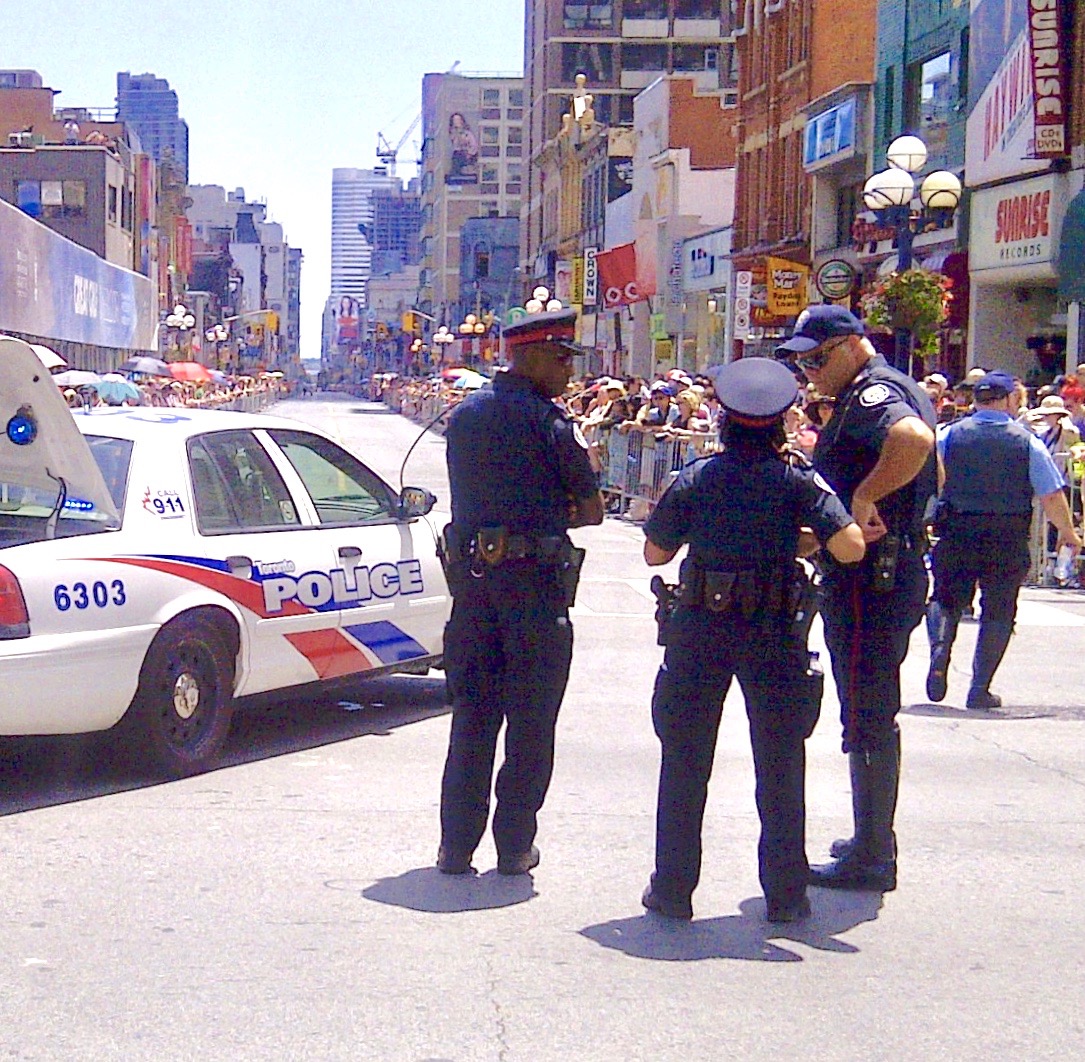
Toronto police at a public event. Have police in Canada (with a few
notable exceptions) also dropped the ball on problem-oriented policing?

In the 1980s and 1990s, the signposts for police triumph were clear. Hundreds of police agencies were trying bits and pieces of the model and reporting good results.

  • Police Chief Jerry Sanders and his agency led the country with POP innovations in San Diego, California
  • Police Chief Darryl Stephens had similar success in his North Carolina city of Charlotte/Mecklenburg
  • The International POP conference drew over a thousand delegates with stories of reduced robberies, assaults, gang shootings, and others
  • Canadian POP projects triggered Canada’s first Problem-Oriented Policing conference in Vancouver in 1995
  • In Britain, a similar POP movement grew (and continues to this day).

Surely, after decades of cutting crime and building community relations, this triumph should lead to positive reform in police service delivery?

You would think.


WHERE IS THE TRIUMPH TODAY?

Somehow, in the intervening years, those efforts fell on deaf ears. Police executives I meet today seldom mention POP as one of their strategies. While the POP movement continues, and the POP conference remains vibrant and relevant, many other POP efforts faded. 

The Canadian POP conference vanished. Police academies rarely teach POP in any meaningful way (or at all). When police leadership in San Diego changed, they eventually dropped POP as an embedded approach, as did many other police agencies. 

In a recent SafeGrowth project we trained 35 NYPD officers alongside community residents. Mindful of the alignment between SafeGrowth and POP, I was disappointed to learn that few of those officers had any experience in POP. In fact, most didn’t know anything about problem-oriented policing. 

It was a sad statement, especially since the annual POP conference, with dozens of innovative crime reduction strategies from around the world, was held later that year a short 3-hour drive north of New York City. 

Of the 40,000 officers in the NYPD, I saw none at that conference. Neither did any of those 35 officers in our training attend and when I asked their Sergeants to drive up, they too were told by supervisors it was not going to happen. That is not to say other police agencies are any different or that others did not attend - they did! At least the progressive ones. But it does make you wonder why success like this does not cling to police organizations?


Disney’s Jiminy Cricket – When you ask about the future of police,
you don't want to hear the sound of crickets
- Image Creative Commons

After four decades, hundreds of POP cases reported on the POP Center website, thousands of officers attending the conferences, dozens of books, and proof of success, when I ask police trainers and leaders today about POP, I get crickets. 

Chirp, chirp. 

It’s a lovely sound on a warm summer night on freshly mowed grass. But in answer to the question of whether police will ever adopt a fundamentally better way to work with the community to solve problems, it is the malady of cultural amnesia.

Why do we find ourselves here? 


NEXT BLOG: A POST-FERGUSON WAKEUP, HOTSPOTS, LEVERS, AND RECOVERING LOST MEMORIES

Friday, January 24, 2020

The passing of greatness - Herman Goldstein

Professor Herman Goldstein - photo Improving Police

by Gregory Saville

Today I write about my friend and mentor, retired University of Wisconsin Law School Professor Herman Goldstein. Today, Herman Goldstein died at home. He was 89.

When I first met Herman 25 years ago, I was impressed by how he so seamlessly dissected arguments, one logical piece after the other, and reconstituted them into a much clearer picture. He did this in his scholarship and, when I asked him personal advice, he did the same. It was a clarity I found refreshing in an academic world rife with politics and insecurities. He helped steer me through a sea of misdirection. It was that kind of clarity that led to him winning the Stockholm Prize, criminology's Nobel, in 2018.

Herman Goldstein winning the prestigious Stockholm Prize in 2018

A CAREER ASKING QUESTIONS

Herman’s career goes back to the foundations of modern police reform. In the late 1950s he was a staff investigator for the American Bar Foundation’s 10 year study of criminal justice, where he began riding with and observing police officers. It led to the earliest-known reflections about the nature of police discretion, a seminal finding that influences policing today. In the 1960s he worked on the President’s Commission on Law Enforcement and the Administration of Justice and in the 1970s, the New York City Knapp Commission on Police Corruption, following the Serpico scandals.

Few were more central, and influential, in writing about the police than Herman Goldstein. However, in my mind the single most formative idea by Herman – and one that resonates today more than ever – emerged from his 1977 book Policing a Free Society:
 “The strength of a democracy and the quality of life enjoyed by its citizens are determined in large measure by the ability of the police to discharge their duties.” 
How many other policing scholars have the insight to study the reality of street policing and discover that a healthy democracy lies in the quality of our police?

In 1979, and then in 1990, he wrote about Problem-Oriented Policing (POP) as path to a safer community and a new relationship between police and community. It has dozens of guidebooks, annual conferences, and publications, coordinated today by the Center for Problem-Oriented Policing directed by Mike Scott.

POP Guides on real-life solutions to real-life problems

I recently read Balko’s Rise of the Warrior Cop: The Militarization of America’s Police Forces and Vitale’s The End of Policing. These authors offer salient points about the inherent flaws in policing, but they miss one essential message – they say nothing about what policing does right. They ignored decades of problem-oriented policing that has cut crime and bonded neighborhoods and their cops. They provided not a single reference or hint that problem-oriented policing even existed!

That is irresponsible writing. If they had done their homework, they would know, as Mike Scott once wrote, “that police accountability is intricately linked to society’s understanding of the police function.”

THE BEST IDEA AROUND 

Thirty years after the publication of Herman’s Problem-Oriented Policing, and in spite of the persistent crashing of one trend-wave after another, the POP model still floats atop the ocean of police reform movements. There is simply nothing quite like it and I’m stunned when I teach police academy instructors, field training officers, or police leaders, and they know very little about POP. Shame on them! For goodness sake, get a little Goldstein in your life and wake up!

One elegant message that Herman taught me – and that all crime prevention and policing people should learn – is that if you want to make things better, look to where things are done better.

Problem-Oriented Policing is such a place. Herman Goldstein was the thought-leader who created it. It’s now up to courageous leaders to make problem-oriented policing happen beyond the piecemeal lip service we see today, hidden behind the armored personnel carriers, night vision goggles, and predictive algorithms.

Herman Goldstein showed us how to make policing better. We owe him a debt. I know I certainly do.

Monday, December 28, 2015

Kafkaesque policing - detours versus directions

Abstract paintings often have a Kafkaesque feel
As we end 2015, the term Kafkaesque comes to mind. It describes some hopeless struggle against bureaucratic, sometimes malevolent, machines. Since this is a future we want to avoid, the following cautionary tale seemed an appropriate year-end story.

Franz Kafka was a 19th Century German writer with books about “surreal predicaments and incomprehensible bureaucratic powers” in which his characters descend into alienation in the face of absurdity.

Think of films like The Trial by Orson Wells, Mulholland Drive by David Lynch or the futuristic crime dystopia by Stanley Kubrick, A Clockwork Orange.

POLICE INNOVATION

Kafkaesque thoughts surfaced when I read the 2013 and 2015 programs of the Police Innovation Conferences. These conferences were not really about police innovation as you might expect. Rather they were technology conferences offering a tech version of police innovation with some very cool gizmos such as drones and robots, brain fingerprinting, and body cams.

The gizmos look cool and I’m sure they have useful applications.

However in today’s police environment there is a much bigger picture. If this were one single technology conference it would be a fun curiosity. But today policing is inundated with so many conferences of similar themes, they detour rather than direct us to a sustainable, post-Ferguson future. A small sample:

  • A national conference on future police trends in which the future is technology 
  • A conference on Smart policing that navigates the future with data and intelligence analysis
  • In Canada, economics of policing conferences with perpetual prattle about fiscal efficiencies and belt tightening, all the while ignoring the private sector and problem-oriented policing strategies that will achieve it. 

CANDLES IN THE DARK

I have yet to see conferences about innovations in police training, such as basic academy courses that teach cops how to work with urban planners to build safer, CPTED-sensitive parking lots before carjackings and car thefts unfold.

Where are sessions on innovative methods to help get cops out of cars and into neighborhoods to work with social activists and faith groups to cut the roots of gang membership before the shooting starts.

There is little available about emotional intelligence skills that arm officers with better conflict resolution and situational awareness tactics to disarm offenders without killing them, or risking officers lives.

To be fair, there are a few candles in the dark - conferences focused on practical, grass-roots police work such as this year’s Problem-Oriented Policing conference in Portland. There are also a few small conferences such as this year’s Police Society for Problem-Based Learning in Madison or the International CPTED Association conference in Calgary. But these conferences do not command the policy discourse. What does? The Armadillo!


ENTER KAFKA

One session at these tech conferences was “Empowering the community - low tech crime prevention”. This session was about how police retrofitted an armored combat military vehicle called an Armadillo with video cams, audio surveillance, and so forth.

The goal? Deploy the Armadillo...
“to high crime areas or places that have experienced a spike in public nuisance type events. The Armadillo feels right at home when parked directly in front of a drug house or problem bar… a symbolic representation of restorative justice in places that have demonstrated public nuisance activity..” 

“At home in front of a drug house or problem bar?”  No doubt there is honest intention here, yet you just know Kafka is rising from the dead!

“A symbol of restorative justice?” Seldom was a more Kafkaesque phrase served up in the name of public safety.

In the spirit of a more common-sensical and balanced future, may we dispense with tactics that awaken dead German writers and get on with the task of building safer, collaborative neighborhoods in 2016.

Happy New Year!


Friday, September 12, 2014

What's happening to our police? Part 1


Hot of the press: Future Trends in Policing from the COPS Office, PERF, and the Target Corporation. It is a report of a 2012 survey and summary of a one-day session with police leaders on the "Future of Policing."

It reveals what some police executives think might happen in future. Is it a prophesy we really want?

TREND: COMMUNITY POLICING?

The survey reported 94% of respondents said their agency was involved in community policing, 89% in problem-oriented policing (COPS). Good news, right?

I've taught hundreds of police instructors over the past few years. Every time I ask them about COPS few, if any, admit to knowing anything beyond the superficial. Practically none of their agencies are doing anything beyond a small sprinkling of COPS specialists, less than 10% at best.

Last month I asked again, this time whether they knew anything about problem-oriented policing. The class had instructors from the east coast, mid-west, Canada, and the south. Same results: Out of 25 police instructors only 1 knew what POP was and he was from Madison, Wisconsin (the home of the POP Center).

94%?

Do police survey responders inflate whether they are doing COPS when they respond to a national survey on the topic? Saying one thing, doing another?


TREND: SCIENCE TO THE RESCUE

Future Trends had very little discussion of problem-oriented policing. In 45 pages of text it was cited only 3 times.

I did however notice the report was awash in GPS, cybercrime, body cameras, facial recognition software, predictive policing algorithms and intelligence-led policing. My personal favorite was NG 911 - Next-Generation 911.

[NERD ALERT: I love that stuff. Anytime I hear references to Star Trek - The Next Generation, my nerd-o-meter tingles. Beam me up!]

In other words science will come to our rescue? Zip-a-dee-doo-dah, what a wonderful day!

TREND: ONE-IN-FOUR

Survey statement: "In the future agencies will place less emphasis on community policing." 

75% of police agencies in the survey disagreed with that statement. Glass-half-full, right? But 25% offered no opinion or actually agreed that in future cops will do less community policing!

In other words, after 35 years of publications, conferences, training courses, and successes that account for at least some reduced crime, 1-in-4 police survey respondents see less community policing in the years ahead! Sounds more like a glass half-empty!

Considering the Ferguson riots two weeks ago that portends a bleak future.

Next week: Part 2 - The good news

Thursday, September 30, 2010

Tent city teardowns, family reunifications, and jobs

Homelessness during the 1930s Depression - Toronto's Yonge Street Mission
Photo Wiki Creative Commons


CPTED tells us that one way to enhance safety is to improve the maintenance and image of a place. We rarely hear how to do that. Is there a specific way that works better than others? One might think image and maintenance is a simple matter. Perhaps that's true in clean-ups for short-term gain, but it is less so if you want long-term sustainability.

This week I saw a clean-up and enforcement project that did it differently. As we teach during SafeGrowth classes, it demonstrates the importance of a rigorous collaborative process. Yesterday that project won the 2010 award for excellence in problem-solving at the International Problem-Oriented Policing Conference in Dallas. It is the Colorado Springs Police Department Homelessness Outreach program.

A year ago I described that one fallout of the Great Recession was the exploding number of homeless in squatter settlements like Tent Cities. I described an interesting innovation in Portland called Liberty Village.


Homeless tent prior to cleanup in Colorado Springs


Now the Colorado Springs Police Department report that they have begun to come to terms with it.

Like many cities, hundreds of homeless people were squatting in unsafe and unsanitary conditions in Colorado Springs. Life in makeshift tents (or in nothing at all) is a miserable experience; there are no provisions, sewage, water, nor protection from the elements. Not to mention the danger of crime.

Police tried clean-ups, arrests, and removal of abandoned property. When they were criticized for civil rights violations, they stopped. Then the sanitation problem worsened with piles of litter, garbage, and human waste. At that point, over 500 people were living in a homeless tent city.

The police formed a special team to apply problem-oriented policing. The key, they say, was collaborating with numerous groups. They spoke to a hundred homeless people to discover their needs.

ANALYSIS - DOING THEIR HOMEWORK

They examined programs across the country and researched new laws. They analyzed and mapped the scope of their problem and found a majority of related calls for police service clustered around the homeless camps. In other research conducted on local homeless people, they discovered that 21% had severe mental illnesses and another 23% suffered substance abuse.

Their homework paid off. When clean-ups took place, they happened in the context of a much more rigorous collaborative process. What did they do?

  • They created referral programs to mental health agencies, alcohol treatment programs, shelters, and jobs programs.
  • They connected homeless people with families and obtained funding to reunite them.
  • They worked with civil rights groups to draft an ordinance prohibiting camping on public property when social strategies failed.
  • They met weekly with people who are homeless, service providers, civil rights leaders, and homeless advocates.

In their report, they say the team has worked with "nine shelter agencies, 11 food providers, 6 mental health care providers, and several other agencies providing medical treatment, drug and alcohol treatment, clothing and other services."

WHAT HAPPENED?

Over the past year, there have been only 29 felony arrests and about 80 minor arrests. Concurrently, of 500 people living in tents, 229 families have been sheltered in better living arrangements, 117 people were reunited with family, 100 people were successful in finding jobs, and they completed 40 clean-ups of camps around Colorado Springs.

I've mentioned before the problem of displacement. Because they were able to help with social service referrals and family reunifications, they managed to minimize displacement. Incidents and problems have diminished and police-related calls for service have declined.

Congratulations to the Colorado Springs community and its police department.

Saturday, November 7, 2009

Crime prevention jibberish - The Holy Triumvirate

A renovated Chula Vista motel

When it comes to neighborhood crime risks, how do we take action? Usually we worship the Holy Triumvirate of Safety - police programs, prevention projects, and government policy.

The Holy 3 come in many forms: design out crime, secure-by-design, Intelligence-led policing, restorative justice, 3-strikes laws, broken windows, neighborhood watch, crime-free multi-housing, hotspot policing and, of course, CPTED.

Not that these are wrong. When surgically applied and well-crafted, they make a difference. But they are not surgically applied nor crafted that well (or at all). Usually they are applied to crime problems in the same way a drunk uses a lamp-post - for support, not illumination.

Consider the all-too-common policy to implement CPTED, Design Out Crime, or Secure By Design (or whatever similar nuanced names apply). Far too often policy comprises written checklists or CPTED surveys that practitioners apply when a new development proposal lands in their in-basket. The real goal of such policy is expediency; to sign off each checklist category and get that proposal into the out-basket. Seldom is the goal to engage a multi-disciplinary team, including those from the neighborhood, to review the proposal. Nor is the goal to use a careful diagnosis to determine what might work and what might not.

A CPTED checklist is idiotic. It is the band-aid on the heart attack.

I created SafeGrowth to combat that idiocy. Thankfully, there are other approaches that do the same. Example: this week I watched presentations by police problem-solvers from around the world at the International Problem-Oriented Policing (POP) conference in California.

Unlike SafeGrowth, POP is led by the police. It tends to focus less on long-term sustainability or community growth and more on responding to immediate problems. But, like SafeGrowth, POP illustrates how creative police officers, working in partnership with neighborhood groups, can solve intractable crime problems.

The conference top six finalists in the Herman Goldstein problem-solving awards were fascinating. One project from Chula Vista, California resolved crime riddled motels infested with drug dealers, prostitutes, and a flood of violence. Tellingly, only after a careful analysis did they craft a response with CPTED, property improvements, targeted enforcement, incentives, and improved management strategies. They even created a guidebook from which others can learn.

They started with the worst offenders, gave suggestions for how owners could gradually enhance their properties and let them choose strategies they could afford. They tracked improvements over a few years. Where compliance faltered, they moved in. The better motels became models for the worst.

Notice how these practitioners didn't assume the checklist position in their research stance! They avoided blind adoption of policy or programs. What made the difference here (and all the POP finalists) is the means by which they took action during their research.

The Chula Vista motels submission won top prize this year. Congrats to them. We should pay attention. Check out their guidebook.