Showing posts with label mass murder. Show all posts

Tuesday, September 6, 2022

A terrible loss - mass murder in James Smith Cree Nation

Unfolding news coverage of the Saskatchewan mass murder
- headline from screenshot  

by Tarah Hodgkinson

In the wake of the tragic mass murder in James Smith Cree Nation, Saskatchewan, we would be remiss not to take this time to offer our heartfelt condolences to this community. 

On Sunday night, two men went on a stabbing spree, killing 10 people and harming over 15 others in the small community just east of Prince Albert. This is one of Canada’s worst mass murders and a terrifying experience for this First Nations community. 

Police found one suspect dead while the other remains at large and suspected to be somewhere in Regina at the time of posting this blog.


The Canadian prairie province of Saskatchewan contains a number of First Nations
communities populated by North American indigenous peoples.
James Smith Cree Nation is one of those communities.


This incident is absolutely heartbreaking. Not only for the community, but for the country as we wait for the suspect to be caught and for justice for the victims’ families. 

Saskatchewan is a special place for all of us in SafeGrowth. We have been working with the city of Saskatoon for over 15 years building the SafeGrowth network. Mateja and I worked with SafeGrowth advocate and senior Saskatoon planner Elisabeth Miller in that city’s planning department. 

We have partnered with North Battleford on their crime issues and on building community cohesion.  Many of us have spent time working throughout the province and connecting with the wonderful and committed people who live there. 


Saskatchewan is well known for its beautiful scenery and
spectacular northern lights. Mass murders are extremely rare.
The last mass murder was over 50 years ago.

That is why tragic news emerging from the James Smith Cree Nation reservation, a community only a hundred miles north of the city of Saskatoon resonates with members of our team. We have not been to the James Smith Cree Nation, but we know that the pain and suffering from this mass murder must be devastating to those communities and the victims.


TOGETHERNESS IN TRAGEDY

We have written extensively in this blog about how public events and celebrations, like farmer’s markets and fireworks, can bring people together. We have documented the cohesive power of local events and community markets and gardens.

We have described how exceptional events can mobilize people, such as the New Zealand earthquake in 2011 or during extreme weather events.

And so, we know that this devastating event is going to have the same impact as other collective events. It will bring the people of Saskatchewan together. Together to find the assailant and fight for justice. Together to mourn and rebuild. 

And we will be with them. Every step of the way. 


POSTSCRIPT

A final sad note a day after we posted this blog: News from police in Saskatchewan report today that the remaining suspect in this mass murder was arrested and transported to hospital where he died from "medical distress".  


Monday, June 20, 2016

The nightmare that won't end


Our work to help neighborhoods tackle crime was overshadowed this week when 49 people were killed by a murderer, madman or terrorist in an Orlando nightclub! Two weeks earlier that murderer sauntered into a local gun store and shopped an assault rifle and handgun from a gun dealer who would later claim “I don’t make the law”

Mass murder is not at all the same type of preventable crime as other crimes that we tackle. On one hand it accounts for a tiny minority of violent incidents each year. Yet taken on whole, the annual American mass murder toll is mind-numbing
  • 2016 - 49 killed in an Orlando nightclub
  • 2015-  9 killed at an Oregon college
  • 2015 - 14 killed by a terror couple in San Bernadino, 
  • 2013 - 12 killed in a Washington DC Navy Yard 
  • 2012-  26 killed, including 20 children, at Sandy Hook school 
  • 2012 - 12 killed in a Colorado movie theatre 

DOMESTIC VIOLENCE

By my own calculations, since 2014, the number killed in mass murders (more than 4 killed at a single event) totals 694 victims! That is less than 3% of total of homicide victims in those years. About 14,000 people are murdered in the U.S. each year. 

To be clear, most murders are not mass murders but rather domestic violence killings and gang and drug shootings. 

Still, mass murders are the most gut-wrenching. And most mass murders have nothing to do with terrorism. Over 90% of mass murders since 2014 resulted from domestic violence or criminal madmen. 

None of which solves the problem. 

It is difficult for me to ignore the same arguments of reason and evidence against off-the-shelf assault rifles that I offered four years ago after the Newtown, Connecticut school murders

MISSING THE MARK

Instead pundits blather on about terrorism, background checks, LGBT hate crimes and mental illness. They dismiss gun control, probably because with millions of firearms in private hands, gun control is a hopeless genie long out of the bottle. 

We are left to watch President Obama delivering his 15th mass murder speech. And in spite of it all, the American gun/murder formula continues to produce yet more atrocities year after year.  It’s like a nightmare that won’t end.

Wednesday, July 27, 2011

Gun crackdowns or transforming violence? Choosing our future


News this week of a mass killing in Norway depicts a racist flat-earther for what he really is; a murderous bigot. Small solace for the victims. Can community safety ever be immune from such madness?

Worried about events far away, I checked on a friend's safety in Mexico following the recent drug cartel slaughter of 20 people in a Monterrey bar.

Mass murder by lone bigots? Hard to see that coming. Drug violence and cartel gun crime? That's a different story with no simple explanation. Something can be done. But what?

Crackdowns?

Some still grasp at simple explanations. I just read a blog from a combat-cop acolyte suggesting more cops and crackdowns is the way to community safety. Facts and research suggests otherwise.

Michael Scott, director of the Center for Problem Oriented Policing, published The Benefits and Consequences of Police Crackdowns, a study of 42 police crackdowns.

He found that carefully planned gun crackdowns did show some promise when "supported by problem analysis and conducted in a way to safeguard civil rights". Yet half (47%) of the crackdowns in his review had no impact, weren't evaluated or had mixed results.

Fast and Furious

The fact is too many crackdowns have unintended consequences, none more spectacular than the failure of last year's ATF operation Fast and Furious.

The idea was to target Mexican gun runners, provide guns through undercover sales, track and then catch them. That would, supposedly, help stem the flow of American guns feeding the Mexican drug war. The opposite happened.

Fast and Furious resulted in a dead US Border Patrol officer and over 1,500 guns missing, many in drug cartel hands. Some may have even been used in the Monterrey shooting. According to ATF's report to Congress yesterday, the crackdown spiraled out of control. An ATF attache to Mexico called it "insane".

So, what will stop the violence?


A short while ago Emiliano Salinas, son of the former Mexican President, provided ideas for the future on TED.com. Watch it HERE.

He gave examples about how to organize each community and act together. Says Salinas: "The problem is that we play the role of victims. We need a civil response against violence."

Made me think of The Tragically Hip's lyrics in Courage:

So there's no simple explanation
for anything important any of us do
and yea the human tragedy
consists in the necessity
of living with the consequences

Monday, August 9, 2010

The crime triangle - a veneer

Proper analysis is the first step to prevent crime
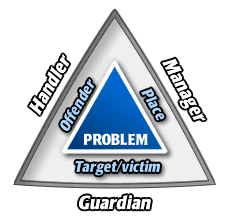
I like the crime triangle. It is popular among crime analysts. It helps analyze crime hotspots. It is also part of problem-oriented policing. Sometimes too it is part of the prevention practitioner’s toolbox. It has elegant utility and simplicity.

The crime triangle emerges from "routine activity theory" (RA) in the early 1980s. RA explained some behavior quite well, like predatory crime (stalking). It did so with a simple premise: crime converges at the intersection of likely offenders, suitable targets and an absence of guardianship (or, more recently, "handlers").

In lay terms, picture the three sides of a triangle with an offender, a victim, and a target/place. When those things come together, so the theory goes, crime goes up.

The crime triangle is useful. Break the triangle and you prevent the crime. Want to increase guardianship? Get property managers to keep better control of their properties. Improve bar management in bars that over-serve. Simple. Elegant.


So far, so good. Except for one thing; that is where it typically ends in the RA world. The crime triangle does not dig deeper into the causes of crime.

Why? Because routine activity (and its crime triangle progeny) is one of those crime and place theories.

RATIONAL CHOICE

RA is less a causal theory explaining why and more a descriptive symbol predicting when, where or how. It ignores why someone becomes motivated in the first place. RA assumes an endless supply of motivated offenders. They are motivated for some reason; we just don't know why. The only "explanation" of motive falls back to rational choice theory.

Rational choice assumes offenders are rational actors who weigh risks against rewards. From the window of RA (and the crime triangle), crime looks like a "normal" condition of life.

True, some criminal behavior is “normal” in the sense that as events, products, and social affairs change, so too do crime opportunities. But as a causal theory, that’s rather trifling. It’s a bit like saying with enough water, sun and moderate temperature, certain environmental conditions will produce rain.

Then again some criminal behavior is not normal at all and RA just doesn’t work. Consider the story of the Connecticut mass murder in the news today.

As the NY Times says, this is “the latest in a series of American workplace tragedies”. It is a sad story about a workplace shooter who killed numerous workmates and then himself. He may have snapped from perceived workplace injustice. Perhaps he was clouded in a drug stupor. Maybe he was insane.

Routine activity theory might suggest how to remove opportunity for future incidents like this. That is a good start. Baby steps.

But RA theory will never actually know why because it will never ask. In cases such as this, the risk and reward assumptions of crime-and-place theories look rather silly. What does a suicidal shooter “risk”? What “reward” was this shooter gaining? Vengeance? (If so, we’re back to motive.)

Motive is a key piece of the puzzle

WHAT CAN THE TRIANGLE DO?

What will the crime triangle tell us in cases like this?

1. Capable guardians - cameras, plentiful supervision, and so forth. Unfortunately this shooting occurred at shift change when there were lots of employees and supervisors about. As for CCTV, how often do we watch nighttime news clips of robbery/shootings on corner-store CCTV? Cameras don’t stop shootings.

2. The time/workplace environment – preventing guns in the workplace. Will metal detectors work? Perhaps, but how difficult is it for shooters to become bombers. What then? Bomb sniffing dogs? At some point Orwellian paranoia replaces civility. Where do we stop? Body cavity searches?

3. The offender – modus operandi (not motive. Remember, RA is motive-neutered). The crime triangle asks if "handlers" like armed security might have intervened (that actually might have helped). Or maybe we could have prevented the shooter from getting guns in the first place? Others can argue 2nd Amendment rights. I won't bother here.

Crime triangle questions just don't do it. Instead, we must also ask this: Why did the shooter shoot? What can we learn about motive to prevent such tragic events in future?

The crime triangle is a useful and elegant baby step. I like it and I use it. But it is veneer. It is short term. It is not enough.

Our analysis of neighborhood crime must include a more robust analytical dialogue. If our analysis does not encompass action to move social life forward, it is not robust. Ultimately, if our theory fails to include motive, we are cluttering our dialogue with junk and the analysis of junk.