Monday, November 28, 2022

Police triumph and amnesia - Part 1

NYPD officers are watched by teens. Where is the future of police crime prevention?

by Gregory Saville

Once upon a time, I sat with famed police reformer and law school professor, Herman Goldstein, and chatted about the future of policing. 

“You know, Greg,” he started, “the more change I see in policing, the more it looks like things stay the same.”

“It’s just old wine in new bottles,” I replied, hoping my trite metaphor would impress (it didn’t).

“Will police ever adopt a fundamentally better way to work with the community to solve problems?” I asked aloud, wondering what kind of response I might expect.

We were talking, of course, about the Problem-Oriented Policing movement (POP) a so-called mid-range strategy to prevent crime that Professor Goldstein founded decades earlier. As Professor Goldstein described the program in his writing, “it places a high value on new responses that are preventive. It is not dependent on the use of the criminal justice system, and [it] engages other public agencies, the community, and the private sector.” 

Goldstein's 1990 book, Problem-Oriented Policing, and
his 1979 article by the same name set the stage for successful police strategies  

Echoing urban writer Jane Jacobs a few decades earlier, Goldstein wrote about the need for police to engage the community: “A community must police itself. The police can, at best, only assist in that task.” That is why community engagement is at the heart of the SafeGrowth philosophy.


TRIUMPH IN POLICING 

Professor Goldstein and I noted the ample evidence for POP success and how it offered a powerful crime prevention strategy. Even now, years later, researchers at the Center for Evidence-Based Crime Policy confirm that POP continues to have success in cutting street violence and drug crimes.

Researchers found that most prevention success emanates from a targeted approach at a local micro-level. They analyzed 31 projects of the latest and greatest prevention strategies at a micro-neighborhood scale and discovered half were POP oriented (13 of them had outright successful interventions and the last two were focused on tactics, not crime). 
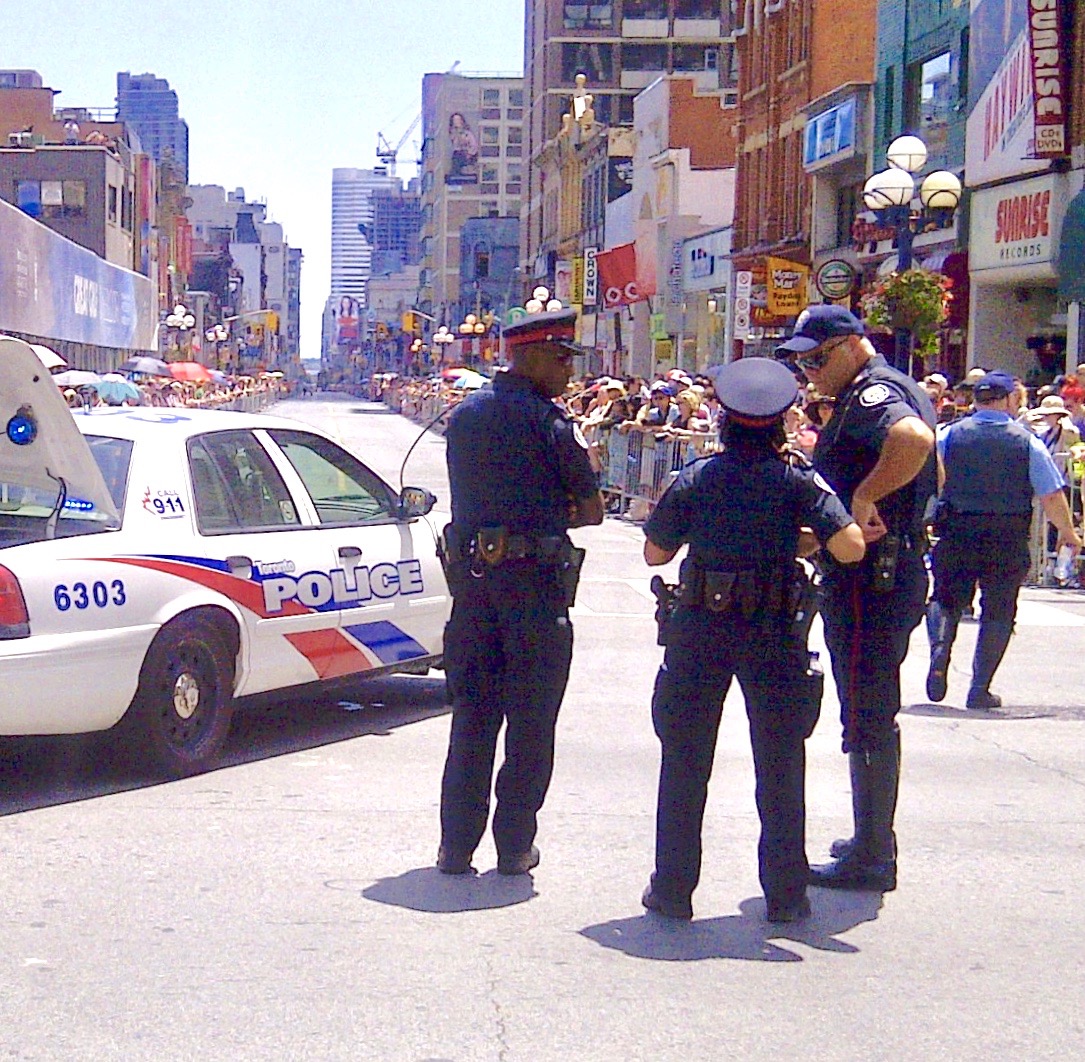

Toronto police at a public event. Have police in Canada (with a few
notable exceptions) also dropped the ball on problem-oriented policing?

In the 1980s and 1990s, the signposts for police triumph were clear. Hundreds of police agencies were trying bits and pieces of the model and reporting good results.

  • Police Chief Jerry Sanders and his agency led the country with POP innovations in San Diego, California
  • Police Chief Darryl Stephens had similar success in his North Carolina city of Charlotte/Mecklenburg
  • The International POP conference drew over a thousand delegates with stories of reduced robberies, assaults, gang shootings, and others
  • Canadian POP projects triggered Canada’s first Problem-Oriented Policing conference in Vancouver in 1995
  • In Britain, a similar POP movement grew (and continues to this day).

Surely, after decades of cutting crime and building community relations, this triumph should lead to positive reform in police service delivery?

You would think.


WHERE IS THE TRIUMPH TODAY?

Somehow, in the intervening years, those efforts fell on deaf ears. Police executives I meet today seldom mention POP as one of their strategies. While the POP movement continues, and the POP conference remains vibrant and relevant, many other POP efforts faded. 

The Canadian POP conference vanished. Police academies rarely teach POP in any meaningful way (or at all). When police leadership in San Diego changed, they eventually dropped POP as an embedded approach, as did many other police agencies. 

In a recent SafeGrowth project we trained 35 NYPD officers alongside community residents. Mindful of the alignment between SafeGrowth and POP, I was disappointed to learn that few of those officers had any experience in POP. In fact, most didn’t know anything about problem-oriented policing. 

It was a sad statement, especially since the annual POP conference, with dozens of innovative crime reduction strategies from around the world, was held later that year a short 3-hour drive north of New York City. 

Of the 40,000 officers in the NYPD, I saw none at that conference. Neither did any of those 35 officers in our training attend and when I asked their Sergeants to drive up, they too were told by supervisors it was not going to happen. That is not to say other police agencies are any different or that others did not attend - they did! At least the progressive ones. But it does make you wonder why success like this does not cling to police organizations?


Disney’s Jiminy Cricket – When you ask about the future of police,
you don't want to hear the sound of crickets
- Image Creative Commons

After four decades, hundreds of POP cases reported on the POP Center website, thousands of officers attending the conferences, dozens of books, and proof of success, when I ask police trainers and leaders today about POP, I get crickets. 

Chirp, chirp. 

It’s a lovely sound on a warm summer night on freshly mowed grass. But in answer to the question of whether police will ever adopt a fundamentally better way to work with the community to solve problems, it is the malady of cultural amnesia.

Why do we find ourselves here? 


NEXT BLOG: A POST-FERGUSON WAKEUP, HOTSPOTS, LEVERS, AND RECOVERING LOST MEMORIES

Monday, November 21, 2022

Turn off the lights?

Lighting for safety is not a simple matter

by Mateja Mihinjac

In our SafeGrowth work, we frequently hear calls from local residents for installing better lighting in their neighbourhoods. It is important that the lighting question is carefully thought through and that urban designers know how to introduce alternative solutions to counter the negative effects of reduced lighting on liveability.

Research on natural surveillance and lighting are some of the most frequent research in crime prevention through environmental design (CPTED). Findings show that improved lighting, either through increased illumination or more consistent lighting increases street activity and reduces fear of crime.

It also leads to increased interaction between the residents and consequently to improvements in neighbourhood social cohesion.

Conversely, reduced lighting, especially when coupled with poor ambient lighting, may lead to an increase in some forms of violent crime.


Many pedestrian walkways are not lit at all


Experienced CPTED practitioners will also recognise that some circumstances or places require eliminating or reducing lighting. Context is everything when it comes to lighting. 

For example, it might be better to redirect people with lighting away from a deserted footpath at night to a busier route. Or perhaps it is advisable to shut down lighting at specific hours to limit the operational hours of a public park thus preventing nuisance behaviour. In both cases, lighting controls can reduce the risk of victimization.

Over the past decade due to the expansive introduction of bright LED lamps, there have been frequent calls from environmental agencies for reducing lighting due to light pollution and its effect on the health of animals and humans.

Greg has also examined the impact of illumination on traffic safety and health, and the importance of assessing the context when deciding whether to light or not to light a place.

More recently, the energy crisis has revived the calls for reducing energy consumption and illumination in our cities.


The city skyline looks well-lit from a distance. Close up, it is not always the case!


THE EUROPEAN ENERGY CRISIS

Europe, especially, has been dramatically affected by the now 9-month war in Ukraine. To help counteract soaring energy prices this winter, the European Commission called for mandatory energy savings by EU countries that need to reduce “electricity consumption by 5% for at least 10% of high demand hours each week”.

As a result, some European cities have reduced the illumination of landmarks, shops, and monuments, decreased illumination levels, or completely switched off or reduced the duration of public lighting.

Slovenia is no exception. Lighting has already been turned off on some motorways and highways where it is legally allowed to do so despite concerns that it might negatively affect traffic safety.


Yellow/orange sodium lighting on a walkway


The mayors of some cities have instructed lights to be switched off before dawn, while in other municipalities promotional digital screens will also be turned off. Some cities decided not to light their downtowns this festive season or will limit festive lights to reduced operational schedules.


IMPACT ON SAFETY?

While the current energy crisis, environmental and health concerns speak in favour of reduced illumination it is uncertain what and if any effects this might have on neighbourhood safety. Many European cities are already poorly illuminated compared to some North American, Australian, or large European cities. 


What is "appropriate" for lighting depends on the context


This is in spite of research that shows poor ambient lighting (that will now replace adequate illumination of some streets) might actually increase safety concerns. Moreover, appropriate lighting is important for improving perceived safety and interaction, especially during wintertime when the sun sets by late afternoon. 

High-quality lighting is the cornerstone of safe design in public places at night. Effective crime prevention means that practitioners and residents must know the proven lighting methods that contribute to safe urban places.


Monday, October 31, 2022

Mental health - COVID's impact

Did mental health reports increase during COVID? 

Tarah Hodgkinson 

We talk about liveability in SafeGrowth a lot. A liveable community is a healthy one. And that includes mental health. 

The COVID-19 pandemic had a significant impact on the mental health of our communities and how we live our lives. While we saw an international decline in most crime types during the initial stages of social restrictions (starting in March 2020), we know less about how these restrictions impacted police-reported mental health. 

There are countless articles and reports raising concerns about the short and long-term impacts on mental health as a result of COVID-19 social restrictions. Most claim that mental health deteriorated across the board, but impacts were particularly acute for disabled, marginalized groups, and women. 


LESSONS FROM CANADA

Furthermore, from Nova Scotia on one coast to British Columbia on the other, there have been calls for increases in Canadian police personnel to respond to the increasing demand for mental health services. In a recent study we published in the Canadian Journal of Criminology and Criminal Justice, we sought to determine if the concerns about mental health were warranted in the Canadian context and if calls for additional resources were necessary. 


The pandemic affected everyone -
A new Canadian study examines mental health impacts


We were able to examine 13 jurisdictions in Canada using a Statistics Canada special survey of police-reported mental health-related incidents. Surprisingly, we didn’t find major increases. 

Rather, police-reported mental health-related incidents were generally stable. More specifically, we found that suicide attempts and incidents generally declined. Apprehensions under the Mental Health Act (a danger to themselves or others), were generally stable with significant increases in only 4 out of 13 jurisdictions. Other mental health-related calls were also generally stable with only 3 jurisdictions seeing a significant increase. 

Counter to widespread concern about the impact of social restrictions, the police-reported mental health-related data shows an unexpected resilience in Canada. When you explore the psychological literature on mental health, this finding is consistent across other contexts.  


WHAT DOES THIS MEAN?

First, it means we may be more resilient than we actually thought. Second, it means that calls for increasing mental health resources to police may be unwarranted.

This is an important point because police are usually not the best equipped to deal with mental health-related incidents. Indeed, because of the de-institutionalization of mental health facilities and cuts to social resources and preventative measures, police have become the only responder left. This isn’t fair. Mental health is not a crime! Police should not be the ones to respond. 


Mental health is not a police issue.
The mentally ill deserve treatment, not prison.


Keep in mind that even though mental health-related incidents are stable, we still have a lot of work to do. And that work shouldn’t be reactive and enforcement-based. Rather, we need to demand our governments invest in evidence-based solutions like basic income, housing, social services, and wrap-around supports. 

These solutions need better funding and neighbourhood-level support to ensure they are appropriate and reach those who need it most. Neighborhood-level capacity-building is precisely what occurs within SafeGrowth programming. We believe this is how we rebuild the kinds of 21st-century neighbourhoods that will help us stay resilient and healthy. 


Wednesday, October 26, 2022

A desert Summit in Palm Springs - COVID finally eases

2022 SafeGrowth Summit hotel - Hilton Palm Springs

by Gregory Saville

Over the past 7 years, the SafeGrowth Network has met annually at our training Summits to teach each other new concepts and tactics arising through our community-building and crime prevention programs. It’s a time for us to recharge our batteries and recuperate in the company of like-minded, funny, and intensely talented, people (Pina colada’s served with pink umbrellas under palm trees comes to mind). 

We invite others outside the network to participate in our Summits, such as community groups, journalists, business associations, housing groups, police, academics, and other urban design professionals. Then we set aside time to give back to the community in the form of public training, presentations, or workshops. 

All that came to a halt with the COVID pandemic relegating us to online Zoom meetings – a distant substitute for sharing good food, relaxing at the beach, or laughing in person. Finally, after a long wait following our Cancun, Mexico Summit in 2019, we had our first face-to-face in three years in Palm Springs, California last week. 


One of the Palm Springs pathways we examined
during our walking audits

PALM SPRINGS, CALIFORNIA

Over the years we have partnered with neighborhood associations, national non-profits, and crime prevention organizations. This year we were delighted when the Palm Springs police department –  in the form of Chief Andy Mills and Lt. William Hutchinson – offered to sponsor our meeting and participate in our 2022 SafeGrowth Summit. 


Palm Springs police chief Andy Mills introduces the
SafeGrowth team to community members


Ten members of our team, (five more virtually) and a half dozen members of the police service, gathered at the Hilton Palm Springs Hotel, the police training facility, and on the downtown streets of the city, to discuss, analyze, audit, and brainstorm different ways to bring safety and livability to neighborhoods of the future. 


SafeGrowth team member Anna Brassard describing SafeGrowth

Mateja Mihinjac outlines a part of model to residents

Harry Tapia explains Livability Academies 


Among other topics, our Summit themes included:

  • a new method for community engagement, 
  • different ways to review crime trends in Palm Springs,
  • next steps for the Livability Academy status in Philadelphia,
  • situational awareness during site visits,
  • SafeGrowth progress in Sweden following the 2022 H22 Smart City Expo,
  • A review of current trends in planning theory,
  • geography of crime theories and community crime theories related to SafeGrowth.

We discussed the situation in Palm Springs and we ran two public sessions on two different days to introduce residents and business owners to different parts of the SafeGrowth model. We gathered 40 community and business residents for presentations on Livability Academies and other programs in SafeGrowth. We toured their city with them so they could show us their concerns and hopes for the future. The local media was terrific in providing accurate and timely reporting on our week in their lovely city. 

THE END OF COVID

Work retreats can be dull and dry affairs, but beautiful Palm Springs did not disappoint with its eclectic street furniture, art, and statues, along with some of the best mid-century modern architecture in the nation (Frank Sinatra and the rat pack lived here). Along the way, we hiked the nearby mountains, went up the gondola, spent time at the weekly street market, and were entertained by the Denver band MOOSGH at the Hotel Zoso

There is no replacement for face-to-face encounters when it comes to SafeGrowth and other forms of community development. It’s great to see the other side of the pandemic.

Best wishes to the many wonderful residents and professionals in Palm Springs, especially Chief Andy Mills and Lt. William Hutchinson. Thanks for the hospitality.  


Wednesday, October 5, 2022

Quality-of-life policing - re-dressing broken windows?

With the increase in street disorder and homelessness, NYPD has
reinstated the controversial "Quality-of-Life" policing strategy


by Mateja Mihinjac

Over the past few years, there has been a growing focus on improving liveability and quality of life within neighbourhoods and cities. This includes our conceptualisation of 3rd Gen CPTED – Third Generation Crime Prevention Through Environmental Design (CPTED) – a theory capitalizing on the concept of liveability that embeds safety from crime and fear.

One potential manifestation of this liveability trend translates into policing with an increasing emphasis on quality-of-life enforcement where individuals are targeted for minor offences and misdemeanours that contribute to crime and disorder. 


QUALITY-OF-LIFE POLICING IN NEW YORK CITY

Quality-of-life policing has been most prominent in New York City, which is undergoing an interesting change under the leadership of new Mayor Eric Adams.

After years of a downward trend in arrests and incarcerations for misdemeanour offences, stats for these activities have started to increase owing to a new stricter enforcement of so-called petty crimes. The petty crimes include fare evasion, petty theft, jumping subway turnstiles, sleeping on a park bench, taking up two seats on the subway, public drinking, public urination, dice games, and similar. According to reports, arrests for these offences have jumped by 25% between January and June of this year.

Nearly 90% of those arrested were people of colour.

This is the first increase since 2014 and the first significant increase since 2007 when the stop and frisk practice was ruled unconstitutional. 


Street incivilities, like graffiti, have returned to New York City


Yet the NYPD maintains that New Yorkers desire, if not demand, addressing the quality-of-life issues. They justify this with a poll showing three-quarters of respondents stated they perceive crime as a very serious issue. 

Of course, the survey simply reflects public perceptions of crime and quality of life, not what specifically the community would like done about crime and quality of life. To translate that into quality-of-life policing would seem to commit the error of what policing expert Professor Herman Goldstein called the “means over ends syndrome”, the process whereby police conflate the ends with the means and place more emphasis on the policing operational tactics than on effective solutions that actually resolve the problem at hand.


Quality-of-life policing enforces minor offences,
like littering and dogs-off-leash


BROKEN WINDOWS POLICING 2.0

Some argue this new era of quality-of-life policing is simply the return of broken windows/order maintenance policing, a policing practice that received much criticism for being unethical and ineffective. 

Its critics argue that quality-of-life policing practices are abusive, they harass predominantly individuals of colour and criminalise people for being poor.

Moreover, in the era of aiming to re-establish positive police-community relationships following all the recent police-community crises (the protest movement after George Floyd’s death; the defund the police movement), it would seem that more aggressive and confrontational policing practices may undermine these efforts for positive changes.


Like residents in all cities around the world, people in New York City
desire a livable city with places that are healthy, fun, and safe

THE FUTURE

My fear is that returning to more repressive policing tactics could also increase the gap between prevention strategies such as CPTED and the disadvantaged communities that gain the most from effective and low-cost practices.

As recently as last year CPTED was vilified by some critics for alleged discriminatory practices when they wrongfully conflated CPTED with broken windows policing. 

We certainly do not need another “prevention” strategy that causes more harm than good – especially since it already did that once. I hope it does not come to that.


Wednesday, September 14, 2022

Personal journey into CPTED - A planner's story

Marriott Bessborough hotel - historical landmark in downtown Saskatoon, Canada


by Elisabeth Miller

As a SafeGrowth advocate and senior urban planner in one of Canada’s major cities, Elisabeth Miller was one of the first Canadian planners to apply CPTED to her everyday work. She is an ICCP-certified CPTED professional with the International CPTED Association and an executive board member of that organization. She is an author of the book SafeGrowth, and a consultant to cities across Canada, the US, and Australia. She helped establish Saskatoon as the first city in Canada to adopt both CPTED and SafeGrowth as administrative policy. This is her story.


I am always curious when I meet other CPTED professionals or practitioners, what their background is, and how they arrived at incorporating CPTED into their professional work. CPTED, especially Second Generation and Third Generation CPTED, speaks to my heart and I can see how proper and inclusive application of CPTED would be helpful to any community. 

I first heard of CPTED at a British Columbia conference about 25 years ago in the mid-90s. It sounded very interesting and an excellent way to help make my community safe. Shortly after this conference in 1996, I attended a 5-day training on CPTED, a course that taught both 1st and 2nd Generation CPTED. I was hooked!

Elisabeth Miller - A personal story from her 25-year history
with urban planning and CPTED


My planning experience up to this point included neighbourhood planning and working directly with communities. Prior to that, I worked on municipal Concept and Sector plans, Land Use and Zoning Bylaws, and other policy related projects – activities that will be familiar to most urban planners. I believe I had a good variety of planning experiences.

The CPTED class was a very interesting combination of police (mostly police) with a few planners thrown in. It offered lectures, group work, site visits, buzz groups, and other problem-based learning activities to situate the learning in our brains. It was a very intense training environment – I loved every minute of it!

Once trained, my task was clear: Implementation!

And THAT was a big deal.


IMPLEMENTATION IS THE KEY

Fortunately, I had a very supportive manager. He also saw the benefit of including CPTED in the way we planned our city and encouraged me to include it wherever I could. So, I included it everywhere! I did not ask, I just included it and decided if the powers that be pushed back then I would deal with it then. 

I added knowledge of CPTED to job descriptions, reviewed plans and commented even if I wasn’t asked. I crafted an “elevator speech” to use on senior management and City Councillors whenever I had a captured audience in the elevator, and I brought various departments to work together to review civic projects.  The idea was, I help you and you help me.


Today, CPTED designs show up throughout Saskatoon
- in this case at the downtown transit center


Working together worked well for all. We decided it might be time to make this a formal part of a planning review, but how should we do this? It meant working with all the different departments that would be involved or who would benefit from a CPTED review. As a corporation, the City of Saskatoon made a conscious decision to start with our own civic projects before moving on to the private sector. This was a very interesting and challenging process.

I interviewed every departmental, divisional, or section manager responsible for projects that would benefit from the application of the principles of CPTED. That was almost a full-time job for a few months. Some were informed, others worried about added time, and there was a small group that really did not care. It was all part of the story that I uncovered. The next step was to get the private developers on board!

We met with local land developers to ensure they understood the process and that it would not cost them more time or money. That led to the establishment of The City of Saskatoon CPTED Review Committee.


Saskatoon's design guideline book provided for urban designers


In 2008 we created a formal administrative policy identifying what would be reviewed, who would do the reviews, and when they would be reviewed. The whole journey took years to accomplish and nowadays the Neighbourhood Safety section looks after the CPTED Review Committee as well as a number of other programs and activities that incorporate the principles of CPTED. 

Over the past 20 years, we managed to offer CPTED (and now SafeGrowth) training to over 400 staff members and others from the community. I believe that Saskatoon today is a safer city due to the work done by the Neighbourhood Safety section and the incorporation of CPTED and SafeGrowth into the planning process.

So, to my professional planning colleagues and other urban designers, the next time you notice someone excited to find out you are a planner at a CPTED activity or conference, it’s probably me. Say hello!