Friday, February 25, 2022

Wild horse redemption


by Gregory Saville

One of the great things about living in Colorado is horses, especially free-roaming, wild American Mustangs. When we first arrived in Colorado, we spent four months living on a ranch with some friends who had a number of horses that we could ride and enjoy. They are remarkable creatures both frightening and magical. 

Step outside any city in Colorado and you’ll find horses on the land, in equestrian centers, and on farms. What do horses have to do with crime and prevention? Think of the Horse Whisperer, the story of how working with horses can help those afflicted by trauma.

In 1986 the State of Colorado Department of Corrections and the U.S. Bureau of Land Management established the Colorado Wild Horse Inmate Program. The horse whisperer program provides jobs to prisoners who voluntarily agree to learn how to tame wild Mustang horses – a case of the rough-and-wild inmate meeting the tougher, wilder, and much more dangerous Mustang horse. Inmates go through hours of classroom learning and then spend up to three months with mentors helping to tame a wild horse. The story is beautifully told by the documentary film The Wild Horse Redemption


The Colorado program teaches inmates compassion, patience, and discipline.
Screenshot from The Wild Horse Redemption


Over the years, hundreds of inmates have been successfully released from prison following the program by learning skills in discipline, patience, and compassion. The program's success is well known among state correctional circles. 

This alternative style of rehabilitation, albeit within a prison system, is a step towards a different way to treat crime and justice. Alternative justice like this is even better when applied before entry into the formal system, in a community setting – the so-called restorative justice method. Otherwise, we only end up trying to rehabilitate people who have already become hardened to crime.


OFFENDER REHAB IS COMMUNITY REHAB

We cannot ignore the rehabilitation of offenders back into society as a part of neighborhood-building. We cannot build and maintain livable, safe communities unless we learn what to do with those who commit crimes. Eventually, almost all offenders end up back in society. 

As criminologist Todd Clear and I wrote years ago about a concept called community justice

“This alternative approach to public safety uses neighborhood problem-solving strategies to obtain better, longer-lasting results. It holds offenders responsible locally and then reintegrates them back into their communities… Society must look at new ways to reform the criminal justice system towards community justice and rebuilding our neighborhoods from within.”


There are better ways to reach out to our wayward citizens.
Screenshot from The Wild Horse Redemption 


RESTORATIVE CITIES

I am excited to hear of the recent announcement by the City of Vancouver, Canada to become a city committed to restorative justice – A Restorative City.

My friend, criminologist Evelyn Zellerer is one of the many initiators of the idea and, as a powerful influencer in the restorative movement, Evelyn plays an enormously positive role in initiatives like this around the world (she also loves horses). 

SafeGrowth is a close cousin to community justice approaches like Restorative Cities. Such approaches teach us that we cannot build our way out of crime without re-building the trust lost through the actions of some of our wayward citizens. 

True, not all will respond. Many are lost in drugs, violence, trauma, and other ailments. They may need intensive and creative programs before rejoining us. But as we see from the Colorado horse whisperers, there are peaceful and productive paths back to us.


Thursday, February 17, 2022

You win, we win - An alternative development model


by Mateja Mihinjac

A couple of weeks ago I wrote on self-governing urban open spaces as venues that support creativity, freedom of expression and informal social programming. The two examples from that blog teach us about the importance of government/non-government/civic society partnerships in order to preserve such venues and integrate them into the urban fabric.

Yet not all informal spaces have such fortune. 


ROG AUTONOMOUS FACTORY

In 2006 a group of students illegally occupied the Rog factory complex, once a home of a popular Slovenian bicycle factory. The building, owned by the City Council and protected as a monument of national heritage, had been vacant for several years, which led to degradation of the area. In their collective statement about opening Rog to the public in 2006 the occupiers issued the following statement:

"Until the City of Ljubljana finds a solution for the 7000 square meters of unused space in Rog, that very space can – instead of staying merely forsaken and unexploited – host ateliers, music, video or graphic studios, theatre and dance halls, meeting rooms for different associations, playgrounds, social activities etc. We want to open a public space for entirely non-profitable and independent activities, and through this initiative contribute to the quality of art, culture, social health, thought and life in Ljubljana."


Graffiti on the Rog factory wall after the eviction describing the
"capitalist outlook" of the municipality


After the occupation, the complex operated as an alternative cultural centre and a self-managed social centre for 15 years. It hosted music performances, held a skate park and a football pitch, a medical clinic for asylum seekers, and housed artist ateliers. Despite the negative reputation associated with squatting and occasional undesirable conduct, the centre became an important place for celebrating diversity, inclusivity, and creativity in Ljubljana.

There were several attempts to evict the centre and in January 2021 the City Council delivered its promises, a move that Rog occupants termed “social cleansing of the city”. During the eviction, the authorities had to forcefully remove some of the occupants who fought to protect the centre from its fate. Shortly following the eviction the city started demolishing the site with a promise to rebuild it into a new modern cultural centre that will house 500 creative workers. The former occupants of the centre remain unconvinced of this trade-off and believe that the city has lost an important informal social place.


Slovenian police implementing eviction order as Rog occupants defend the autonomous zone
Photo by Goran Jakovac of IPOP
NonCommercial Creative Commons 4.0 International (CC BY-NC 4.0)


ALTERNATIVE DEVELOPMENT MODEL 

The Rog Autonomous Factory was not intended to be a permanent space. It aimed to fill the cultural void and prevent the degradation of a vacant heritage space. In other cities, authors suggest that the temporary use of space can function as a catalyst for long-term sustainable development. However, for this to be realised, there needs to be a consensus between the users of the space and the municipality.

In their article on regenerating urban spaces, Cotic and Lah proposed an alternative model where informal and formal stakeholders find a consensus about the functioning of space. This alternative model envisions the co-governance of groups representing all the various interests in public spaces. 

Could the municipality have approached the issue of the Rog Autonomous Factory more effectively? 


Police action to evacuate the Rog autonomous zone
Photo by Goran Jakovac of IPOP
NonCommercial Creative Commons 4.0 International (CC BY-NC 4.0)


A LOST OPPORTUNITY 

The municipality showed little interest in discussing the matter with the occupants or making an effort to come to a consensus about the use of the space. 

In our SafeGrowth work, we put special emphasis on partnerships and collaboration between formal and informal organisations. For an effective neighbourhood liveability strategy, local governments play a crucial role at the table. But they must come to the table. 

In SafeGrowth we employ the search conference method to do this, a process we described in places such as New Orleans. The first application of the search conference in this type of work appears in the book, Crime Problems - Community Solutions, describing a 1988 search conference in Canada.

Such collaborative methods not only benefit the local community, but also provide a platform for building mutual trust, discussing issues, and finding workable solutions. They also lead to better liveability, wellbeing and life satisfaction outcomes for the residents.

The Rog centre is a lost opportunity for the municipality. The municipality might have adopted an alternative development model of urban planning in which everyone involved could identify the best way to preserve the social and cultural heritage of the centre. 

Perhaps we can look forward to an alternative future where both sides could win?


Wednesday, February 9, 2022

Fear and safety in the city - Feminist City: A Field Guide

Day Without a Woman 2017 protests in New York City
Photo Alec Perkins, Wiki Creative Commons

GUEST BLOG - Lilit Houlder is an urban planner working with a consulting firm in Edmonton, Canada. She is the most recent member of the SafeGrowth team and in this blog she reviews the book Feminist City: A Field Guide. 


In Leslie Kern’s 2019 book Feminist City: A Field Guide, readers discover the contemporary female experience of urban space. Kern is an associate professor of geography and environment and the director of women’s studies at Mount Allison University.

Her research is mainly focused on gender and cities, gentrification, and feminist urban theory, which is often reflected in the book. I blogged previously about diversity with a focus on indigenous inclusionary practices and this book looks at similar issues using the concept of “intersectionality” as one lens. 

Kern’s personal stories from growing up in Toronto shed light on struggles and uncomfortable situations women deal with in public spaces. She addresses her privilege of being a white, cisgender, middle-class female and admits that her feminist perspective on fear and safety is only one of many. Intersectionality is reinforced and brought up often in the book, bringing up the notion that women of colour, single mothers, non-binary people, and other marginalized groups may experience fear and crime in the city differently from one another. 


DEFENSIBLE SPACE - ONLY PART OF THE SOLUTION

Her approach was refreshing to read since the subject of contemporary feminist geography tends to focus on privileged women and fails to emphasize issues of age, family, sexuality, and race. Kern claims that fear is contoured by these wider issues - an admirable admission that should be discussed more often as part of safe urban environments. 

Using Oscar Newman’s defensible space, Kern declares that physical environments are only a part of the solution to reduce fear and crime in an urban space. Social and political change plays an equally important part, mimicking 2nd Generation CPTED principles of social cohesion, community, and culture - a point made over a decade ago by DeKeseredy and Schwartz in their study on Gendered Second-Generation CPTED and Woman Abuse.


Feminist Protest at Buenos Aires, in 2014
Photo Beria Lima de Rodrigues, Wiki Creative Commons

While Kern does a great job eliciting a sense of empathy from her audience, the book leaves the reader with more questions about how we can close the gap between feminism and white feminism – for example, how to avoid divisiveness, acknowledge differences, and discover how to work together. 

Kern mentions that making cities safer for privileged women often comes at a cost to marginalized groups. Consider urban revitalization projects. A gentrified neighbourhood can bring a new sense of security for white, middle-class females, but at the same time drive other marginalized groups to the urban periphery. 

As Kern puts it, “safety becomes a private commodity.”

Immigrants and people of colour are often subliminally associated with danger and criminal activity, causing victimization of these groups. A study in Malmo in 2008  found that public violence against veiled Muslim women was mainly committed by older, white, Swedish women. 


Emma Watson, ambassador for UN Women, speech in Uruguay
Photo Cotidiano Mujer, Wiki Creative Commons

This reflects back to actor Emma Watson’s call for solidarity and her famous acknowledgment of her blind spots around race. Says Watson, "Feminism is not a stick with which to beat other women” when criticized by other feminists on various issues. 

Reading Kern’s book is tense as you navigate through the political space of women vilifying one another - white feminism is seen as an exclusionary movement. Practicing separatism and divisiveness rather than solidarity (from either side) is not beneficial for anyone. Kern’s book certainly leaves room to see what this solidarity could look like. 


Monday, January 31, 2022

It's snowing outside - extraordinary weather communities

Winter snow in Canada

by Tarah Hodgkinson 

I’ve been back in Canada for a few months now after living in Australia for a few years. Something I missed terribly, though none of my Canadian friends could believe it, was snow. In Brisbane, the weather never dropped below 8 degrees Celsius and most of the Australians I knew had never seen snow in their life. 

I, on the other hand, had grown up surrounded by snow. For the first month every time a few flakes fell I had my face pressed against the window like a little kid. 

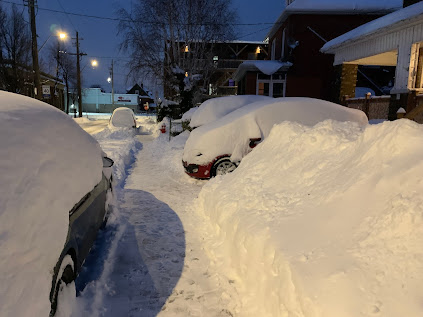
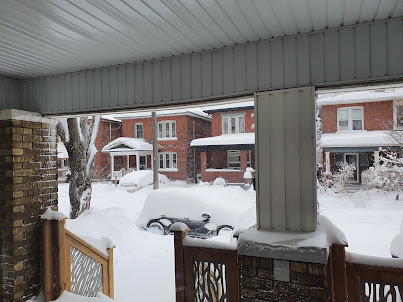
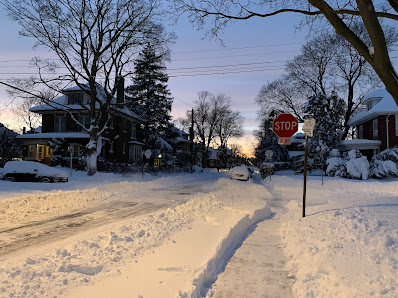
A few weeks ago Ontario received a massive snowfall. Several cities, including Toronto and Ottawa, woke up to a minimum of 30-40cm. It shut down major roadways and forced a snow day on the first day school classes were supposed to return to being in person. 

So why all the fuss about snow? The last time I wrote about snow, I was complaining about the injustice of snow on sidewalks for folks living with disabilities. 


Shared snow shoveling in a neighbourhood


This time I wanted to write about how snow, much like other collective weather events, has the potential to bring us together. When I woke up the day of the snowfall I couldn’t wait to get outside and start shovelling (remember it had been a while). 

But what I found amazing was how quickly the neighbourhood came out to join. I met many of my neighbours for the first time. We laughed as we tried to dig out our cars. A few local residents helped older folks to shovel out their driveways and sidewalks. It became a whole day affair. People stopped and chatted and planned who/where else needed some help. When some people ran out of steam, others took over until the neighbourhood was walkable again. 


A PARADISE BUILT IN HELL

This quickly reminded me of an oft-quoted book on this site – A Paradise Built in Hell by Rebecca Solnit. She suggests that when we face exceptional events like extreme weather or disaster, it often creates a sense of connection and unity - something we have all been missing lately.  

While not all extreme weather events may trigger long term social cohesion, there are those that do. You may recall it was the aftermath of Hurricane Katrina that led to our involvement in the New Orleans, Hollygrove livability project. Back in 2010 and 2011, this site posted blogs on how Hollygrove resident teams removed blighted homes, how they launched a flurry of targeted revitalization projects, including a seniors walking group and a decade-long community farm, and how they ended up cutting crime 78%. 


Sidewalk snow shovelling often require neighbourly cooperation 


These small, but significant, moments are part of the tapestry that make great neighbourhoods. Residents take an opportunity to help one another and gain connection in the process. They get a better sense of who lives nearby and what kinds of support they might need. They are also more likely to talk to each other when issues like community safety emerge and decide to do something about it. 

Maybe this is why I like snow so much. 


Tuesday, January 25, 2022

My shadow's the only one - an epidemic of loneliness

"My shadow's the only one that walks beside me"
- Lyrics by Green Day

by Gregory Saville

The opening lyrics of The Boulevard of Broken Dreams disclose: “My shadow’s the only one that walks beside me…My shallow heart’s the only things that’s beating”. 

As we wallow in our current cult of self-care and self-healing, I remember that twenty-two years ago Robert Putnam published his book Bowling Alone about the collapse of traditional community and the rise of loneliness. And here we are, decades later, about to emerge from a Pandemic into an epidemic of loneliness! We drive our cars alone! Ride the transit alone. Walk through crowded spaces, still feeling alone. We can feel alone in social gatherings and in a marriage. 

We have all felt the pain, at one time or another, of that kind of loneliness. It is truly a terrible thing.

Research suggests over 40% of our population often feels alone, which is not at all the same as seeking solitude or being alone. Loneliness is insidious! It is harmful to our mental health and it poses a significant public health risk to everyone. Scientific studies also correlate loneliness to higher levels of violence.


Even colorful urban design can trigger loneliness

RISK FACTORS 

It is the condition of our communities that matters most when it comes to preventing loneliness. When we house people alone in single flats, in alienating nursing homes, or fail to provide opportunities for social gatherings, we build the foundation on which loneliness rests. It arises when people live alone, have no intimate partnerships and few friends, or suffer strained relationships. 

None of those things are easily fixed, but all of them can be prevented.

Mateja has blogged about the Happy-to-Chat benches in Helsingborg, Sweden and also about speaking to strangers on transit. Tarah has written about the importance of Third Places to create opportunities for connection. She’s written about how the best form of self-care is to care for others


LONELINESS IS A TERRIBLE DISEASE

I too have written about the damage loneliness can do to our health (lonely people get sicker sooner and have higher mortality rates), all of which is backed up by behavioral science.


Simple axioms for fighting loneliness offer hints
 

A decade ago I blogged about the well-known Roseto Effect  – the town in Pennsylvania where residents experienced a powerfully strong sense of community with a huge circle of supportive family and friends. That in turn had a role in reducing stress, mitigating isolation, and cutting loneliness. Roseto had among the highest health rates and the lowest mortality in the nation. 

Intimate connectedness and social support networks – those are the assets of great neighborhoods. If we are not creating neighborhoods, places, and relationships that eliminate loneliness, then what the hell are we doing?


Tuesday, January 18, 2022

Self-governing urban open spaces

The creativity of an urban open space - Pixlapiren

by Mateja Mihinjac

During my work travels over the past years, I have found – often by accident – many interesting places with an alternative local subculture. These places always intrigued me to learn more about how they emerged and who manages them to keep them alive and flourishing.


PIXLAPIREN, SWEDEN

I recently discovered one such place by the pier in Helsingborg, Sweden. Pixlapiren is a meeting place intended for everyone to visit and explore, and for local residents, organisations and groups to create. People have opportunities to meet, initiate and share ideas and form place identities to strengthen local democracy and challenge segregation problems. 


Learning to garden in Pixlapiren


They can also obtain a pixel (a development space measuring 10 x 10 metres) to create and display their creative outputs. Other activities occurring at this place include street art festivals, community gardening, skateboarding, beach volley, swimming, water skiing, various festivals and workshops. 

Pixlapiren is an example of urban commons, a form of self-governance that was originally established by the local government as part of the urban renewal project with the purpose of exploring new forms of co-development. The space is now self-governed by users, NGOs and non-government actors that manage and steer the resources while the municipality acts as a facilitator. In the process, governance changed from open co-governance to self-governance. 


METELKOVA, SLOVENIA

The second example of a self-governing space, the Metelkova City Autonomous Cultural Centre, is in Ljubljana, Slovenia.

“Metelkova” is an autonomous social and cultural centre that since the early 1990s occupies the space of the old military headquarters. It started as informal commons with the tension between squatters occupying the space and the municipality. At one point, it was even declared illegal. 


Art installation in Metelkova, Slovenia


The space remains contentious due to non-compliance with the building codes and urban planning regulations. However, due to its extensive contribution to cultural activity in the city and its attractiveness for tourists, the municipality is now also linked to the site through its institutional actors. It capitalises on recognition of this space as a tourist attraction as well as a national cultural heritage status that was awarded to Metelkova in 2005. 

Today, Metelkova is a self-governed and self-managed community that receives European cultural funds. It has become a home to many artists and creatives, a place of art exhibitions, art installations, festivals, concerts, performances and clubs. LGBT associations and NGOs now also hold offices in the space. While independent, connections with many institutions and organisations, and its cultural and tourist prominence have solidified its position in the city.


Metelkova also hosts Hostel Celica, with renovated rooms from former prison cells


URBAN OPEN SPACES

The literature on urban open spaces teaches us about the prominence of these spaces as a “vital element of the urban matrix”. From SafeGrowth we also know how important they are for the social sustainability and the cultural character of the neighbourhood.

Pixlapiren and Metelkova add an important social, cultural and tourist character to their respective cities and are based on collective movement and self-governance. 


Seaside seating on recycled materials in Pixelapiren


While the journeys of these two places started somewhat differently (the first one was initiated by the city government while the second started as an illegal occupation), the evolution of such spaces in the years ahead teaches us about the importance of government/non-government/civic society partnerships. The success of these spaces also speaks to the importance of the community that manages the space and assumes self-governance. 

Urban commons strengthen local democracy and they offer a great opportunity for local governments to involve people in local decision making. That is an excellent way to prevent tensions that might arise from unwanted activity in those spaces. Urban commons like these provide local governments with a way to leverage social sustainability and cultural character into neighbourhoods of the future.