NOTE: This week my colleague Gerard Cleveland from Perth, Australia and I share this blog about drones. Gerry is an attorney, a specialist in school violence, and the co-founder of the concept called 2nd Generation CPTED.
Drones will change our lives as much as COVID-19 and the internet. The possibilities for future generations are endless. Kids today say ‘what is dial up’? In ten years they will ask ‘what’s a fire truck’? We certainly hope so.
We have nothing against firefighters - our point is about technological revolutions and the future.
Consider that much of our current urban landscape with its ugly suburbs and huge roadways are built for, among other things, the passage of fire trucks. If we don’t need the space for those huge trucks and ladders, we may just be able to realize Jane Jacobs' dream of town planners and architects designing and building more interactive, less segmented living spaces.
Once we get design of our communities out of the hands of the pragmatists with no vision, we may start building liveable spaces that we want rather than accommodating the transport needs of emergency services.
FIRE DRONES IN THE FUTURE
Over the years, visions of a different kind of city made appearances in this blog: Arcosante, the Aerotropolis, and the Smart City. This latest drone innovation tested in China and some other countries fits into the Smart City vision. It is, after all, pretty smart to adapt drones for dangerous duties.
Fire drones are only one possible way new technologies might transform how we design cities. For example, the SafeGrowth Network is currently working with colleagues in Helsingborg, Sweden to introduce crime prevention innovations at the Helsingborg 22 Smart City Exposition in two years.
In the meantime, after we eliminate fire trucks, and save a squillion or so on fire suppression, maybe someone out there can also design colour blind community protector robocops to patrol the streets?
Topaz Park homeless encampment, Victoria BC
- Photo courtesty of Victoria Buzz
by Jon Munn
GUEST BLOG – This week’s blog tells a story of how COVID-19 affects the homeless, just as it does communities around the world. The blog was submitted by Jon Munn, an urban planner and SafeGrowth Advocate residing in Victoria, British Columbia. Jon is directly involved in the crisis as a member of a local neighborhood action committee. This is his story about how one city is responding to that problem.
COVID-19 has revealed long-standing weaknesses in our health and social systems. The least resilient long-term care homes are showing high death counts. Physical distancing in homeless shelters and couch surfing reveals how huge spaces are needed when health orders force marginalized people to spread out in convention centres, hockey arenas, parking lots, and playing fields.
Homelessness is tough to tackle because it’s not one issue. It’s a result of housing costs, lack of social housing, domestic abuse, mental illness, drug addiction, and so on. The easy thing to do is to combine all these issues into one hot potato and pass the potato.
COVID-19 restrictions came to British Columbia on March 17, 2020. The Provincial Health Officer made an order to prohibit gatherings over 50 people. The next day a provincial emergency was declared and local governments and agencies closed or restricted services to ensure a physical distance of 2 metres (6 feet) between people.
Provincial parliament in Victoria, the capital of British Columbia
photo Joe Mabel, Creative Commons
Victoria, a city of 90,000 people in the Capital region of 350,000, is the location of most regional services for homeless people. At the start of the crisis, hundreds of shelter spaces in the city were almost emptied, so on March 23rd, the Victoria Mayor announced outdoor shelters (tent camping) in three parks. Due to limited ability to staff the parks, Topaz Park near Victoria’s northern boundary remained the only site.
Topaz Park behind fencing
THE FIRST VICTIM
The first victim was communication. Perhaps the mayor felt she was pressured into a decide-announce-defend position by the health authorities? The police chief got stuck in the middle as an emergency spokesperson. If homelessness was a regional issue, there was a deafening silence from neighbouring municipalities. Topaz Park neighbours were not involved or notified. Whose agenda was being served by punting the homeless hot potato north? The wealthier city residents to the south? The downtown business community? Was this a plan the mayor had all along?
The provincial health order had commitments to help vulnerable populations, but there was no plan in place to move people into the many vacant hotel rooms in this tourist city. Authorities knew they needed a safety plan or risk a repeat of a 2015 homeless protest and police actions. This time Victorians generously donated tents for the first of two encampments. Tents emerged two kilometers north at Topaz Park shortly after. In effect, there were now two hot potatoes.
Some of the homeless tents prior to relocation
COMMUNITY INVOLVEMENT AND OVERDOSE DEATHS
In the communication vacuum, neighbourhood activists emerged at the nearby Quadra Village Community Centre. The Board at the Centre and its neighbourhood action committee (NAC) wanted to know how to deal with what could be a permanent crime-ridden tent city in their park – one of the city’s largest. Alternatively, could better solutions be found? The federal and provincial governments were offering up money and their hands were forced to act by physical distancing.
I got involved with the NAC for my expertise in community and land use planning. The NAC needed to know how decisions were being made and if there was any way to influence the course of events, so we decided to try and break down some communication silos.
The first ally was the police chief, who was willing to attend a community Zoom meeting on April 9th. The chief brought camp organizers from the nonprofit Coalition to End Homelessness. The meeting revealed the initiative was understaffed and barely able to get sanitary and camp areas organized. Community members said they expected more. The overdose deaths of four people in the Topaz Park camp was discussed widely, as were police reports of increased property crime near the park. The situation got more media attention.
Security at one of the Topaz Park entrances
NAC members volunteered at Topaz Park and found that an assessment of the campers' needs was already done. It wasn’t complete, but work was underway to look at individuals’ needs instead of moving people in one group as ‘campers.’ Specific hotels or other locations could then be staffed with people to address mental health, drug addiction or other needs. Without such supports, the game of hot potato would return.
On Saturday, April 25, a press conference was called and a new provincial COVID order was made by Provincial authorities. The order moved homeless people into hotel rooms or other shelters by May 9, 2020, and camp areas would be cleared. In all locations, local government resources were too poor to effect change.
A second Quadra Village-Topaz Park community zoom meeting was held on April 29, 2020. Over half of the 67 registrants didn’t attend, perhaps believing the provincial actions would address the concerns. Provincial Housing and health officials, as well as local police attending the meeting, did not instill complete confidence, but they came with deeper pockets and a transition plan for campers.
ROOTS OF HOPE
The two reasons to have faith in the COVID homeless relocation come from previous commitments by the federal and provincial governments.
First, in 2016, the government of Canada gave support to a health-based harm reduction and Housing First approach to create an environment for stabilizing homeless people who were also involved with drug use.
Second, in 2017 BC Housing announced the Rapid Response to Homelessness (including modular housing) as an immediate response to the growing issue of homelessness across the Province. The magic of modular housing was that it could be constructed quickly, some projects in as little as three months.
Some homeless will relocate temporarily to the Victoria hockey arena
Photo J. Newall, Creative Commons
One key question remains about Victoria’s Topaz Park: Will we have faith in the system, or will we be looking at fields of mud and used needles by the time the winter rains return?
Part of this story will unfold by May 20, 2020. Only one modular housing project, now in development, has been slated for the Victoria region. A long term issue will be to secure land for modular and other Housing First units, which is a difficult task in a region with low land supply and high costs.
Has COVID helped spur more comprehensive action on the complex issues of homelessness in Victoria? Will economic, social, or political snags trip it up? Stay tuned… these are strange times!
It has been over a month since the world went into lockdown and we were all told to #stayhome. Much has changed since then. As we have noted in previous blogs, the world has pulled together to stop the spread of the virus and protect our most vulnerable. We are also witnessing irresponsible leadership and divisive politics. It has been a trying time and while many of us are beginning to adapt to this new normal, there are still many who are out on the frontlines of the pandemic risking their lives.
Much has changed in our communities as well. In conversations with other criminologists over the last few weeks, I have heard how crime trends are changing around the world. As people move inside and away from the public realm, the nature of crime opportunities is also changing. While these data are still preliminary, some researchers are finding early declines in burglary and theft, while others are warning of dramatic increases in domestic violence.
Indeed, the city of Vancouver has not been immune to these shifts. Commercial burglary has increased dramatically compared to previous years. This is unsurprising to many readers as there is no longer the watchful eyes of owners and employees, and natural surveillance is obsolete.
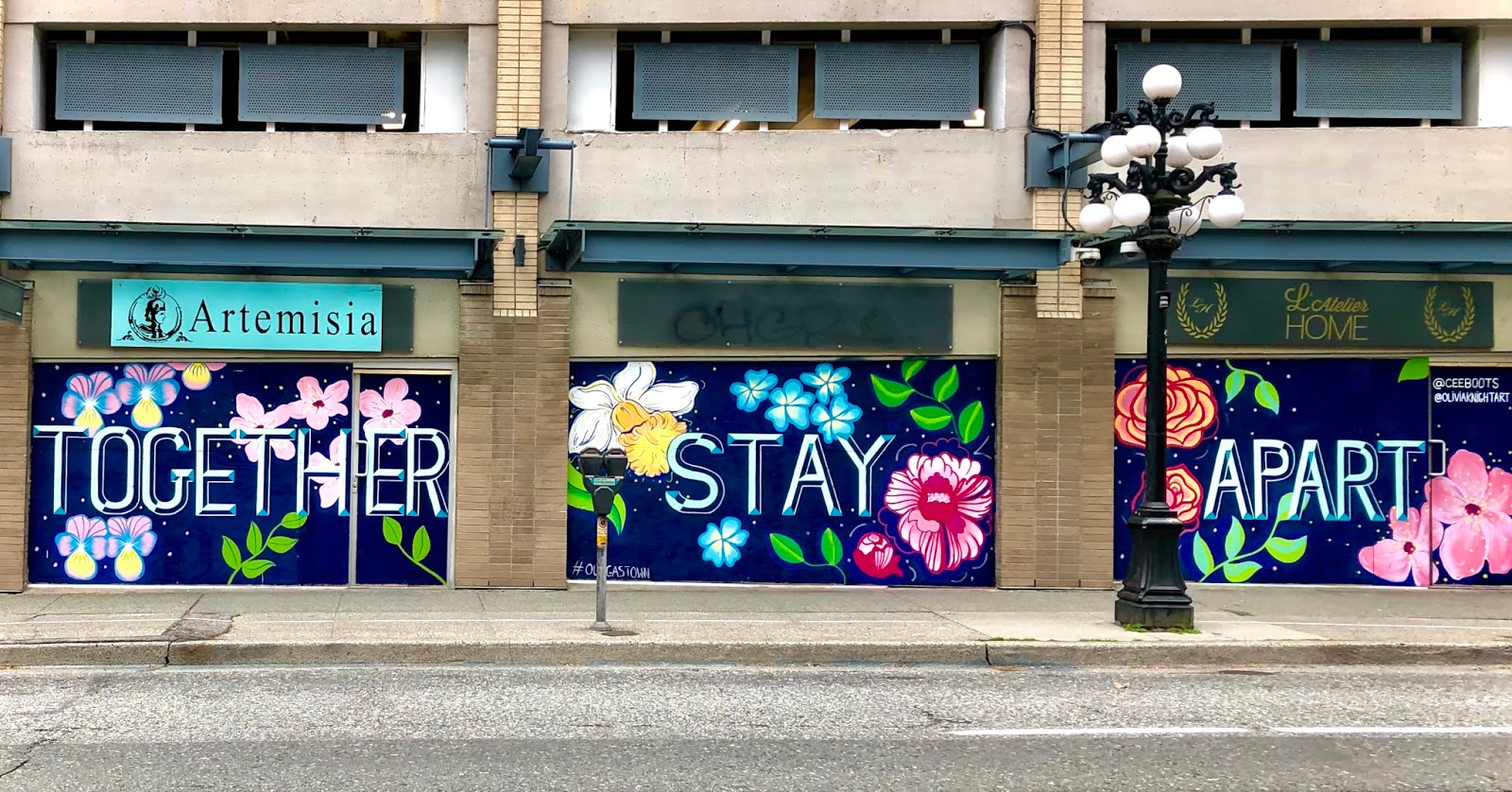
Many business owners in Vancouver’s Gastown neighbourhood have taken to boarding up their windows as an interim target-hardening measure. However, for those who have spent any time in communities where the downtown is failing and businesses are boarded up, you know this can be a very depressing sight.
One of these Vancouver businesses was less than satisfied with the dreary look of the boards. Local business, Kimsprints, reached out for local artists to paint a mural on the boarded-up shop. The artwork couldn’t be about just anything. It had to celebrate the frontline workers and their incredible efforts to respond to the COVID-19 crisis. Soon after, murals of Dr. Theresa Tam, Canada’s public health officer, and Dr. Bonnie Henry, British Columbia’s health officer were painted over the boards.
The trend continues with several more painted boards, paying tribute to those assisting during the crisis and brightening the appearance of a community in lockdown. While the crisis continues, these beautiful pieces of community art remind us that not only do we need to support our frontline workers – including demanding worker protections and appropriate pay – but we also should remain resilient and connected rather than divided.
Tokyo at night. Will future cities look like this?
Photo by Wiki Commons
by Gregory Saville
The local kids were out again after sunset tonight howling like timberwolves at a full moon, a show of solidarity for stressed healthcare workers. Millions of apartment dwellers in cities around the world bang pots and pans and now these suburban kids, ancy from weeks of quarantine, perform their own nightly ritual. In the words of John Lennon: “Imagine all the people, living for today.”
I have wondered of late how pandemics affect urbanization. Jane Jacobs tells us epidemics are defeated within cities and with new medicines, innovative planning, and science. But, as we’ve blogged over the past month, we are threatened not only with a deadly disease, but with an aftermath of social distancing, social isolation, and a future that is gated for some, exclusive for others. Fear is a powerful motivator for change. How can we make things right?
A NEW NARRATIVE
We should not be running away from urban areas into isolated rural enclaves. Some say we need to re-suburbanize and separate – permanent social distancing. They ignore our basic human nature to connect – to howl at the moon in gratitude for others.
Some claim density spreads disease, a statement that confuses density with crowding. High-quality urban design promotes connectedness and avoids crowding; Low density is not the answer.
Population density is different from crowding
Consider Taiwan and Louisiana. Population dense Taiwan, with 23 Million residents has (at time of writing) 380 confirmed COVID infections and 5 deaths. The rural state of Louisiana with 4.6 Million, suffers a horrific 20,014 infected and 801 deaths.
Taiwan no doubt has a better public health system. It probably has better governance. It has the luck of island geography (although the Philippines infection rate suggests otherwise). Perhaps they should have cancelled Mardi Gras in late February? Yet, none of those things are about density.
One thing is certain: A cohesive, well-informed and networked community like Taiwan moved much faster to curtail COVID-19. If you recreate that cohesiveness, education, and networking at the level of the neighborhood, you create a city of networked urban villages. We wrote about a city of networked urban villages in SafeGrowth: Building Neighborhoods of Safety and Livability.
Neighborhoods will look different
STEPS FORWARD
What steps do we take to get there? With so much infrastructure already in place, how do we modify cities to create something healthier, more livable and more pro-social? Remember, there are elections all over the world later this year. What should you demand for your candidates? How about demanding they start working on the following steps:
City politicians– Stop approving low-density commercial “strips” where it is difficult to walk from one shop to another. Sprawl forces residents drive to distant shopping plazas and it separates them. When the pandemic fades, we won’t need more separation! We cannot learn neighbor skills if we cannot find our neighbors. Try clustering developments into common areas where ‘strangers’ can become friends, what architect Ross Chapin calls Pocket Neighborhoods.
And for goodness sake, put pro-social urban design ahead of new expressways and road widening.
Architects – Stop building multi-family developments without involving the users. Conduct design sessions to give everyone a say before construction begins. If you want people to truly care about their neighborhood, let them share their dreams and aspirations. And stop building such ugly townhomes. In SafeGrowth we conduct search conferences to create shared community visions. How about asking residents what best fits their lifestyle? Would they prefer a community woodwork shop or a workspace for crafters? What about a co-working office?
Crowding in Denver multi-family townhomes. We can do better!
City leaders – Stop fighting Smart Growth development policies because you think fewer property tax dollars accrue. You do not have to reinvent the development wheel to do something different, just attend a Smart Growth conference or read some books on the topic. Try Charles Montgomery’s book Happy City: Transforming Our Lives Through Urban Design.
Bankers– Stop making it so difficult to lend to Mom-and-Pop stores. They are the blood pulsing through community life. Local stores cannot match the conglomerates for prices, yet they support local families and they better respond to local needs, like sponsoring community barbeques or craft markets in front of their stores. They need your help to reduce costs and remain a vibrant part of neighborhood life!
Mortgage lenders – Change your lending practices and encourage collaborative housing – a form of community-building that helps citizens work together, especially during crises like pandemics. One example is private equity co-housing, a proven form of neighborhood living in which residents create their neighborhoods. Unfortunately, speculation and inflation have shut down too many cohousing projects. Lenders – You can help!
Transportation managers – Stop wasting fossil fuel by sending huge, empty buses from one vacant bus stop to another. People avoid buses because they are inconvenient, unpleasant, and take forever. Any new, healthy configuration for a city should be designed around networked urban villages and they will need radical innovations to bind them together. Uber figured how to use the internet to transform cab service. Why can’t we do this with public transit? How about supplementing regular routes with smaller, comfortable, shuttles-on-demand, ordered online and paid by e-commerce? And smaller shuttles for regular routes too!
Educators and school trustees – Get your students into the community. Get them to learn history, social science, geography, and science by learning how to work with residents on real community problems. The problem-based learning movement does that and it is already in many high schools. They will learn face-to-face social skills they cannot learn on troll-infected social media. Educator and thought-leader Gerard Cleveland is a guru in this movement.
Organizers/social workers – While residents socialize superficially, after decades of computer screens and social media they have lost the deeper skills of managing conflicts and solving problems together. They desperately need shared communication and problem-solving skills. Please, help! For example, look up our friend Evelyn Zellerer who teaches peace circles and restorative justice.
Nihilists, doom-and-gloomers– Stop fearmongering! Yes, we will suffer but this pandemic will end. There might be a paroxysm of political rage, maybe economic turbulence. And as before the pandemic, we still must reverse our environmental damage before we reach criticality. Despite it all, people are not inherently evil and progress is already underway. If you doubt that, read Steven Pinker’s Enlightenment Now: The Case for Reason, Science, Humanism and Progress.
Inexorably, in fits and starts, we will build a better future.
Responding to our global COVID-19 pandemic, New York sociologist Eric Klinenberg recently wrote that social distancing will lead to, not only an economic recession but also to a future changed in unexpected ways.
Perhaps! But only gravestone epitaphs are written in stone and I choose to write my own future, which brings me to New York.
New York is the city where Jane Jacobs wrote about the power of social networks in her famous book Death and Life of Great American Cities, a book that launched the CPTED movement. She wrote that we keep the peace on our streets through an “intricate almost unconscious network of voluntary controls and standards among the people themselves.” In other words – us!
Pandemic realities - Abundance of safety lighting...absence of people
Strange advice coming from New York, the city with apartment towers far above urban parks, strangers yelling and car horns blaring! The endless rush hour! And today New York is the epicenter of the American COVID-19 pandemic, a city where thousands have already died in a country that leads the world’s infection rate.
Yet, despite it all, this YouTube showed up from New York City:
And it’s not only New York! This spontaneous flash of solidarity with health care workers has become a social epidemic of goodwill all over the world. It’s now in Italy, Germany, India, Israel, and in cities all across the Americas, from Sao Paulo, Brazil to Vancouver, Canada. Applauding with abandon – usually, around shift change at hospitals – New Yorkers join millions of others around the globe to cheer healthcare workers with pots, pans, whistles, hands, and anything else they can find.
This reaffirms the reality of Jacobs’ intricate, unconscious social network. Despite food hoarding, panic purchases, and obnoxious herd behavior, people eventually figure out that they depend on the social connections of everyday life to survive.
PUBLIC HOUSING AND CRIME
Never was this yearning for connection more evident than during our SafeGrowth work in New York City over the past two years. Members of our SafeGrowth team worked with the New York Mayor’s Office of Criminal Justice to teach CPTED to residents, including how to set up plans to improve life in their apartment towers. No small feat considering this public housing had some of the highest crime rates in the city.
Impressively, people pulled together in this biggest of cities, in places with so-called intractable crime rates, and they began to cut crime and improve safety. They created plans and they implemented many of their ideas because they knew they depend on social connections to survive everyday life. It was like Jane’s spirit hovered over the city that she once called home, a place where the velocity of daily living speeds past the average person at breakneck speed, as she whispered the ghostly incantation: “Pay attention to each other! Care for each other!”
Social distancing in New York City parks
As we face the new COVID-19 reality, the lesson is clear: We can create inclusive neighborhoods from far and wide, suburban and rural, rich and poor. We know how to build pro-social urban designs and places of connection and resilience. Perhaps Klinenberg was right; COVID-19 will change our future in unexpected ways. Still, more importantly, it is us who will shape what that future looks like!
URBAN REFORM
For years, SafeGrowth Advocates (and many others) have fought against the retreat from public life, the withdrawal from the discomfort of strangers, and the overwhelming fear of violence by too many of our fellow citizens. In her blog last week, Mateja reminds us that we must battle both the physical and the social virus. Similarly, a few weeks ago, Tarah blogged that there is a big difference between social isolation and social distancing.
Social isolation and abandoned street - blight is not far behind
If we cling to social distancing and isolation in our public life after COVID-19, we will leave very little humane life to retain our humanity. The social is, after all, what makes society. Even the Council on Foreign Relations knows this truth – the future of global health is urban health.
William Fulton, planner and former Ventura city mayor, recently blogged that the post-pandemic city will lead to “an increase in remote work arrangements which will lead to more activity in neighborhoods, more flexibility in public transit options and a renewed appreciation for taking a walk.”
If that is the future we want then we need practical methods to deliver services where people can stay safe and healthy in their neighborhood. We need places where residents know each other and where they feel comfortable walking, day or night, and where they do not have to drive for food, medical care, and recreation.
THE UNCONSCIOUS NETWORK
Millions of strangers all over the world do not spontaneously bang pans and cheer outside their windows because they want isolation from their neighbors. They do it because they yearn to express their emotions in a safe public place in a way they can see and hear their neighbors doing the same. Even with a raging pandemic, they share a common realization that we all – healthcare workers, doctors, food delivery people, everyday neighbors, and police – need each other.
It’s the unconscious network in action.
How will cities evolve following the pandemic? Some claim cities will isolate, gate up, and separate. They say technology will prevail to protect us! But, in truth, we shall not find salvation in seldom-monitored CCTV systems or in the socially-hollow gated community. As King Lear says, that way madness lies!
NEXT BLOG: What can we do to create different, healthy, and safer places? There is another way!
It feels as if overnight our lives have dramatically changed. People getting sick and dying by thousands, hospitals inundated with an influx of patients, the economy heading into recession, and countries in lockdown. There is much uncertainty about what the future months will bring.
At a time when our solidarity should be at its highest, reports show how criminals (and some politicians) are exploiting people’s fear and how crises like these “bring out the worst in humanity”. Despite these bleak times, we cannot let COVID-19 also become a social virus. We need to start building resilience now so that we can tackle the challenges that lie ahead.
Quarantines and empty playgrounds
YOU
In the previous blog, Tarah wrote about the importance of maintaining social connections while we physically distance ourselves from our loved ones. Our positive personal relationships keep us grounded.
Luckily, with today’s technology maintaining social connections is easier than ever. And new social innovations are arising to help us connect, such as the Canadian caremonger movement.
YOUR FAMILY
As family members are trapped in their homes, many find it difficult to cope and maintain peace. Children and youth who lack peer support and school connections, due to social distancing, rely more than ever on their parents to provide support and reassurance.
This brought back personal memories of the 1991 Slovenian Independence War when my family had to shelter from potential bombing in a 2 x 2 metre basement space. As a young child, I did not grasp the severity of the situation as warplanes flew over us. To make it easier on my brother and me our parents made the hours of basement hiding appear like a game. As a result, my memory from then is that of closeness and safety.
We seek connections in families and in groups
For children, the quality time they spend with their parents during these weeks might define whether they remember grief and trauma in the years to come or a sense of care and safety from which they can build resilience. The family bonds they develop during this time represent a critical point in the life of children that can protect against potential future anti-social behaviour and criminality.
YOUR NEIGHBOURHOOD
Our neighbourhoods are our tribe. A socially cohesive neighbourhood is resilient and able to rebound and restore quicker than a neighbourhood with alienated residents when confronted with hardship. We have published our account of how SafeGrowth provided collective action and neighbourhood resilience in a post-disaster New Orleans following Hurricane Katrina.
Some of our post-hurricane community building in New Orleans
As Tarah mentioned in the last blog, the current social distancing restrictions are in stark contrast with the SafeGrowth philosophy. But we can still continue to greet local residents with a smile as we pass them (from the appropriate distance), we can talk to our neighbours and check on their wellbeing, and thank our local business and services for their work in supporting us. We can start planning local events and meetings, and set common goals to work towards as we restore our neighbourhoods post-crisis. We can activate our tribe and prepare for collective action now.
Activating our tribe - Outdoor events will return
MOVING FORWARD
In the next blog, Greg will describe practical ways we can move forward into the future following COVID-19. As life starts to normalize in the coming months, we will slowly start rebuilding our lives. It won’t be easy. We will continue being cautious about physical interactions, travel restrictions will likely still be in place, unemployment and homelessness will be high, businesses will go bankrupt, and many of us will grieve for loved ones lost to the pandemic.
Despite the promises of a job stimulus and financial assistance, governments won’t have the resources and capacity to help everyone, every family and every neighbourhood. But there are things we can do to plan for the future.
We cannot let COVID-19 become a social virus. Our shared global experience will change us collectively. Our hope at the SafeGrowth Network is that we realise how interdependent we are and how important it is that we build resilience not only within our family and friendship networks, but within our neighbourhoods where we spend our lives.