Sunday, October 28, 2018

Access to food - Justice in the city

Community gardens in New York public housing - responding to food deserts

by Mateja Mihinjac

When a neighborhood team at our recent SafeGrowth workshop decided to tackle the issue of food access, the topic sparked my interest. As they uncovered the links between food access and food deserts, the conversation quickly shifted toward injustice and social disadvantage and what could be done about it.

UNDERLYING ISSUES

It isn’t that municipalities ignore food access. Decision makers have been attempting to address the issues of food deserts and food swamps by introducing new supermarkets into needy neighborhoods. However, simply installing a new supermarket in a deprived neighborhood will not solve inequality. Food access has historic roots in structural racism, segregation and concentration of poverty in pockets around cities, not surprisingly the same neighborhoods where crime flourishes. These are the sparks that ignited the food justice movement.

Detroit church replacing parking lots with gardens 

Activist and community leader Karen Washington talks about food apartheid in African American neighborhoods as a symbol of the inequality that has led to numerous social problems and limited access to affordable and nutritious foods.

The consequences manifest in reduced levels of both physiological and psychological health, so frequently prevalent among the socially disadvantaged. Many of these disadvantaged neighborhoods also suffer from disproportionately high levels of crime and weak social cohesion.

CRIME AND FEAR

There are well-established correlations between violent crime and socio-economic inequality. For example, research from New York City shows that neighborhoods in the city with the lowest median household income have the highest numbers of food deserts. Unsurprisingly, these neighborhoods persistently suffer from higher levels of crime than other more affluent neighborhoods.

Ottawa apartment towers overlook new public gardens

To the residents on the ground the consequences are dire. As they navigate through high-risk streets – for example, when they get groceries – they are vulnerable to crime. The elderly, especially, are fearful of gang violence simply by walking or using public transportation. To worsen their fears, when they travel to outside neighborhoods they tend to experience discriminatory attitudes and harassment.

As a result, residents end up spending their meager earnings by having groceries delivered despite the additional expense. Too often they must rely on cheaper processed (and less healthy) food options near their neighborhood.

Rooftop gardens in New York - using all available space  

New shop owners are also less likely to invest in these food inaccessible neighborhoods because they don’t consider it economically viable. Not only must they factor the reduced buying power of residents, but they must balance their resources with safety risks and the effects of fear from crime. All too often, these factors do not pass the cost-benefit test of food corporations, thus leaving too many city residents out of the equity equation.

Next blog: Some solutions for a lasting change.

Saturday, October 6, 2018

Big Apple Rot - New York's Street Scaffolds

Sidewalk scaffolding at night in New York
by Tarah Hodgkinson 

Strolling down the streets of New York is always awe-inspiring. The buildings are beautiful and the streets are alive with the bustle of a city that never sleeps. But in the last few visits to New York I have had a hard time looking up at the buildings in Manhattan. Shielding my view, block after block, are scaffolds on building fronts covering sidewalks. These scaffolds cover sidewalks and make it difficult to walk through the already crowded streets.

It turns out I wasn’t the only one concerned as I found numerous articles about the issue. I also found that due to numerous accidents related to falling building facades and bricks from New York’s aging buildings, the city enacted Local Law 11, requiring an engineering brickwork check on building facades every five years.

Over 7,700 building scaffolds cover New York City sidewalks

Since New York is an older metropolis, it makes sense that the city does not want people getting injured from falling debris. But is it possible that everyone is checking their brickwork at the same time? There had to be more to it.


One NYC Buildings Dept map shows over 7,700 scaffold sheds

THE IMPACT OF LAW 11

It turns out it costs roughly $25,000 to put up the scaffolding to do the appropriate work on a building façade. However, half of that cost is paid to put that scaffolding up, and the other half is paid when taking it down. Reports indicated that many building owners were simply avoiding the teardown costs and retaining the scaffolding as a permanent protection against liability.

Perhaps this pricing model is part of the reason for all the scaffolding. If you have to pay to have it taken down, why bother?

I would argue there are a few reasons to take it down. It impedes pedestrian traffic and it’s difficult to navigate if you have mobility issues (imagine trying to get around these with a wheelchair). The excessive scaffolding also reduces street visibility, requires extra lighting (and higher energy costs) to enhance visibility at night and takes away from the historic beauty of New York City.

There must be a better way to protect pedestrians

Why not rewrite city policy and instead create an incentive system to take down the scaffolding? What if property owners paid $30,000 to put the scaffolding up, but received $5,000 when it was taken down? I have no idea if this fits into the current payment scheme, but it seems this change would trigger more demand to remove all that unnecessary scaffolding.

While it may not address the sheer number of buildings that require these five-year checks, it would help to restore the Big Apple’s walkability and visibility that is so important for street life and safety.

Friday, September 28, 2018

Small is beautiful - Pastor Barry and Islandview


GoogleEarth view of the Episcopal Church and Detroit's Islandview neighborhood

by Gregory Saville

With 267 murders last year, Detroit has a city population of 700,000 and murder rate 8 times the national average. It suffers a decimated tax base and in 2013, the largest city bankruptcy in US history. Naturally, you might associate it with crime, racial inequity, and blight. But would you associate it with urban innovation and rebirth?

With a renaissance of late, a lively downtown Detroit looks far different than a decade ago. And while that transformation is triggered by large, corporate reinvestment, it is the inner and outer suburbs where much of the blight and crime originates. How, I wondered this past week on project work in Detroit, does a neighborhood reinvent itself?

Neighborhood hubs can emerge from local churches
PASTOR BARRY

Then I met Pastor Barry Randolf at his Episcopal Church in the Lower Eastside neighborhood of Islandview. Not only has Islandview begun transformation, but Pastor Barry and his team have grand visions for the years ahead. Our task was to teach the SafeGrowth program in the neighborhood and work with our new friends at the Restorative City initiative.

New initiatives have fertile ground in a place like Islandview thanks, in no small measure, to Pastor Barry. He leads his church with programs like a community garden, a tea manufacturer, T-shirt design company, landscaping company, an employment program, a bike repair shop, mentorship programs, media production workshop, audio/video production, and others.

Community gardening on church property

SPEARHEADING LOCAL LEADERSHIP

Not only does the church provide opportunities for jobs and work, but it also spearheads a community development corporation to build and purchase affordable housing (213 units in the neighborhood thus far). Pastor Barry told me that he and his team locate small numbers of market-rate housing across from well-designed, affordable housing to help stabilize and diversify the neighborhood. They then hire local residents to work with builders and learn the skills of construction. 

With baseball cap and passion, Pastor Barry shows us housing under renovation
sponsored by the church housing corporation

Pastor Barry’s work is widely featured in local media and we were thrilled to offer our SafeGrowth tools to Islandview’s considerable toolkit. For me, the Islandview story illustrates the value of local organization and the power of competent neighborhood planning. As we say in our SafeGrowth Vision Statement, the successful 21st Century city will be based on a linked network of self-governing and self-learning neighborhoods

A few units of nearby affordable housing.
Small diverse pockets of housing can stabilize neighborhoods.
When it comes to designing out crime beyond superficial security strategies, urban development and community-building like this digs at the roots of crime. With apologies to E. F. Schumacher, small truly is beautiful. Thanks, Pastor Barry, for the reminder.

Sunday, September 9, 2018

Gentrification vs the cultural creatives

Doing it right - Denver artists spruce up a local storefront

by Gregory Saville

It was November 22, 2017, and a sidewalk sign just went up outside a Denver coffee shop. It read:  “Happily gentrifying the neighborhood since 2011”. The neighborhood exploded in outrage and the latest Internet meme was born. Realizing his massive gaffe, the owner dumped the sign, apologized, and has suffered a PR disaster ever since.

Gentrification is an ugly word these days. In SafeGrowth we spend much time in troubled places facing reinvestment and redevelopment. What can be done about crime prevention efforts and gentrification?

GENTRIFICATION IS NO JOKE

The cycle is well-known. Older neighborhoods suffering blight and crime turn into run-down wastelands. Groups looking for affordable spaces - artists, students or working class folks - move in and begin to fix them up. They build play areas for kids, bocce ball courts for elders and handball courts for kids, or gazebos in parks for weekend barbeques. Residents patronize local Mom & Pop stores. Artists set up studio lofts and paint interesting murals in alleys and eventually open spaces to showcase their art.

Movie night on the neighborhood basketball court

Richard Florida once described this process glowingly and called such groups Cultural Creatives who end up bringing a new life to old neighborhoods.

Then the new life evolves into a cultural economy that triggers waves of consumer spending, especially by real estate investors looking to capitalize on the “cool factor”. Reinvestment displaces low-income apartments as rents increase to accompany investment.

Ultimately the Creatives are forced out, and the area becomes the latest wealthy, unaffordable hangout for Hipsters.

It is called gentrification and it is the real estate version of hostile architecture. In his latest book Florida no longer speaks so glowingly of the process and now claims Creative Class migration ends up becoming a winner-take-all game that makes things worse.

EXCLUSIONARY DISPLACEMENT

A recent study on gentrification by the Federal Reserve Bank says:
"In its early phases, gentrification may not result in displacement, but over time, in the absence of protections, tenants may be forced to move." 
Pop-up neighborhood bookstore in New York City

The study concludes that gentrification often leads to exclusionary displacement unless careful planning and protections are put in place. Even in places where cities try to protect affordability, some owners install “poor doors” for low-income residents and other doors for the rest (a practice recently outlawed in New York City).

Obviously we must be vigilant. In SafeGrowth our motto “To-For-With-By” proclaims that we work with residents and enact strategies by residents versus to or for them.

In our new SafeGrowth book Mateja Mihinjac describes the SafeGrowth principle called Neighborhood Activation. It shows how we navigate through the gentrification conundrum because, ultimately, all those engaged in crime prevention and urban redevelopment must be careful to do no harm.

Friday, August 31, 2018

Security and beauty - A new kind of fencing

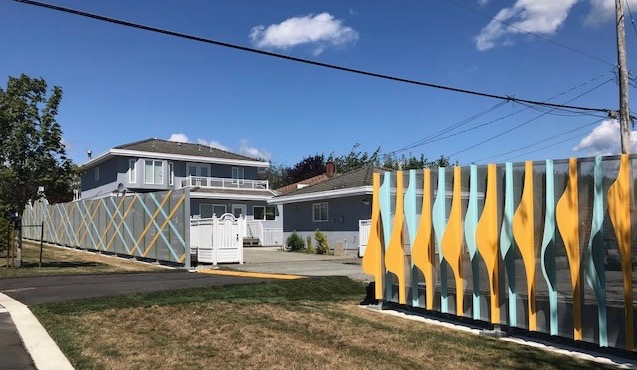
Decorative fencing in British Columbia
by Tarah Hodgkinson

On a recent walk in Burnaby, British Columbia, what was normally an uninteresting and car-dominated street, offered a surprise. As I turned a corner, I was delighted to see a major change since my last visit. The city had built a vertical park! A beautiful walking space including bike lanes, areas to sit, green spaces and artistic architecture.

What was most interesting was the way in which they city had treated the neighboring houses. Along this vertical park, the city had installed decorative visibility fences. Essentially these fences are neither wooden fences with no visibility nor chain-link fences with visibility but a hideous look.

Presenting the street with a more attractive, look
These fences are particularly interesting because they address an important issue for corner homes and homes on edges of land-use changes, in this case, residential to commercial. Homes in these locations are often at increased risk of burglary and vandalism.

Tall wooden fences can simply block the external view of an intruder once they are over the fence, making it easier for these individuals to commit a crime. Additionally, residents cannot see if a threat exists on the other side of the fence. Chain link fencing, however, often gives the impression of “fortress” mentality and can increase feelings of fear, making the neighborhood appear hardened. Chain link fences are also quite easy to climb.

Vibrant colors make a difference
These decorative visibility fences provided visibility to both residents and surrounding eyes. At the same time, they create a beautiful linear space for folks to walk through. They are also difficult to climb.

This vertical park and the accompanying decorative visibility fences are a great example of finding beautiful ways to address privacy and safety in neighborhoods on the edges of commercial use.

Friday, August 24, 2018

What if public art could serve a second purpose?

Public art framing a street artist in Brisbane
GUEST BLOG: SafeGrowth Advocate Anna Brassard recently mentored a high school student about design and safety and encouraged her to submit her project here. Sophia Marchenko is a grade 9 student at Calgary’s Master’s Academy and College. We congratulate Sophia on her exceptional work and welcome her contribution to SafeGrowth. 


by Sophia Marchenko

In grade nine this past year, I had the opportunity to participate in the Professional Initiatives Program at my school, Master’s Academy and College. As part of the program, I was matched with a mentor in a field of my interest and was challenged to create my own research project. I was fortunate to be matched with Anna Brassard, an urban planner. The central question of my research project became “What if public art could serve a second purpose?”

I asked: What if public art could also be a bird sanctuary? A way to improve safety? A crime prevention system? An electric vehicle charging station? A way to generate electricity?

Public art and street furniture in Christchurch, New Zealand container village

I found many examples of public art serving a functional purpose within Calgary and beyond. There were examples in Calgary, such as the public transit bus stops currently being built with art pieces, and artistically designed stormwater filtration systems. I looked into musical swings in Montreal, Quebec, and Chicago’s multimedia Crown Fountain. All of these examples display messages of beauty, culture, environmental stewardship, and community, while serving a practical purpose.

Since my school is located right beside the newly constructed Flander’s Bridge, I’ve seen how reckless drivers can get in that area. There is a plan for a new piece of public art for that area and I wondered whether a piece of public art could contribute artistic elements to the bridge while also helping to slow down traffic and improve safety.

I was put in contact with a transport engineering at the City of Calgary and he described the existing traffic volume is 94,000 vehicles per day at that location, a very large amount of road traffic. There were many schools in the area that have kids crossing Flanders Bridge every day.

Flander's Bridge in Calgary, site of potential public art project - photo City of Calgary


FLANDER'S BRIDGE PROPOSAL 

I decided that my public art would have speed signs incorporated in an artistic way, showing drivers their current speed and encouraging them to slow down. It would also have artistically-integrated solar panels to generate the needed electricity. I liked the idea of using strips of copper for most of the design and having the whole design illuminated with soft light at night.

By the end of my research project, I realized that I had learned a lot about public art and how an artistic element on a key piece of Calgary’s infrastructure could also contribute to a safer environment for both drivers and pedestrians. It was an eye-opening experience to learn from an urban planner, an architect, students at the University of Calgary’s Faculty of Environmental Design, where Anna had years ago taught a SafeGrowth program, as well as planners and engineers from the City of Calgary. Many thanks to my mentor throughout this program, Anna Brassard, for opening my eyes to the field of urban planning.