Saturday, April 30, 2011
The future
 The study of the future
You may have noticed in these blogs my intrigue about the future. I believe thinking about the future is not only entertaining, but it is useful for visioning better forms of social life.
In architecture and planning I've more than once blogged on this:
Organic architecture
The Venus Project
The Rio Olympics
The archology of Arcosante
Project H\
A similar movement exists in policing. It is called the Police Futurists International (PFI)
PFI is an excellent organization in which I briefly participated in the recent past. PFI founder Bill Tafoya, an old friend, has been a pioneer in futures research for awhile. The Police Futures Working group is another leading organization thinking about directions for the future.
Check them out!

Sunday, April 24, 2011
The story of dangling shoes
 Scene from "New York's Hanging Sneakers"
Why do people toss shoes over power and telephone lines?
Urban legend (and one of my own former blogs...oops!) suggests it's to mark illegal drug sale locations or gang activity. Really? I have dangling shoes in my community and yet we have no gang activity and practically no street drug sales.
A terrific new BBC documentary, New York's Hanging Sneakers, aired recently and discovered no clear answer. Drug deal locations are only one of many possible reasons.
A recent article in the Toronto Star followed four cases of dangling shoes and found four different stories - none conclusive.
 In New York, dangling shoe mock-ups are the new urban chic
Cops typically describe dangling shoes and drug sales as urban myth. In the Toronto Star article one Toronto drug cop says, in his experience, the drug explanation is bunk. That's neither scientific nor surprising. Obviously drug dealers would spend only a very short time near their dangling shoe marker and probably depart long before cops figure it out.
To complicate matters, dangling shoes can mean anything from a local fad, a prank, drug activity or the death of a gang member. Snopes.com confirms the multiple explanation theory, a theory that started in 1996 when one writer described 14 different possibilities.
Truth is, it depends. It depends on street culture. It depends on the prevalence of gangs. It depends on bored local youth. Truth is, without a proper CPTED risk assessment, you can only guess. And as we know in prevention, guessing is never a good idea.
Thursday, April 14, 2011
Frank Lloyd Wright's reminder - Beauty Matters
 Inside the Taliesin School of Architecture
I recently visited Taliesin West, famed American architect Frank Lloyd Wright's winter home and school of architecture in Phoenix. It showcases his ideas for using local materials, linking outdoors with indoors and what he called organic architecture. Always interested in shaping buildings for the human experience, Wright's designs probably gave life to our modern demand for human scale streetscapes.
When it comes to urban design, scale is everything. It shows up in my blogs on large-scale planning and the freedom of performance-based zoning. It shows up at the opposite end when the Design Against Crime crowd re-think small-scale items like benches and ATM mats.
Nowhere is the importance of scale more obvious than in the lifelong work of famed American architect Frank Lloyd Wright.
 Irregular and interesting shapes break the monotony of right angles
Wright is an icon. Between 1893 and 1957 his work firmly positioned him atop the American architectural scene. He rebelled against staid European traditions of the previous century and sought to create a brand new American architecture.
Except for one thankfully forgotten book (Broadacre City) he rarely overstepped his skills into large scale planning. There are some cranky critics (like me) who think his clumsy planning ideas in Broadacre City are culpable for the incomprehensible spaghetti-style road shapes and acres of monotonous single-family lots in today's suburbs.
That one leap in scale was a rare blemish in a tapestry of design innovation and pure architectural genius. It's kind of like hearing for the first time Mahatma Gandhi was cruel to his wife in his early years. It doesn't jive with the greater picture of a hero even though it may be true.
Scale, truly, is everything.
If you haven't visited Taliesin West - do so! Wright reminds us why we need beauty in our cities.

Wednesday, April 6, 2011
Forts, Shannon Gilbert, and a serial killer
 |
| Screenshot from news coverage of police investigating serial murders in Long Island beach communities in 2010 |
Sometime during the evening of May 1, 2010, a young woman named Shannon Gilbert, ran away from a house party in a neighborhood of Oak Beach, NY. Later that night, she was stalked by someone in an SUV and ran to another home in that same neighborhood screaming "They're after me".
Since then police looking for Shannon have found the bodies of eight young women nearby, apparent victims of the so-called Craig's List serial killer. Shannon has not been found.
Some reports say Shannon was a prostitute hired to work that night. Others say she was bi-polar and a drug addict. Criminologists tell us high-risk lifestyles are a factor in murder. All those things might be true. Of all the things that matter most, those things don't.
What matters most is Shannon deserved protection from violence and harm. How do we get that protection?
Shannon may have been "on the job", but she wasn't on the street. The Oak Park house Shannon fled was in a gated community.
Since then police looking for Shannon have found the bodies of eight young women nearby, apparent victims of the so-called Craig's List serial killer. Shannon has not been found.
Some reports say Shannon was a prostitute hired to work that night. Others say she was bi-polar and a drug addict. Criminologists tell us high-risk lifestyles are a factor in murder. All those things might be true. Of all the things that matter most, those things don't.
What matters most is Shannon deserved protection from violence and harm. How do we get that protection?
Shannon may have been "on the job", but she wasn't on the street. The Oak Park house Shannon fled was in a gated community.

Gated communities, or master-planned communities, have a notorious history. A decade ago planners Blakely and Snyder claimed 8 million Americans lived in gated communities (GCs).
In Fortress America, they wrote gated residents are "retreating from their neighbors by locking themselves behind security controlled walls, gates and barriers."
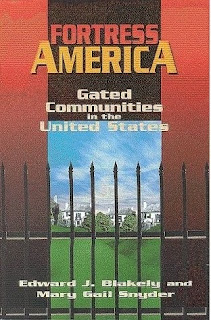
Some GCs sell exclusive enclaves of leisure and prestige. Most sell the promise of neighborhood defense and suburban security.
Research suggests GCs offer no more security, possibly less than well-run, crime prevention programs.
Shannon's story suggests this is true.
A millennia ago Feudal Europe forted up in hundreds of walled, medieval castles. Robin Hood (at least in my childhood imagination) saw forts as protection for those with power and oppression for those without.

Some GCs sell exclusive enclaves of leisure and prestige. Most sell the promise of neighborhood defense and suburban security.
Research suggests GCs offer no more security, possibly less than well-run, crime prevention programs.
Shannon's story suggests this is true.
A millennia ago Feudal Europe forted up in hundreds of walled, medieval castles. Robin Hood (at least in my childhood imagination) saw forts as protection for those with power and oppression for those without.
Back then democracy did not exist. It was also an age that offered up the Black Plague. One hopes we have progressed since then. One wonders.
May Shannon be found safe.
Thursday, March 31, 2011
Magic carpets?
 Privacy mats for ATM safety
Sometimes things come along that are…well, just plain cool.
I've written before about the design against crime movement in the UK. They have shown us how to use inventive ergonomic design to curb bad behavior, reduce loitering on public benches and cut crime at bike racks.
My friend and colleague, UK professor Lorraine Gamman, recently sent photos of her talented colleagues work at the Design Against Crime Research Centre in London. They have come up with a method to cut ID theft (shoulder surfing) and ATM crime through a privacy mat.
It's simple enough. Stick a 3M mat to demarcate territory around ATM machines. Says one article, the mats can "be laid directly onto pavements or the floors of shopping centers. They take just 20 minutes to lay and no planning permission if they unbranded." People are "controlled" through subtle messaging to keep far enough away to protect your PIN and far enough to make it difficult to snatch and run with your cash.
 More on privacy mats in the upcoming issue of CPTED Perspective
It won't stop everyone, but I'm told it seems to work. Why?
The first thing you learn in CPTED is something called proxemics - how people use their own sense of personal space to ensure their privacy. That subtle messaging is precisely what privacy mats accomplish, albeit in a subtle and inexpensive fashion.
I've said before territoriality doesn't happen without social capital.
When it comes to small scale design, it seems I'm wrong.
According to one European ATM security survey, over 85% of respondents indicate privacy spaces help reduce crime at ATMs. Loraine tells me more rigorous evaluation research is underway.
Like I said - simple, cheap and effective.
Cool!
Thursday, March 24, 2011
From desolate to dynamic - northeast Philadelphia
 Scene from Desolate to Dynamic
"If it wasn't for the recreation programs, where would the kids be other than hanging out on the corner, selling drugs?" [Daniel Clark, neighborhood recreational organizer, Philadelphia]
Exactly right, Daniel!
Eastern north Philadelphia is a "community service desert" with few recreation centers or playgrounds. With a quarter million residents, it is less a neighborhood and more a mini-city of rich and poor. For much of it, years of divestment have left few services for kids and families. Handball courts are rare and parks, obsolete. One community worker claims there are 40,000 vacant and blighted properties.
The asset map below shows only 5 community asset hotspots (in black). They are surrounded by large swaths (in grey and white) where few community services exist anywhere within walking distance.
 Asset map showing lack of services
In such a place it can be easy to lose hope. Unsurprisingly crime flourishes in such places.
Last year, as part of a larger neighborhood redevelopment project underway, I worked with LISC and ran a SafeGrowth training. I met remarkable community development workers in the training. They chose field projects to improve the quality and safety of depleted services in northeast Philadelphia, particularly a local handball court.
The LISC Community Safety Initiative website describes what happened next. Click HERE.

Local playgrounds, shown above, were in need of care and repair. This month they released a video describing how their work is turning the desolate to dynamic.
In the video you'll note that the transformation unfolds during a time of stark budgets. According to program officers the city has "a capital-spending program that is barely large enough to maintain existing facilities, much less build new ones."
Still, they find paths forward. If you want to see them, check out their video from Desolate to Dynamic HERE.
The best part of the video was Kiki, listening to this charming young lady and watching her amazing basketball skills.
I've said it before about youth in the city - it's kids like Kiki who will show us the way forward.
Subscribe to:
Posts (Atom)