
Showing posts sorted by relevance for query cctv. Sort by date Show all posts

Saturday, December 10, 2016

CCTV marries A.I.


Who will keep watch in isolated places?

I have been pondering security technology encroachments into public life, particularly regarding CCTV monitoring. There was a time, it seems now very long ago, that the UK began installing CCTV. Hundreds of millions of dollars, and over four million (and counting) CCTV cameras later, the UK is the most surveilled society on earth.

We were assured that would never happen in the US, or other developed countries. Violate our civil rights? No way cried the libertarian and democratic pundits in unison. 

Still, if you have nothing to hide…

Today, London and Beijing have over 400,000 CCTV each (proving politics is no guarantee either way). In the US there are over 30 million CCTV cameras, mostly in private hands. But there are now CCTV on streets in every major US city (Houston and Chicago lead the way with over 14,000 in Chicago alone) and public support is growing.


Will the brain behind the camera soon be an intelligent computer?

APPLAUDING OR BOOING?

On one hand, we applaud when police apprehend the Boston terrorists due in large measure to public CCTV. We also later watched those same terrorists as they planted and exploded the devices - prevention was not a result of those cameras. 

I always applaud traffic intersection CCTV to cut car crashes, especially in my city where drivers spend more time in narcissistic self-obsession trying to beat the red light rather than watching where they are going. 


CCTV in public spaces is not new

THE NEW REALITY

Recently I’ve been reviewing the latest in CCTV analytics, intelligent tracking and real-time scene analysis. In other words, CCTV on steroids. The latest is no longer motion detection or auto tracking (so old school). The latest is intelligent video analytics, a major evolution from facial recognition software of yesteryear. Video analytics is made possible by exponential increases in processing power and so-called ‘intelligent’ algorithms. 

And now it is part of security and public safety, watching for suspicious movements, packages, behaviors. Watching you! How does the computer know what to look for? It uses algorithms based on past behavior. In future, it may use artificial intelligence to learn on its own. And that is where things get interesting.

Wired magazine puts it this way:
“voice, image, and motion recognition will transform human-computer interfaces into a seamless interaction between the user and all the computing devices in that person’s life.”
A few years ago I blogged about economic theorist Jeremy Rifkin, his forecasts, the Internet of Things and his predictions for disruptive technologies. It seems he was right. Should we be worried?

- Gregory Saville


Thursday, November 21, 2013

Boston Marathon and CCTV - Are we learning yet?

Minutes after the Boston Marathon bombing 7 months and 6 days ago
photo Aaron Tang, Wikimedia Commons 

I enjoy watching the fictional TV cop show NCIS where Gibbs and the gang use omni-present CCTV to catch crooks doing crime. What fun! What fantasy! I hated watching the Boston Marathon bombing where CCTV caught the real act, live.


For years I've been writing about CCTV in public places in the United States and in Britain. Never shy to adopt barely-studied methods elsewhere, Canada's now in on the act. Yesterday's Leader-Post reports that "downtown Regina will be protected by 33 closed circuit (CCTV) cameras" during the upcoming Canadian Grey cup football championship game.

Let's see if I remember… 


Seven months and 6 days ago the radicalized Tsarnaev brothers carried pressure cooker bombs in backpacks in plain view of CCTV along the route of the Boston Marathon. An hour after police swept the area for explosives, they blew up their bombs killing and injuring bystanders. The whole horrible thing was caught live on CCTV. 


For a decade UK has led the world with thousands of CCTV in public places. Now a recent UK government study tells us 80% of CCTV images are ineffective and that "cameras are mostly used to trap motorists rather than catch criminals."

I'm glad cops use CCTV to catch crooks after the fact. But keeping the Grey Cup festival safe? All I see here is journalistic Alzheimer's.

Thursday, January 27, 2011

The Soft Cage - Surveillance in America

A community-led CCTV control room from Joseph Morales presentation at ICA

I just finished reading the 2004 book, Christian Parenti's The Soft Cage: Surveillance in America from Slavery to the War on Terror. It shows how public surveillance started with a trickle and turned into a torrent. While generally well-written, he lapses into some obtuse theory and heavy-handed politics. Still, the message is worth the torment.

Parenti starts by echoing a common sentiment: "what harm is caused by the proliferation of everyday surveillance?" He ends by concluding: "There are risks in social anonymity, but the risks of an omniscient and omnipotent state and corporate power are far worse."

The story travels the fascinating, historical journey of surveillance: metal slave tags during the antebellum years, the birth of the mug shot, biometrics and face-recognition technology, DNA fingerprinting, invasive Internet cookies and so forth.

I was especially fascinated by the sections on CCTV. TV's NCIS will have us believe Big Brother can see all. Parenti's research suggests there is a reality gap the size of the Grand Canyon when it comes to the effectiveness of existing CCTV technology. Still, it proliferates. Over 30% of American high schools have CCTV. Like a growing number of other cities, Washington DC Police use cameras for surveillance of public streets.

Then there is the UK! I've reported in previous blogs about millions of CCTV in British cities, London's Ring of Steel, and the role of CCTV in the crime triangle.

Parenti claims those millions of cameras scanning for decades haven't caught a single terrorist and are still a threat to civil liberties. Findings like this make Soft Cage a worthy read.


Conceptually, Parenti draws on the unintelligible, circular theories of French historian Michael Foucault.

One painful sample: the fetishism of home security, while clearly being about actual security and target-hardening, is also a cargo cult of individual defense against social disintegration of the sort described by Katz [where] imaginary, or magical, forms of agency are acted out in the face of massive and nebulous threats.

Apparently Parenti has never been victim of a home invasion or burglary.

He also makes some fundamental errors such as misidentifying Oscar Newman as a promoter of target hardening and completely missing the entire crime prevention through environmental design movement. It would seem fiscal cost cutting at Soft Cage publisher Basic Books ran too deep in their editing and fact-checking departments.

The book could also use updating. I'm thinking of Joseph Morales and his presentation Not Quite Amish at last year's ICA CPTED conference. Joseph described how his community organization democratized public CCTV and became an effective crime prevention tool.

Overall, Soft Cage is worth the read. Surveillance has its place. We just have to make sure we choose the right place. Books like this help us choose.

Saturday, March 21, 2009

George Orwell, CCTV and the Ring of Steel


How many times have you turned on TV news and watched security camera images of crooks robbing a convenience store? Or CCTV images of street violence broadcast on the evening news? Security cameras have been with us for many decades, usually inside buildings and vulnerable underground parking lots.

Ever since the UK installed thousands of cameras on public streets a decade ago debate has raged whether they prevent crime or infringe on our privacy. Or both. Offical eyes watching our every move!

Since the early 1990s the UK has led the way. Today over a half million cameras have watched public places all around London. This is the so-called ring of steel. Orwell would roll over!

Obviously we cannot consider city safety until we look at the issue of CCTV in public places. Does it work? Are there better answers?

The most authoritative voices I have found are David Farrington and Brandon Welsh. Most of their UK research shows conflicting results. Half the time public CCTV can have a positive (but small) impact. The other half the time, no impact at all.

read the Farrington study

Later they report street lighting has equal crime prevention impact to cameras in downtown areas, but these effects were greater in the UK than in North America.

read the Camera vs Lighting research

This is all music to the ears of those practicing Crime Prevention Through Environmental Design - CPTED. The CPTED folks have said for years building a livable and vital downtown, where a wide range of people spend their leisure evening hours, is the best way to improve the natural visibility.

I remember when public cameras were installed in in Sudbury, Canada over a decade ago following some downtown bank robberies. I recently read a Washington Post article on a similar trend in US cities

read the Washington Post article

None of which answers the questions: Does CCTV really work to prevent crime downtown? Are there better ways to prevent crime?

One thing we know for sure:

Every time we watch a robber or street violence on CCTV, the crime is already underway. Cameras might help police catch bad guys later. But those cameras did nothing to prevent crime in the first place.

If they did, we wouldn't be watching them on TV!


Tuesday, April 30, 2013

CCTV, Boston and T.S. Eliot

Boston lockdown after terror attack last week (photo - Sacramento Bee)

If Boston proves anything it proves we need more CCTV, right? Yet police, CCTV, and the community working together caught the terrorists, not CCTV alone. We presume CCTV will cut crime and make things better. Crime might drop (which is good), but things don’t always get better.

The CPTED 3-D method (I don't teach it) states the design of a place should reinforce its designated use so that "illegitimate" users are kept at bay. Yet Jane Jacobs wrote that, if given the chance, people make spaces work in their own unique ways. That is what makes them safe.

Similar questions were posed a decade ago in Keith Hayward’s "Space, the final frontier: Criminology, the city and the spatial dynamics of exclusion."

SPACE: THE FINAL FRONTIER

Hayward threw down the gauntlet to the Criminology of Place crowd- situational crime prevention, environmental criminology and by association (not mine), CPTED.

Unfortunately Hayward wrote in the gibberish of post-structural "Foucauldian" prose, an academic fad popular among a small group of academics in the UK and Canada. Tragically it delivers little to those preventing crime except unreadable text. That's a shame because Hayward has a brilliant mind with important things to say.

He attacked theories of the then-emerging community of crime analysts and crime mappers. Today crime analysts populate every major police department. They desperately need this message.

Top down crime maps and CCTV can distract attention from what matters most

One part of that message: Spatial patterns - robbery hotspots, burglary densities, crime displacements - miss the point. More accurately, they are such a small part of the point that they distract attention away from the keys to prevention - causes behind criminal behavior.

SECOND GENERATION CPTED

Hayward's corrective is theoretical: link the individual experience of victims, offenders, and other citizens with the urban, social and cultural facts that create conditions for crime.

I think it is simpler. It’s the corrective Gerry Cleveland and I offered a decade earlier in Second Generation CPTED. Blogs on descriptive symbols and articles on Second Generation CPTED spell this out in detail.

Street life in Tijuana, Mexico - center of a narco-war?
Here are some starting places:

  • Crime analysts should create a picture of crime motives in each neighborhood and link that to groups who might mitigate those motives. Otherwise they should stop calling themselves crime analysts and instead call themselves Imosprs – Incident-Mappers-of-Selected-Police-Records!
  • Traditionalists tell me that community "culture" strategies in CPTED are beside the point. They say cutting the opportunity is the thing. They are wrong! Both are essential…concurrently! 

A friend of mine likes to quote T.S. Eliot: "We had the experience but missed the meaning." Let’s not miss the meaning of Boston.


Sunday, July 8, 2018

Smart Cities in the 21st Century


by Gregory Saville

Where will we emerge in the next few decades and where will crime fit into the future city? Our new book, SafeGrowth - Building Neighborhoods of Safety and Imagination (we announced it in our last blog), has a chapter dedicated to answering this question. Here is an excerpt:

A VISION FOR THE FUTURE

“The Smart City is the latest addition to the urban planning lexicon. Smart cities - also known as digital cities or wired cities - encompass the idea that new information technologies will transform city services by better managing urban affairs.

It is, as yet, unclear how the Smart City will impact safety, inequality or crime neighborhoods. Advocates speak glowingly of the Smart City vision, such as how digital technologies might lead to a new form of e-governance. Already there are signs this is coming to pass. Ubiquitous CCTV security cameras on public streets already require police monitoring and response.

In cities like London, England, there are over a half million CCTV cameras pointed at streets, sidewalks, and parks, and the trend is worldwide. In Calgary, for example, there was an 80 percent increase of CCTV cameras on public streets from 2011 to 2016. Now over 1,100 integrated cameras point at buildings, sidewalks and streets throughout the city, all monitored at the city’s Integrated Security Centre.

Canada's 18th Century parliament in the background.
The modern Museum of Civilization in the foreground.
NEIGHBORHOOD WATCH IN CYBERSPACE

Another Smart City innovation is neighborhood-networking websites, a social network for neighbors via websites that focus on specific areas. This allows neighbors to share information and plan events, such as block parties. It is a 21st Century version of Neighborhood Watch that fosters neighborliness (or just old-fashioned nosiness). Because network members must live within the designated neighborhood, and identify themselves to others on the website, these websites tend to avoid some of the rancor that plagues other social networking sites.

Neighborhood-based social media do have safety and security advantages; residents can monitor and report nearby break-ins, car thefts, or even organize block parties to get to know each other in real time. It’s easy to imagine how SafeGrowth neighborhoods, where residents work together to tackle local problems, might relish a cyber version of Neighborhood Watch that needs no police management, is accessible 24/7 on tablets and cell phones, and requires no neighborhood meetings that otherwise clutter busy schedules.

"Habitat" at Expo 67 - Montreal's World Fair. World-renown architect
Moshe Safdie's vision of 21st Century housing.
Yet both Smart City innovations come with drawbacks. In spite of claims for protection from crime, civil libertarians complain that constant CCTV surveillance on public streets invades our privacy. And evidence is inconsistent whether CCTV in public streets works better than human-based systems, like Jane Jacobs’ eyes-on-the-street. Further, private neighborhood social networking services are not easy to monitor for cyberbullying, in spite of claims to the contrary and there have been complaints about racial profiling. How does one decide what to do?

Will the Smart Cities movement hinder or hamper SafeGrowth neighborhoods? As yet, there is no clear vision of what Smart Cities will become. Perhaps we should worry less about the technology and more about educating the Digital Generation on how to build a SafeGrowth city in the 21st Century?”

For the full story, get our SafeGrowth book from Amazon.

Sunday, January 8, 2017

The Japanese solution to gun crime

Tokyo from the top of the SkyTree - World's largest city - photo by Yokalica (C) 
                                                         Creative Commons license

by Greg Saville

There is a remarkable story in today’s Guardian newspaper titled “How Japan has almost eradicated gun crime”. It says in 2014 Japan had “just six gun deaths compared to 33,599 in the US.”

Six gun deaths? In the entire country of 130 million people? The US averages 10 gun deaths per 100,000 persons (both felonious and accidental). Canada is less than 2. The UK and Australia under 1. Japan's number is so low it doesn’t register!

Ah, say the naysayers, that may be six gun deaths but you cannot compare the two countries! Raw population size alone accounts for the difference! Right?

Nope. Both countries have large populations: Japan is the 10th most populous country and America the 3rd. At 130 million, Japan is just under half the US population of 325 million.

Ah, say the naysayers, there are lots of other reasons why you can't compare.

Let's consider them...

POVERTY?

Does the US have more poverty?  Nope! The US reports its relative poverty rate at 13.5%. Japan posts its relative poverty rate at 16%.

CULTURAL DIVERSITY? 

America is far more diverse and Japan is far more culturally homogenous. True, that probably leads to shared social attitudes about non-violence in Japan. But it is a fact that most American urban violence is not between different racial groups but rather within them (a truism ignored by fact-free politicians).

HISTORY? 

Perhaps American history, with a civil war and multiple overseas wars, fuels a culture of violence? Nope, Japan isn't that different! Consider Japanese militarism following the Meiji Restoration, the Sino-Japanese wars, the Russian-Japanese War, and of course WW2.

URBANIZATION? 

Perhaps there are more frustrated people who live in dense American cities and that drives them to crime (the US is 81% urban)?  Nope! Japan is 78% urban and the world’s largest city - Tokyo - is one of the densest and most urban in the world. It is also among the safest.

SECURITY TECHNOLOGY? 

The latest in criminology is to explain global crime declines via increases in security technology, DNA fingerprints, predictive policing, CCTV computer algorithms, etc.

Nope, that doesn't work either. DNA fingerprinting works after a crime, not before. It might get a chronic offender off the streets. But given DNAs investigative scarcity around the world, claiming it accounts for crime declines stretches the logic gap to Grand Canyon proportion. Predictive policing has not been around long enough to register on statistical radar screens.

And CCTV? Every time I turn on the nightly news I watch an "exclusive report" of a robbery "caught on tape"? If CCTV is so great cutting crime, why do gun robberies keep showing up on the nightly news? Obviously, research on CCTV effectiveness is spotty.

Security tech isn’t the answer.

GANGS and GUNS

John Hancock Observatory Night View
Chicago had over 700 homicides in 2016
- photo by allen McGregor (C),  Creative Commons license 

Stats are hard to come by, but rough estimates suggest there are 1.4 million gang members in the US and 100,000 Yakuza in Japan. That’s a whopping difference of .4 to .07 percent of each country’s population respectively (almost 6 times as many criminal gang members per capita in the US).

The gang theory makes some sense since Yakuza are not only fewer in number but far more disciplined than their US counterparts. But the obvious explanatory elephant in this room is simple. Guns!

CARNAGE IN FLORIDA, AGAIN

After years of blogging about mass murder, guns and gangs in places like Orlando, Connecticut, Los Angeles, and too many others, I’m not going to harp on gun control or the long-proven crime causation theory behind it. For clear thinkers, it is study-laden and it is obvious. It is also a theory well understood in places like Canada, Australia and especially Japan.

So the American carnage continues. Yesterday there was yet another mass shooting on US soil by a madman triggered by “voices” (said the FBI). This latest mass murder was a lone gunman at the Fort Lauderdale airport and in 80 seconds he shot and killed 5 and injured 11. That is more than all those killed by guns in Japan for an entire year.

Six.

Tuesday, January 24, 2023

The return of broken windows and other stopgaps


Broken windows theory, often confused with CPTED, is a police strategy to cut crime
- photo by Smallbones, Creative Commons

by Gregory Saville

Last year, in frustration over increasing incidents of violence, the NYPD returned to their broken window theory to cut crime, a much-criticized program from the past.

Can cops really prevent crime? There is a big difference between responding to emergencies and apprehending offenders, versus preventing crime. They are not the same. 

If you ask the Frustrated or the Cynical, they say no! Crime goes up and down regardless of police actions. Even people like urban writer Jane Jacobs said that police, while important, are not the main way to prevent crime – people in the community are. 

If you ask the Supporters or the Optimistic, they say yes! Problem-oriented policing seems to cut crime, at least in some cases. But it is a rare strategy in policing nowadays.

What of other strategies? Consider predictive policing and especially hotspot policing, a tactic that goes back decades. When I was a cop we called this showing-the-flag in troubled areas. Flag showing put cops into high crime areas at just the right time.

Some researchers, like criminologist David Weisburd, are big hotspot policing advocates. He points to research that shows early success. Still, there are plenty of questions. When Denver police tried it, they cut gun crime in 3 of 5 hotspots, but citywide gun crime increased anyway.


POLICE CRIME PREVENTION

What about crime prevention officers? Crime prevention specialists do some good work, but they are a tiny fragment of the total police roster. They split their time between a myriad of disconnected programs and they seldom work within the operational goals of a neighborhood-based safety plan. 

What about technology? The research is not convincing. CCTV in public places, for example, has a spotty record with dubious results. We have blogged on CCTV before. We've also blogged on the problems with Shotspotter Acoustic Gun Detection technology. The NYPD domain awareness system is the latest technology in this regard. Unfortunately, crime in NY is still increasing.

What about tough-on-crime like zero-tolerance enforcement, stop-and-frisk tactics, and broken windows policing? Does it work? The research is inconclusive. In fact, parts of the NYPD stop-and-frisk strategy were ruled unconstitutional by the US Supreme Court. 


TOUGH ON CRIME? 

Tough-on-crime programs rely on what criminologists call deterrence theory – strict prison sentences, mandatory sentencing, and other punishments. Deterrence theory has one of the longest research histories in criminology. It shows that deterrence does not prevent much crime! It might work on minor infractions like speeding. But for hardcore criminals, substance addicts, gang members, and others, it does little. 

Jail is also part of deterrence theory and while it may incapacitate an offender for the duration of the sentence, without intensive programming (like Colorado’s horse whisper program) and post-release supports, results are discouraging. If a convict exits prison and returns to the same blight, poverty, and desperate conditions that led him or her to prison in the first place, not much will change. 

Great programs exist but they are too few and too underfunded. 


Fire prevention...not the same as crime prevention. But close enough!
- photo Hungryogrephotos Creative Commons


FIRE PREVENTION

In the final analysis, stop-and-frisk, hotspot policing, CCTV, tough-on-crime, and many others are little more than stopgaps. They calm the winds, but the hurricane continues. 

Fire prevention takes a whole different approach. Fire officials learned long ago that driving around blindly on random patrol waiting for the fire was futile. They might send fire specialists to places where fires often break out – fire hotspots (pardon the pun), and then dispatch the engines. But those are nothing but stopgap measures.

Instead, they learned about the root causes of fire, the materials, and the types of situations where fire was likely. They developed preventive education about risky situations, like smoking in bed. They created building codes with fire-resistant materials and regulations requiring extinguishers in new construction. That is how they prevent fire. They dug at the roots and used scientific knowledge about the causes.


Paradox: noun - par.a.dox [a statement that is self-contradictory or logically untenable] 


THE CRIME PREVENTION PARADOX 

It may not be exactly the same as crime, but it is close enough! And that leads to the conclusion that all the stopgap measures above have one simple paradox: In order to work, those measures need already-committed crimes. There can be no crime hotspot unless existing crime already makes a place hot. Crime prediction is impossible unless you already have an existing pattern of crime from which to make your predictions.

The paradox gets even worse when you deploy stop-and-frisk, showing the flag, or tough-on-crime, all of which show up in the hotspots where poverty, inequities, blight, and fear already exist. Stopgap programs are unlikely to prevent those things that have existed for decades. You cannot prevent something that already exists. You can mitigate it once you discover it and stop it from recurring. That is all fine and good. But it is not prevention, per se. 

The fire people are right that to prevent something, you must understand and diagnose it. You must have a local, long-term plan with specific goals. 

This deeper and more comprehensive fire prevention method is more difficult with crime because the causes of crime are complex and multi-faceted. Of course, that is no excuse to stay confined within the walls of stopgap measures. There are more collaborative ways to build communities out of crime. 


WHAT NOW?

One answer is to get the police to collaborate with neighborhoods on the kind of community-building we describe in SafeGrowth: Building Neighborhoods of Safety and Livability. This method has been well-established and previous books have outlined early versions, such as Paul Grogan and Tony Proscio’s Comeback Cities: A Blueprint for Urban Neighborhood Revival.

Another answer, also linked to SafeGrowth, is Bill Geller and Lisa Belsky’s Building Our Way Out of Crime. That too describes deeper ways out of stopgaps and towards more comprehensive prevention. 


Bill Geller and Lisa Belsky published their summary of community transformation. An abbreviated summary is at POP Center Library. The full book is available online


All this points toward one particular answer to the question: Can police prevent crime? There are ways for police to prevent crime and all of them start and end with collaborations directly with the community. 


Tuesday, May 19, 2009

Lighting and crime: Toronto the beautiful


This week I spent time in Toronto, a city with a terrific downtown and dozens of vibrant and healthy neighborhoods. It is also a city with a lighting mish-mash. Bright, glaring halide lights line some streets while yellowish sodium lights line others. There seems no rhyme or reason as far as I can tell.

A decade ago local activists convinced policy folks the bright halide's were the way to go. Their research suggested halide's white color made it easy to see faces at night and reduce pedestrian fear. I’ve never been able to find those studies so I’m unclear how robust they were.

Halides are everywhere on Toronto’s streets. Frankly, in some cases their sharp and glaring impact looks awful. Someone has forgot that, as with all urban designs, one size does not fit all. Some tactics work in one place but not another. Why switch from one lighting form to another without knowing specifically what is actually needed at that place?

The lighting-for-safety debate is decades old. A famous 1981 UK study made the definitive claim that lighting did not decrease crime. Case closed! Or so they thought. Science by definition always challenges assumptions, even well established ones. Lighting studies since then have done precisely that.

In 2004 criminologists Brandon Welsh and David Farrington's in-depth study on CCTV vs lighting concluded: "Improved street lighting is an effective form of surveillance to reduce crime in public space and it has few if any perceived harmful social consequences (unlike CCTV), and may attract less public resistance than CCTV surveillance cameras." Is that the final word? Unlikely. Nor should it be.

Lighting in some places will make places safer. That much is fairly obvious. But when and where? There comes a time when practitioners must act. Smokers may, if they unwisely choose, continue to smoke regardless of the medical research showing it will kill you. Yet we still wisely legislate against media images promoting teenage smoking.

Similarly, perhaps we should start legislating for a proper crime diagnosis in specific places and then installing the proper lighting to fit? We have engineering standards for lighting levels in traffic intersections. We have the Dark Sky folks who want to cut light pollution that drowns out starlight. Why not pressure our local politicians to legislate for a neighborhood by neighborhood diagnosis of proper lighting for safety?

It is not a case of more-light-is-better. Crime is not simple. The lighting-for-safety equation isn't simple. The devil is in the details. Local ordinances and by-laws need to be carefully drafted, not in some generic fashion. But we need to act.


Monday, October 25, 2021

AI vs CPTED at the 2021 ICA virtual conference


Facial recognition technology at a Chinese train station - photo Creative Commons

POST SCRIPT: SINCE THIS BLOG WAS POSTED, THIS KEYNOTE PRESENTATION WAS PUBLISHED BY THE ICA HERE.


by Gregory Saville

A man walks through a public plaza on a pleasant Sunday afternoon and passes by a CCTV. Minutes later he is arrested by police on suspicion of a crime that, in fact, he did not commit. The man is African American. and, unfortunately, facial recognition software on the CCTV is vulnerable to false positives 

A predictive policing algorithm sends police patrols to the same neighborhood for the sixth week in a row to prevent crimes that have not yet occurred. Based on mathematics from earthquake prediction, this algorithm is hardly the best model for predicting human behavior and crime. It has no way to know that residents of this disenfranchised neighborhood are utterly fed up with over-policing, especially when the police don’t actually do anything except show up in their patrols cars. 

I blogged on these stories earlier this year. 

The stories are real and they reflect real events. Unfortunately, according to experts, predictive policing algorithms have serious problems with over-policing minority areas. The Los Angeles Police Department is the latest agency to abandon their PredPol programs (they claim it is due to Covid). Similarly, scientists specializing in evaluation have also criticized facial recognition software. They claim it cannot accurately read facial characteristics of black men! 

These stories reflect the threat of introducing Artificial Intelligence into crime prevention. Thus far, at least with CPTED, things in the AI world are not going well.


The lure of AI in forensic detection and crime prediction


THE 2021 ICA CPTED CONFERENCE

On Nov 3, I will deliver a keynote address to the 2021 International CPTED Association virtual conference, hosted by Helsingborg, Sweden, the Safer Sweden Foundation, and the International CPTED Association. It will be the first ICA conference since the last pre-COVID event a few years ago. The topic of my keynote is Artificial Intelligence, Smart Cities, and CPTED – An existential threat to the ICA. 

Based on my own experience with a tech start-up company a decade ago, and an experiment with some predictive critical infrastructure CPTED software, I came upon some fascinating books on AI. One, in particular, AI 2041 by Kai-Fu Lee and Chen Quifan, describes how AI will infiltrate all aspects of urban life – health, transport, schools, entertainment, crime prevention, and safety.  They tell us there will be no part of the future city without AI. This is especially the case with the Smart City movement in which scientists and planners envision a city embedded with AI. 


Security tech has made inroads into the world of CPTED


THE SORCERER'S APPRENTICE  

What happens when AI systems go wrong? Artificial Intelligence is at the apex of new technologies and the implications for CPTED are significant.

AI is a potential threat of a higher order. It is a case of the Sorcerer’s Apprentice: An independent system that analyses problems and makes decisions using machine learning instructions independent from us. But when things go inevitably wrong, we end up scrambling like mad to stop the damage from unintended consequences (eg:  false arrests and over-policing). 

If you’re interested in this topic in more detail, come to the 2021 ICA CPTED CONFERENCE, which runs from Nov 2 – 4 as a virtual conference. The dynamic conference program has dozens of sessions on crime prevention and CPTED from around the world. My keynote runs on Nov 3 at 9:20 – 9:45 PM Central European Time (1:20 – 1:45 AM Mountain Time). A recording of the conference for registrants will be made available for later watching for those who are asleep in their time zones. POST SCRIPT; THIS PRESENTATION IS HERE.


Monday, September 1, 2014

A few years after tomorrow


There are these new urban regeneration schemes called malls-without-walls, one example being the Liverpool One development in the UK. They bring to mind Oath of Fealty, a science fiction by Larry Niven and Jerry Pournelle. They raise a thought worth pondering.

The Liverpool One land development is owned by the British Duke of Westminster. It privatizes 35 downtown streets and spans 42 acres all controlled by a private security force and CCTV. Of course big shopping malls are not new but they are usually relegated to the suburbs far from the downtown core. Not this one.

LIVERPOOL ONE

The Liverpool One land development project turns a new corner. Costing up to $2 Billion it is a central city shopping mall on steroids - hotels, plazas, shops, golf course, apartment towers, open air designs all policed by private security.

Decades ago Oath of Fealty prophesized a massive high-tech, city-in-a-city called Todos Santos, constructed following race riots and walled away from the chaos of Los Angeles surrounding it.

A thousand feet tall, single-structured super city, Todos Santos residents lived with constant surveillance in return for safety away from the grime, crime and bedlam that was a future Los Angeles. (Imagine the opening sequence of the film Bladerunner). Residents gladly offer up their Oath of Fealty for the benevolent Todos Santos security blanket.

In 1981 Oath of Fealty prophisized a new kind of city
Liverpool One is nowhere near that. It is a mega mall on steroids, not as sophisticated as the futuristic arcology, Todos Santos. It looks like a well-designed, upscale mall. Its private streets are subject to regular city by-laws.

Thus far.

Yet it is more interconnected than most open air malls and has abundant private security and pervasive CCTV. And like all evolutionary trends it exists in a context.

FEAR

Consider the fear triggered from watching the Ferguson mayhem this week, dozens of riots in cities around the world in recent years and, in spite of declining crime rates, millions who now live in gated communities.

In all these contexts there is one constant. Fear! Who wouldn't want to live in a beautiful, secure place of the future?

Consider the comments about Liverpool One by Roy Coleman, criminology faculty at Liverpool University: "The rules for the newly privatised city centre fabricate an ideal citizen - aspirational in consumption and thinking big with urban pride."

That sounds very Todos Santos. It leads me to ask some elephant-in-the-room questions: If we have the resources and desire to build safe mini-cities within cities where people can freely choose to live, is that a good thing? Or if it is such a bad thing, why are so many of them showing up?

Thursday, August 12, 2021

Fake news, CPTED, & the search for authenticity


A fake of the masterpiece painting by brilliant painter, Goya "City on a Rock"
- photo Creative Commons

by Gregory Saville

I recently spoke to some senior administrators about Crime Prevention Through Environmental Design (CPTED) and how they might use it to cut crime. They knew a little about the concept, but it was clear that they had been victims of fake news. It brought to mind an old question in philosophy: What does authentic actually mean? Why should you care?

You should care because many of the ingredients that flavor a high-quality life depend on authentic products, systems, and technologies that we now take for granted. Consider food and water. Governments regulate and inspect our food/water supply and require that those who produce or ship it must follow standards of hygiene and public health. 

Millions of deaths throughout history were caused by infected food or unregulated water systems that transmitted diseases like typhoid. Today, mass deaths from food or water are rare in most of the developed world and, thankfully, increasingly rare in the undeveloped world. Authentic public health matters. 

It’s the same in crime prevention. Authenticity matters a great deal for your own livability.


CPTED AND AUTHENTICITY

How does one determine authentic CPTED and effective crime prevention? 

Dictionaries describe authenticity as something supported by unquestionable evidence and verified and accepted as real “because of agreement with known facts or experience.”

The Detroit police "Green Light" crime prevention zone uses
CCTV surveillance to make it safe. Some reports suggest otherwise.  

There is a great Ted Talk by Daniel Levitin, a neuroscientist and cognitive psychologist, who describes ways to compare authentic facts from fake news. I have drawn on some tips from Dr. Levitin, and applied them to crime prevention and CPTED: 

“LIES ARE TUCKED INTO THE TRUTH” 

Early writing about CPTED described cutting hedges for better visibility and territorial markers to help residents control their own properties. That was 50 years ago and crime prevention science has learned much since then. CPTED has grown up. It now includes 2nd Generation CPTED to build community cohesion and pro-social activities. CPTED is no longer just surveillance, blight removal or painting murals to enhance community pride. If you want to know the latest, go to the website of the only non-profit, professional and international organization for CPTED – the International CPTED Association (ICA), or the regional affiliate chapters of the ICA.

“WEBSITES MASQUERADE UNDER MISLEADING NAMES” 

When searching online for CPTED expertise or training be careful to locate names, bios and expertise of those behind the website or delivering the course. If you cannot easily find those names, bios, or expertise - in plain view - go elsewhere. Never assume because the website claims it is a “national” center or it provides “certification” that is true. Check to see if they are affiliated with the ICA. Check to see if that site is for-profit, or non-profit. Follow the money! 

Does that website provide the names of a diverse group of experts with a wide variety of experience, because that is how CPTED actually works. Otherwise, you are probably dealing with a small group of for-profit consultants – usually retired police or security. Don’t misunderstand; I have no problem with for-profit consultants with policing, criminology or urban planning expertise (I am one of them!) But, they come with different qualities, experiences and reputations. As they say – caveat emptor.

CPTED target hardeners say this New York bench should have dividers to
prevent homeless sleeping. Really?

“CLAIMS THAT REST ON FALSE SOURCES” 

The problem in CPTED today is “authorities” who do not read the source material or the related scientific research. They make wild claims like “lighting prevents crime”. It doesn’t! With the right research and in the right context, it might help! But that’s far from a done deal. Or they offer inauthentic facts and claim “eyes on the street” cut crime. Strategies like natural surveillance or even CCTV might help in the right location, with the right pre-diagnosis. But that is not a definitive fact. Claiming otherwise is not only inauthentic, it’s wrong. 

If you want authentic expertise, read historical bibliographies of the science, read the latest studies, or ask a formally certified CPTED practitioner who holds a professional certification from the ICA. Embrace authenticity.


Monday, August 9, 2010

The crime triangle - a veneer

Proper analysis is the first step to prevent crime
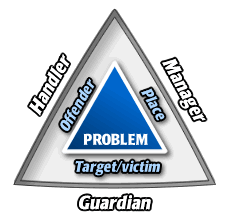
I like the crime triangle. It is popular among crime analysts. It helps analyze crime hotspots. It is also part of problem-oriented policing. Sometimes too it is part of the prevention practitioner’s toolbox. It has elegant utility and simplicity.

The crime triangle emerges from "routine activity theory" (RA) in the early 1980s. RA explained some behavior quite well, like predatory crime (stalking). It did so with a simple premise: crime converges at the intersection of likely offenders, suitable targets and an absence of guardianship (or, more recently, "handlers").

In lay terms, picture the three sides of a triangle with an offender, a victim, and a target/place. When those things come together, so the theory goes, crime goes up.

The crime triangle is useful. Break the triangle and you prevent the crime. Want to increase guardianship? Get property managers to keep better control of their properties. Improve bar management in bars that over-serve. Simple. Elegant.


So far, so good. Except for one thing; that is where it typically ends in the RA world. The crime triangle does not dig deeper into the causes of crime.

Why? Because routine activity (and its crime triangle progeny) is one of those crime and place theories.

RATIONAL CHOICE

RA is less a causal theory explaining why and more a descriptive symbol predicting when, where or how. It ignores why someone becomes motivated in the first place. RA assumes an endless supply of motivated offenders. They are motivated for some reason; we just don't know why. The only "explanation" of motive falls back to rational choice theory.

Rational choice assumes offenders are rational actors who weigh risks against rewards. From the window of RA (and the crime triangle), crime looks like a "normal" condition of life.

True, some criminal behavior is “normal” in the sense that as events, products, and social affairs change, so too do crime opportunities. But as a causal theory, that’s rather trifling. It’s a bit like saying with enough water, sun and moderate temperature, certain environmental conditions will produce rain.

Then again some criminal behavior is not normal at all and RA just doesn’t work. Consider the story of the Connecticut mass murder in the news today.

As the NY Times says, this is “the latest in a series of American workplace tragedies”. It is a sad story about a workplace shooter who killed numerous workmates and then himself. He may have snapped from perceived workplace injustice. Perhaps he was clouded in a drug stupor. Maybe he was insane.

Routine activity theory might suggest how to remove opportunity for future incidents like this. That is a good start. Baby steps.

But RA theory will never actually know why because it will never ask. In cases such as this, the risk and reward assumptions of crime-and-place theories look rather silly. What does a suicidal shooter “risk”? What “reward” was this shooter gaining? Vengeance? (If so, we’re back to motive.)

Motive is a key piece of the puzzle

WHAT CAN THE TRIANGLE DO?

What will the crime triangle tell us in cases like this?

1. Capable guardians - cameras, plentiful supervision, and so forth. Unfortunately this shooting occurred at shift change when there were lots of employees and supervisors about. As for CCTV, how often do we watch nighttime news clips of robbery/shootings on corner-store CCTV? Cameras don’t stop shootings.

2. The time/workplace environment – preventing guns in the workplace. Will metal detectors work? Perhaps, but how difficult is it for shooters to become bombers. What then? Bomb sniffing dogs? At some point Orwellian paranoia replaces civility. Where do we stop? Body cavity searches?

3. The offender – modus operandi (not motive. Remember, RA is motive-neutered). The crime triangle asks if "handlers" like armed security might have intervened (that actually might have helped). Or maybe we could have prevented the shooter from getting guns in the first place? Others can argue 2nd Amendment rights. I won't bother here.

Crime triangle questions just don't do it. Instead, we must also ask this: Why did the shooter shoot? What can we learn about motive to prevent such tragic events in future?

The crime triangle is a useful and elegant baby step. I like it and I use it. But it is veneer. It is short term. It is not enough.

Our analysis of neighborhood crime must include a more robust analytical dialogue. If our analysis does not encompass action to move social life forward, it is not robust. Ultimately, if our theory fails to include motive, we are cluttering our dialogue with junk and the analysis of junk.

Saturday, January 22, 2011

Oz Graff and Banksy

Stencil graffiti can be annoying and funny at the same time

This week I'm at the University of Sydney, Australia for a Crime and SafeGrowth workshop.

It gives me a chance to wander the streets of this beautiful city and compare it to my experience last year and a decade ago. In 1998 Sydney was a city of graffiti. Last year, not so much. Much has happened in Sydney, and in the world of graffiti, in the past year.

Some of the trends appeared in blogs I've written on train graffiti, murals, and the ICA Graffiti Guidebook.

Graffiti is called graff by practitioners of this underground über-chic, street artists, wanna-be street artists, and just plain sweaty vandals. Graff is pandemic in both virtual and real space all over the world.

Take for example the stencil graffiti trend started by Britain's anarchist Robin Hood, Banksy. Stencil graffiti now makes appearances in art galleries and in art books. Graff-folk gather on websites to advertise their wares or simply look for cities to "practice". Says a graff-writer in one post:

I'm from Los Anzgeles and will be out in Sydney next week. Although I'm not traveling for graff I would DEFINITELY like to paint while I'm there (as well as stickers)... If anyone can give any info on ANY cool spots to paint as well as GET paint I would greatly appreciate this...

Police and prevention specialists tinker at the edge of graff, sending in the enforcers, writing new laws and installing CCTV. Police map it along with other crimes. But it seems they simply don't get what is going on.

Graffiti mapping in Sydney, Australia

In Sydney, like elsewhere, traditional enforcement tactics hold back the tide: anti-graffiti teams, resistant sprays, CPTED lighting, and so forth (probably why graffiti has somewhat declined in Sydney).

The truth is, like most large cities, in Sydney resistant pockets flourish - some interesting and inventive, most just blight. Example: Around Sydney's central train station where CCTV watched everywhere, I counted 31 public murals, every one graffitied.

Most public murals are not graffitied. Then again, these were not "community-based" murals painted by local artists. They looked corporate, perhaps designed by city or train station officials.

Banksy's documentary film, Exit Through The Gift Shop premiered at the Sundance Film Festival last year. It is well done, glorifies the good, bad and ugly, but more importantly it provides insight; insight we need to better understand the future of the public realm.

It also suggests to some degree, like it or not, the once-maligned is now going mainstream.


Thursday, November 29, 2018

May they fail


Times Square echoes Bladerunner - hyper-commercialized,
electronic billboards in every direction

by Gregory Saville

The writing on the shop walls and the floating billboards was Anglo-Chinese. On the street, the cityspeak combined English, Chinese and Spanish, a vernacular that served the homeless, the marginally employed and the unfortunate. Pollution and environmental collapse led to constant clouds and pelting rain. The affluent traveled to off-world colonies on Mars and elsewhere, leaving the rest of us behind. Bio-engineered, human-like robots called Replicants used their artificial intelligence and rebelled.

That was the horrific world described in Philip K. Dick’s book that became the 1982 sci-fi classic, Bladerunner. I blogged on Bladerunner architecture last year. When I watched Bladerunner in the 1980s it seemed like an impossible future. And it was set for such a long way ahead – 2019!

That's next year! With only a month left, how close is that future?

No escape - walls of electonics

UNFOLDING AS WE SPEAK

It doesn’t take much imagination to see a Bladerunner vision unfolding. True, we are nowhere near that specific dystopia. We still don’t have flying cars (but we have self-driving ones!). Yet, one wonders...

This week I watched NASA’s exciting landing on the planet Mars. Space X CEO Elon Musk says he’ll get people to Mars within six years. How long before off-world colonies evolve?

This year I watched the fruits of some incredible advances in artificial intelligence and bio-engineering, including the world tour of the remarkable Sophie, the first thinking and speaking robot to attain citizenship. Sophie tells us not to worry; real robots are not like Bladerunner.


Then there is the decades-long Chinese economic miracle or the environmental mess we watch with increasing regularity in hurricanes, wildfires, species extinction and climate chaos.

Philip K. Dick, it seems, was on track.

How might we derail that particular future? The usual formula is to rethink geo-politics and create new macroeconomics. Nevertheless, the maxim ‘think global, act local’ has special relevance here. Take, for example, Philadelphia!

ONE NEIGHBORHOOD’S STORY 

Over the past few years, we brought SafeGrowth to Philadelphia. We now have some great advocates working for the neighborhood association, HACE. This year they began implementing their latest 10-year 2025 Neighborhood Plan.

For years HACE and friends have been diligently working to transform the blight, drugs, and crime into a greener, socially connected, economically vibrant neighborhood. Now their new, SafeGrowth-infused 2025 plan is underway and they’ve been making strides.

They installed new, clean walking trails where garbage was once strewn.

The HACE Trail project in Philadelphia

They instituted Philadelphia’s first SafeGrowth Livability Academy, a collaborative workshop with 30 neighbors and police during which they developed problem-solving strategies for their neighborhood.

The HACE plan envisions greener areas, community gardens, better resourced neighborhood hubs, safe intergenerational and affordable housing. HACE has already built over 200 units of affordable housing and leveraged over $100 million in redevelopment and improvements. A host of community-building strategies are already underway.

Neighborhood bridge now cleaned and repainted

For example, they, and their partners shut down a drug infested, homeless camp along a railway underpass. That naturally displaced addicts to street level, resulting in a public outcry (after decades of inaction). Ultimately, that led to a more coordinated city response to treat drug users, expand homeless beds and increase shelters.

HACE built affordable housing
There is a long way to go and resources and shelter beds are still scarce (one estimate suggest Philadelphia has 50,000 opioid addicts, many of whom end up here). But at least action is finally underway.

That is the hard community-building work that cuts crime, improves livability, and gets neighbors engaged in shaping their own future.

In spite of successful resident-based projects, cities like Detroit
fund expensive CCTV technology to cut crime

BEYOND SECURITY

Too many mayors get caught up in a fear-based echo chamber that makes them vulnerable to peddlers of security technology and promises of a bright, high-tech future.

Too many city leaders act as obsequious errand-boys for the technologists, embracing the faint promise of hostile architecture, public CCTV, automated security robots, predictive algorithms seeking crime, and audio software to track gang gunfire. (Wouldn't it be better to prevent the gunfire in the first place?)

They do this with the ill-informed hope that technology will prevail. But in doing this, they snatch defeat from the hands of successful action-based community projects right in front of them.

They invite a Bladerunner future. May they fail.