
Showing posts with label situational crime prevention. Show all posts

Friday, December 31, 2021

Do the right thing - It will satisfy some and astonish the rest


Walkable, carless, pro-social, and safe. What do future neighborhoods look like?

by Gregory Saville

With apologies to Mark Twain, that quote above is what came to mind as 2021 ends. Such a turbulent year with so many distractions – Covid, mass shootings, increasing crime, social unrest! It’s hard to look back through the lens of the 24-hour news cycle and social media and not conclude that we are going to hell in a handbasket.

Do yourself a solid and have a read of Bailey and Tupy’s exceptional book Ten Global Trends Every Smart Person Should Know. They use those increasingly rare things called facts to soundly debunk the doom-and-gloom-is-everywhere theory.

Bailey and Tupey's book Ten Global Trends - using research and facts to tell the truth. 


When you've read Global Trends, (and after you mask up, vaccinate, and elect better politicians with better policies), then give a thought to doing the right thing for safety in 2022 and learn some state-of-the-art theories in neighborhood crime prevention. There are a few good ones to pick from, but be careful - some only go halfway. 

Here are a few to watch:


SITUATIONAL PREVENTION 

In the 1970s they created electric car alarms to cut auto theft. You know, those pulsing lights and blaring horn alarms (BLEEP...BLEEP...BLEEP) that, nowadays, most people just ignore.

Around the 1980s, they created The Club to lock a steering wheel so thieves could not drive the car. Unfortunately, thieves adapted and learned to hacksaw the steering wheel and slide The Club off. One thief said: “So if it takes 60 seconds to steal a car, it now takes 90.”


The Club auto theft prevention device - photo Wiki Creative Commons

In the 1990s auto manufacturers adopted another situational crime prevention approach to harden the target. They created vehicle immobilizers, electronic devices that prevent a car engine from starting until a proper key transponder is present. Immobilizers prevent hot wiring and also eliminate that annoying BLEEP...BLEEP...BLEEP.

What is the result of situational crime prevention?

Some criminologists say the increasing adoption of security technologies has cut crime opportunities all over the world. Crime everywhere has decreased and auto theft has plummeted, as you can see on the graph.
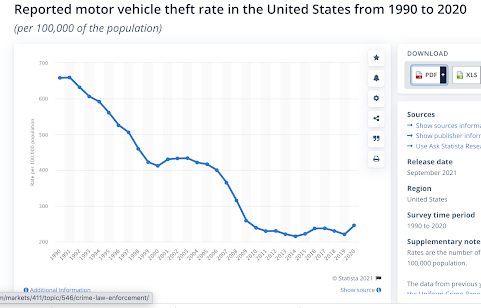

Auto theft rates sunk as theft devices were adopted...

Except, there are a few glaring problems with this theory. First, not all crime rates around the world have declined in spite of more security technology! (Latin America comes to mind). 

Second, consider this...
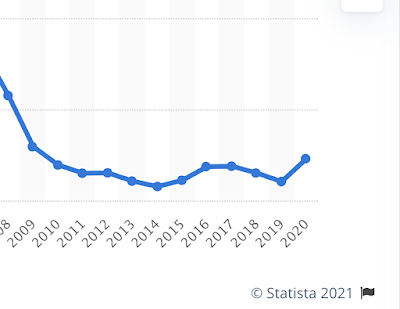
...up until the past decade when rates began increasing.


Even with improvements to auto theft prevention, decade after decade, in the past ten years auto theft rates have NOT declined. In fact, they have started to increase! Look at the reality in the chart above of the past 10 years! How can this be? Security technologies have not vanished.  

Why are auto theft rates increasing? Perhaps the situational prevention theory spends so much time hacking at the branches of crime opportunity, it missed digging at the roots of crime causation?


FOCUSED DETERRENCE

Consider another recent prevention theory - focused deterrence, also known as CVI (community violence interrupters). I blogged on this promising strategy a few weeks ago.


Most modern crime prevention strategies zoom down from the level of the
entire city into specific areas (SafeGrowth), specific situations (situational prevention), or specific offenders (focused deterrence)


In a 2019 article, "There is no such thing as a dangerous neighborhood",  Stephen Lurie says we should not fix broken neighborhoods but rather target the small group of chronic offenders in those neighborhoods who cause most problems. That is how CVI intervenes in the cycle of violence. Says Lurie:

"The notion that public disorder drives criminality can seem an intuitive approach to public safety. But if people understand that most serious violence circles specific interpersonal group dynamics in structurally disadvantaged communities, order maintenance policing seems more like what study after study shows it is: an unnecessary evil."

Regrettably, permanently resolving a complex crime problem is not as simple as intervening with the offender before they rob or shoot. As the late Desmond Tutu warned, "There comes a point where we need to stop just pulling people out of the river. We need to go upstream and find out why they're falling in."  

No doubt we need to do something fast when violence threatens and that is something at which situational prevention and focused deterrence both excel. But there is no hiding the fact that they both hack at the branches - neither one alters structurally disadvantaged communities in any meaningful way. 

Criminologists will tell you there are many seeds to crime causation. But over a half-century of criminological research amply demonstrates that the dysfunction, trauma, substance abuse, and blight in disadvantaged communities provide the breeding ground from where most chronic offenders emerge in the first place. Severely disadvantaged places create an endless supply of chronic offenders and if we want to dig at the roots of crime, and not hack at the branches, we must face those structural disadvantages. That is from where hope emerges and that is how we do the right thing.  


ANOTHER WAY - SAFEGROWTH

Some criminologists and law enforcement officials will complain that it is exceedingly difficult, (and takes a long time) to deal with deep structural problems in neighborhoods. Part of that is because the expertise and professions that deal with such problems are not found within criminology or law enforcement. They are found in economic development, urban planning, neuropsychology, cognitive science, and education. 

That is why SafeGrowth practitioners collaborate with experts in all those different fields and then work with residents to co-develop prevention plans. This kind of deep-dive capacity-building is neither simple nor fast. Ultimately, SafeGrowth marries community development and social prevention with 1st, 2nd, and 3rd Generation CPTED. The method has been successful for decades. Our SafeGrowth book describes how we keep our eyes on the real prize. 

A few other recent examples:

These are only a few of many ways forward. In 2022 let’s do the right thing and not lose sight of the fact that, if we want to build a better society, we actually have to build a better neighborhood.

Happy New Year. 


Thursday, November 24, 2016

Ethics in criminology - avoiding Frankenstein


Frankenstein - a story about over-extended science 

by Mateja Mihinjac

The story of Frankenstein, when a scientist’s experiment runs amok, is a fictional account of science gone wrong. A few weeks ago I attended a criminology conference about crime prevention and communities. The conference targeted academics, police, local councils and groups like Neighbourhood Watch and Police-Citizens Youth Clubs.

The take-home message as it turned out, however, was not an appreciation for cooperative community-driven crime prevention. Instead, the delegates were fascinated by presentations on evidence-based criminal justice showcased through the technical whizz of some presenters and the call for a scientific response to crime.

EVIDENCE-BASED APPROACH

The evidence-based mantra is the latest trend in criminal justice and policing, often called the evidence-based approach (EBA) in crime prevention and evidence-based policing.

These academics (they call themselves “scientists”) maintain that criminal justice policies should be driven by scientifically evaluated strategies that have been proven to work, a laudable goal to be sure. But to support these arguments, EBA proponents like to compare the evolution of criminal justice to medical science.

The biological and physical sciences use experiments in controlled labs
They maintain that by applying scientific techniques that allow for objective, comprehensive and rigorous assessments, they will be able to guide public safety professionals with approved solutions and thus eliminate guesswork that had guided their work in the past. It is a proposition long criticized as unrealistic by social research experts like National Academy of Science member Stanley Lieberson, former chair of the Sociological Research Association.

LIMITS OF EBA

Crime is a social problem characterized by complicated causes and interconnected underlying factors. The science that the EBA crowd follows is based on quantitative number crunching and the kind of controlled experiments that are simple to control in the chemistry lab, but far less so on the street where crime occurs.

How likely is it that the same methods in physical science are ideal methods for truly understanding the complexities of crime? How realistic is it to think the multifaceted social factors of social disorder and crime can be extracted, reduced to small components and then tested in experimental designs?

Harvard’s Malcolm Sparrow also warns that relying too much on evidence-based practice is a risky proposition; it risks dependence on a limited pool of validated solutions and dependence on quickly outdated solutions in today’s rapidly changing society. Further, Sparrow says that the excessive time needed to establish a knowledge-base to satisfy evidence-based policing proponents means that results may take too long to be operationally relevant.

Data-driven, computational experiments can take years to complete
One argument for establishing evidence-based practice is to eliminate the disconnect between academics and practitioners. But escalating the evidence-based rhetoric does not help narrow this gap; in fact, it only perpetuates the division between the two.

This is especially true when EBA academics consider themselves as governors of the research that judges policies rather than establishing a mutually beneficial collaborative relationship. There is no worse way to create top-down solutions that exclude those who are affected by these policy decisions — the public.

TOWARDS AN ETHICS-BASED APPROACH

This does not mean, as the saying goes, that we should throw the baby out with the bathwater. Evidence-based practice has an important role to play, particularly in crime prevention and policing. Evidence-based research provides directional patterns that might support the effectiveness of certain measures.

However, decision makers should not rely solely upon today’s trending EBA promises especially when solutions may infringe upon social equality. Ethics cannot be pushed aside from decisions made too quickly from a complete lack of evidence, or too slowly from a plodding EBA platform in which “scientists” take months or years to conclude anything of value.

Sparrow partially attributes the overwhelming focus of the evidence-based policing movement on place-based interventions such as situational crime prevention, CPTED or hotspot policing. In these cases, ethical questions seem very distant when researchers use secondary data, such as crime statistics collected by police, and their computational calculations do not directly involve people.

It is ultimately still people who will experience the effects of place-based interventions.

"Big Data" does not solve our problems if we have weak connection to
those under study
One example of this vulnerability is evidence-based solutions such as target hardening in situational prevention or CPTED that minimize criminal opportunities (when crimes may not have actually occurred) but may also reduce opportunities for liveability, walkability or socializing. This is why we need to engage communities each step of the way during evidence-based research and practice. Other professions do it — why can’t we?

Schram neatly summarizes the evidence-based versus ethics-based debate:
“we need less top-down research which focuses on a ‘what works’ agenda that serves the management of subordinate populations and more research that provides bottom-up understandings of a ‘what’s right’ agenda tailored to empowering people in particular settings”. 

Saturday, August 29, 2015

Target hardening - the journey into the desert

Razor wire - the ultimate target hardener
This week I fielded inquiries about target hardening. It reminded me of the story of the mirage in the desert:

When the desert traveler dying from thirst sees the mirage of an oasis he diverts toward what he mistakenly thinks is his salvation. He does so, not because it is real, but because it is all he knows and because he is desperate.

This is what happened when shop-owners in London installed spikes to deter sleeping homeless people. The global backlash became an embarrassing public relations nightmare far worse than homeless people looking for a bed. Clearly, target hardening was a mirage that backfired.

Target hardening remains a mirage because we have very little research about its impact on community-building or on the perception of the public. Target hardening definitely conveys a message. What message does it convey about buildings, benches, urban parks and residential property? Does it drive people away for fear of crime? Is that message helpful for building local pride in our future communities?

Target hardening seeped into CPTED language in spite of its utter absence in the early literature from the CPTED pioneers. As far as I can tell, target hardening as a CPTED strategy showed up about a decade after CPTED was born.

Then in the early 1980s Ronald Clarke adopted target hardening as a component of situational crime prevention and that is where it has resided ever since.

Historically target hardening has been around a very long time. Some instructors like to equate medieval forts as examples of target hardening, but stretching a metaphor to antiquity does a disservice to contemporary democracies where human rights bind modern societies together.

PERSISTING IN THE LEXICON 

Still, target hardening persists in the security lexicon because at times it works very well. I use it when other options don’t work such as high risk public housing prior to community-building programs. Regrettably, research on the topic is thin. Most target hardening research obsesses on common property crimes such as burglary, vandalism and thefts and to a lesser extent, robbery.

There is scant research on crimes against persons such as homicides, shootings or gang related violence, and what does exist is spotty. Luckily some research on target hardening still shows up in the property crime literature.

The truth is we know very little about the broader impact of target hardening. And our ignorance portends a rather scary future until we answer the single most important question about it: Is target hardening simply a mirage diverting us from more substantial, sustainable, and community-minded answers?


Monday, December 8, 2014

Criminology's Nobel Prize 2015

The 2015 Stockholm Prize in Criminology - criminology equivalent of the Nobel Prize 
Imagine this:

...a large, white passenger van driven by an off-duty cop filled with some top criminologists recently arrived at the Toronto International airport. Destination? A conference retreat centre bathed in amber tinged autumn leaves on a lake in northern Ontario. Purpose? Gather world-renown criminologists, skilled practitioners and engaged community members in a unique search conference to explore new paths for crime prevention and environmental criminology.

It was 1988 and I was the driver. The conference was the final project in my master’s degree. My passengers included Ronald V. Clarke, dean of criminology at Rutgers University and Patricia Mayhew from the UK Home Office. Was I intimidated?

Duh!

This month Mayhew and Clarke won the 2015 Stockholm Prize in Criminology for their work creating situational crime prevention. Roughly equivalent to the Nobel Prize, the Stockholm Prize is the most prestigious criminology award in the world.

Grounds of retreat center north of Toronto - 1988 Conference in Research Futures in Environmental Criminology
A CONFERENCE RETREAT IN CANADA

The drive north in 1988 was the first time I had met Clarke and Mayhew (and most of the other scholars) and I was anxious to make a good impression. Even then they were giants in the field.

At one point I dropped them off briefly at what I thought was a regular restaurant to pick up more arrivals. On return I discovered, to my horror, my precious cargo was being lambasted by a hard rock band of the heavy metal variety bashing away on cymbals and electric guitars.

“You know,” said Clarke, barely audible with the roaring din behind us, “they are really quite good.” He added with a genuine smile, “This is some excellent rock!” Academic prestige, I learned from Clarke, does not require malignant egos.

Mayhew and Clarke's open hearted and non-pretentious manner helped make the conference a success (later published as Crime Problems, Community Solutions). They were truly exceptional people.

Ronald V. Clarke, co-winner of 2015 Stockholm Prize with Patricia Mayhew (photo not available)

SITUATIONAL CRIME PREVENTION

While Mayhew went on to co-develop the U.N. International Crime Victimization Survey I came to know Ronald Clarke professionally. Years later I presented him with the International CPTED Association's lifetime achievement award. We served as judges together on the Problem Oriented Policing Award Program (where, as Chief Judge, he was my boss). From Ronald Clarke I learned how a classy scholar does robust scholarship.

By pioneering situational crime prevention Mayhew and Clarke helped legitimize CPTED arguments at a time when, as Clarke writes, C. Ray Jeffery’s CPTED and Oscar Newman’s Defensible Space “were both given short shrift by criminological reviewers.”

Their Stockholm Prize is well deserved. Congratulations to them both.