
by Greg Saville
These are trying times, a statement that qualifies as the understatement of the year! This is especially so when it comes to policing and racial protest. While protests and riots are a global phenomenon – especially recently in places like Hong Kong, Europe, and South America – in the past few months the latest Ground Zero for police and racial unrest is in the USA.
Since May, America has seen over 14,000 arrests during protests in 49 American cities, extremist violence caused by racist groups like the Alt-Right, and the Black Lives Matter movement protesting police shootings of unarmed black men.
And now Defund The Police!
I attended a police meeting recently in which I listened to suggestions to modify warrior-style training and rebrand police services in response to this turbulence. It felt like we were arguing over where to place our beach towel to keep the sand off while ignoring the roaring Tsunami about to crash onto us and wash us out to sea.
Over 20 major city police chiefs have resigned in the past few months, including Rene Hall, the African-American chief in Dallas, Atlanta police Chief Erika Shields, Seattle Police Chief Carmen Best, and other chiefs in Rochester, Richmond, Louisville, Detroit, Milwaukee, Portland, and even Toronto, as the racial protests spread to Canada.
Clearly, this is not a beach-towel-moment in history. What is to be done with the police?
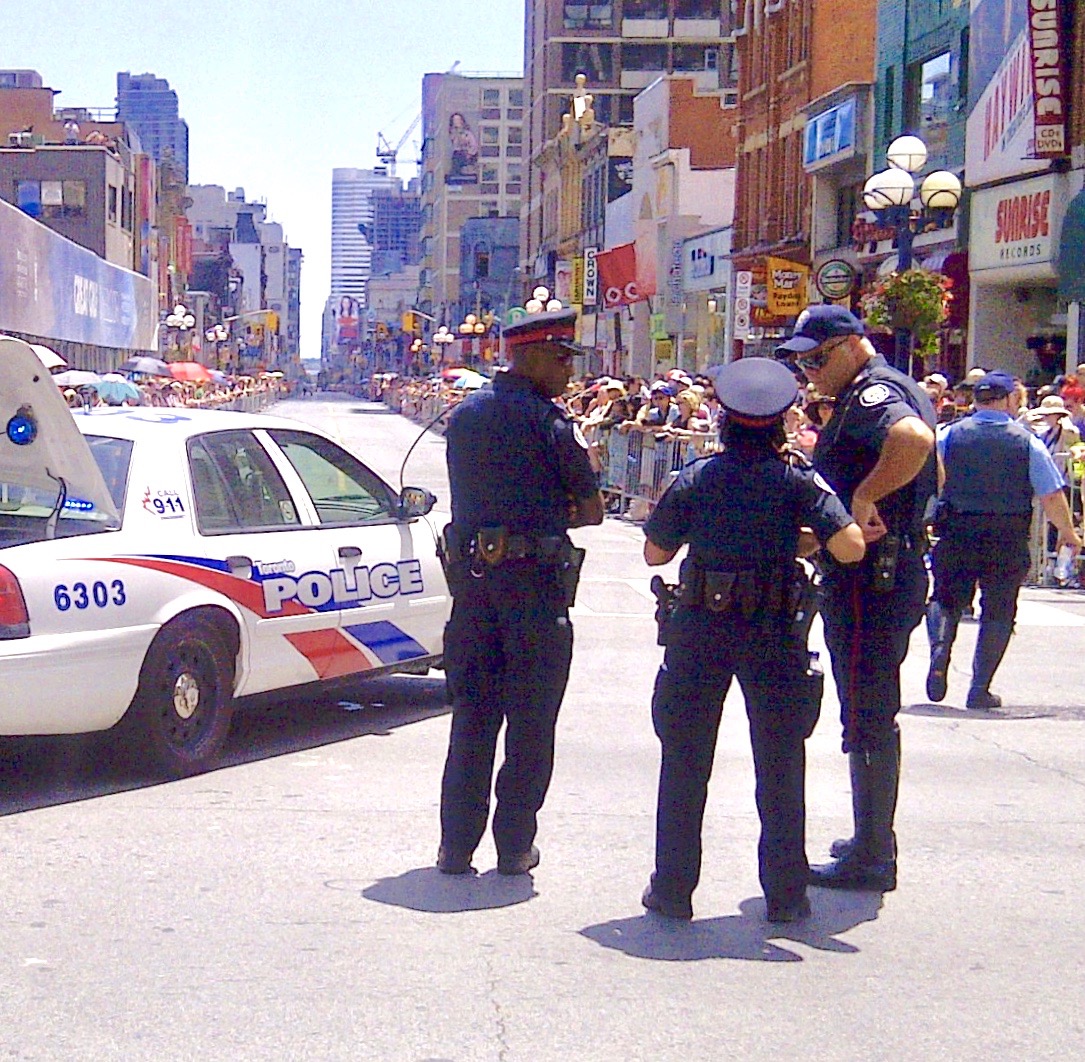 |
| Toronto Police Service on crowd control |
COMMUNITY POLICING?
Since the 1980s, police reformers have worked diligently to transform police practices from rigid law enforcement-warrior style policing, to community-based problem-solving. For over two decades, I have worked alongside some of the best and brightest police officials and reformers in the world to do just that – people who I respect and who I know care deeply for both the police profession and safer, more just, communities.
Sadly, in my estimation, since at least since 9-11, the movement towards community policing has reversed and lately, it has collapsed. I speak in admittedly simplistic terms, but it seems to me that the warrior cop has commandeered the community cop. Almost in response, the defund-the-police movement represents a belated and instinctive reply to that illicit expropriation.
I have read books explaining why community police reform faltered since the 1980s, for example, Malcolm Sparrow's, Handcuffed: What Holds Policing Reform Back and the Keys to Reform. I also have read far-fetched books describing the End Of Policing. But watching police/race riots on the news this week (the latest in Philadelphia), those books now seem much less far-fetched.
THE TSUNAMI ARRIVES
And now where are we?
Forbes magazine described the immediate impact of defunding the police. In a dozen cities, municipal leaders have committed to defund, or reallocate, over a half-billion dollars in police service budgets thus far. This includes over $300 million in New York City, over $100 million in Austin, Texas, Los Angeles, and San Francisco, over $10 million in Oakland, Seattle, Washington DC, Baltimore, Portland, Philadelphia, and over $1 million in Hartford and Salt Lake City.
We are told police services are already underfunded and cops are working harder than ever, running call-to-call. Perhaps that’s true. But, if so, it is only half the story.
 |
| NYPD patrol vehicle street parking |
SAFEGROWTH IN ACTION
Here is what I know for certain: In two different cities, we recently taught SafeGrowth programs to local residents, shopowners, and community groups. This included how to create action plans to cut crimes in different high crime neighborhoods – a topic in which you’d think the police have a powerful vested interest (the training was free and they had plenty of prior notice). We ended up with two local cops at one and none at the other. The police agencies in question each employed over a thousand cops on staff.
We got two.
Maybe they were understaffed and too busy to attend. But still! We were cutting crime at the roots with proven, evidence-based methods. We were teaching residents how to partner with police (and vice versa) in order to create safer neighborhoods in crime hotspots. This is the very goal that defund-the-police advocates seek!
There is an American national election next week and this tsunami will crash upon those who win it. Much is at stake.
Next blog: What can be done?
