|
| Mural in one of Calgary's neighbourhoods |
By Larry Leach
Larry is Executive Director of Calgary’s 12 Community Safety Initiative – a non-profit crime prevention collaborative. He was awarded the Queens Diamond and Platinum Jubilee medals for his contribution to community-building. He is a member of the SafeGrowth Network.
Decades ago, North American society had an unwritten social contract. When you need help, you can reach out to your neighbours. When they needed a cup of sugar or help building a fence, you were there as a community to help. As we progressed through the decades, a sense of community was valued less and we began relying on institutional support. This is the message we have described in prior blogs regarding the Bowling Alone book by Robert Putnam.
Today, we spend our time in an isolated society without the natural neighbour support we once took for granted.
I won’t preach about getting back to the old days (or about the social contract concept of philosopher John Locke). Still, it’s important to recognize what we had and how it’s been eroded over time to make the next shift better and how to fix what is clearly a societal issue.
We used to know our neighbours, those struggling and those doing well. We knew each other’s children. If a child was struggling, the community picked that up, usually finding out from the local school. They were involved in their lives. School teachers were local, knew the families, and often taught all the siblings and sometimes even the parents. The local police officer knew people in the neighbourhood. Importantly, in knowing came caring.
 |
| Children need not grow up alone. We can do better to care for each other. |
As communities found more to do and value, they found less value in this approach, and big government and big charity stepped in to fill the void. Today, teachers change schools often and, in some police agencies, officers are discouraged from policing in their own neighbourhoods. Parents move their children to schools they think are better for their children and drive long distances to put their child in the best sports club or activity, where they hope to achieve success at an early age.
Throughout this time, we learned that service providers cannot replace family, friends, and significant community members. Humans need connection – a fact well-known in social psychology, and reported in prior blogs by both Mateja and Tarah.
 |
| As with many local community organizations, Calgary's 12 CSI runs a community ambassador program and others like anti-bullying, community walks, and safety audits. |
FILLING THE VOID
If a sense of connection is missing, how do we fill that much-needed void? In the 1985 book Careless Society, community activist, and author, John McKnight warned of a time when we would believe that We Can’t: We can’t do things for ourselves and each other; We can’t care for our own children or a neighbour’s child; We can’t muster enough individual or personal will to tell the politicians We Can.
In contemporary North American societies special agencies now fill these gaps. For example, I am the board chair of a Youth Centre called Cornerstone Youth Centre. This centre did not need to exist when communities made sure the kids in it had lots to keep them occupied. When they slipped, the community was there to pick them up.
Additionally, several agencies have developed around homelessness. Again, this is something that families and communities used to handle. Now it is handled by an agency funded by some level of government. I spoke in a previous blog about how some of these agencies are too big and they are not addressing the needs of the communities where they work. Often they have no relationship at all with the surrounding residents in the neighbourhood.
WE CAN
I also work for a non-profit called 12 Community Safety Initiative, the neighbourhood organization that helped launch the first-ever SafeGrowth Summit in 2015.

In 12 CSI we employ Ambassadors to walk the neighbourhood, helping residents and visitors to the area connect with services and each other. It is small and nimble and connected to the communities it serves. If community members are unable to be the eyes and ears of their own community, or are unable to help their neighbours, then Ambassador and outreach programs will fill that void until individuals, families, and communities follow the model of caring vigilance and demonstrated compassion.
This may all seem like nostalgia for a better time, or perhaps it is a naive expectation of the wisdom, generosity, and power of community. But if we are going to participate in our safety, the safety of neighbours, and the creation of a better world I firmly believe we must say, "We Can”.
Neighbourhoods that take the idea seriously that they are responsible for many of their own needs, will be in a better position to come together and build programs that are truly for community members (and run by community members) before an outside agency arrives and decides it for them.
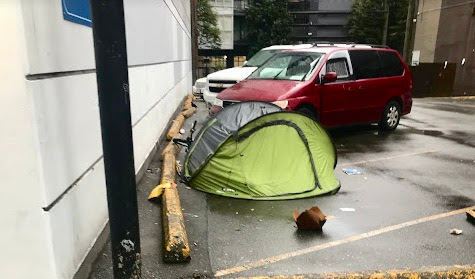 |
| Local communities can have a major impact on problems like homelessness |
As we reported in a previous blog on homelessness, Finland’s communities are doing exactly this with great results. That country made it mandatory for municipalities to shelter and provide outreach services to the needy in their own community. They now have the lowest homeless population in the world. It is government-funded, but it is also community-based. Each municipality is responsible and accountable to its own residents for these services.
As we say in SafeGrowth, the experts are the people who live in the neighbourhood. It all starts with having a good look at your neighbourhood strengths and the resources needed to help people. We do not need to go back in time to recreate the past, but we can all take some responsibility for how our neighbourhood operates.
I offer this final challenge: What will you do to make your neighbourhood better? It is up to us. We can!
[Personal note: Thank you to Bob McInnes for his thoughtful contribution to this blog].