Showing posts sorted by relevance for query vancouver. Sort by date Show all posts

Wednesday, January 5, 2011

Catch and release - Swimming upstream in Vancouver

Vilfredo Pareto's 80/20 Principle

What does a 19th century Italian economist have to do with neighborhood safety? Consider Vilfredo Pareto's principle that the majority of a phenomena can be explained by a minority of causes. Sometimes called the 80/20 Rule, criminology has long demonstrated a small number of chronic offenders cause a significant portion of crime.

Reflecting on my Comstat and police leadership blogs recently, I came across a fascinating news documentary Pareto would have loved. It's called Lock Em Up.

It's about competent policing and quality leadership in an unlikely place - Vancouver, BC. I say unlikely because, with all my harping on the skid row tragedy in that lovely city, one might assume I blame the cops or their chief. Not so. In Vancouver at least, I don't think that's the case. Jim Chu, Vancouver's Chief and their Chronic Offender Unit - COU - have put research to good tactical use. Similar to the Winnipeg auto theft solutions project I mentioned two years ago, this seems like a winning ticket (though, as you'll see below, in Vancouver there is a number missing from their lottery ticket).

A DENT IN CRIME

Property crime is rarely seen as a serious matter, yet it comprises 75 percent of all crime. In 2009 Vancouver had over 21,000 thefts and 5,000 break and enters. As Pareto might warn us, chronic offenders with multiple offenses cause a significant number of those crimes.

What is a chronic offender? Vancouver defines a Chronic as someone with over 39 convictions (that's a lot of convictions). There are also Superchronics, a group with over 79 convictions each. That's convictions, not crimes. They committed far more than that. One offender interviewed in the film below says he has broken into well over 1,000 homes.

How many chronic offenders are there and how many property crimes to they cause in Vancouver?

The COU and the Vancouver Police planning section report that over 5 years, 379 chronic offenders were charged with over 12,000 offenses, roughly 10% of all yearly property crimes. It is of course much higher since chronic offenders were not charged for all of their crime, only a small number. The reality is probably more like 25% - an educated guess I'm sure both Pareto and COU detectives would confirm.

Vancouver Police report, 2008

In other words, out of a half million people only 379 cause between 10% to 25% of all property crime in Vancouver! Their research report is available for review by clicking here.

If there was ever a case where chronic offenders should be removed to protect us, this is it. Remove them for drug treatment, incarceration, or both. But, get them off the street.

What do police do in Vancouver? Since a small number of chronic offenders create a significant portion of crime, police strategies target habitual offenders to break that cycle. Vancouver Chief Jim Chu is behind the approach.

Criminological research, where it is done well, is fairly clear. It shows that arresting Chronics and getting them off the street works, at least until the courts release them again. That's the missing link in this chain - the Vancouver court system, one of the most lenient in Canada. Stunningly, their study showed length of incarceration actually got shorter as the Chronics committed more crime. Worse still, over half of the Superchronics received less than a month in jail - and 25% of the Superchronics received less than a day in jail.

CATCH AND RELEASE

In short, cops caught them so judges could release them. Talk about frustrating! The report says:

as these offenders tend to specialize in low‐level property offences, their sentences tend to be relatively short. These short sentences do not serve to incapacitate them and protect the public for any significant period of time, nor, in most cases, are they long enough to allow for admission into appropriate addiction treatment programs.

Makes one wonder, who are the real culprits? Unaware, ill-considered and lenient judges? That's what the CTV documentary suggests. What about criminologists failing to inform decision-makers? Where is the Canadian research? Of 30 habitual offender studies cited in the report, only 4 were from Canada (two of those were graduate student theses).

As I said in a previous blog, when social tragedies happen like the public housing fiasco in St. Louis's Pruitt-Igoe and gang infested Jane-Finch corridor in Toronto, someone is asleep at the wheel.

In Vancouver, it's definitely not the cops.

Sunday, February 14, 2010

Magnificent Vancouver


 Vancouver, Canada. Photo David G. Gordon, Creative Commons

It's time to balance the ledger.

This blog talks about problem cities and successful cities. Vancouver's Downtown Eastside has made a few appearances here as it represents the former, mainly due to persistent poverty and crime. So why does Vancouver consistently vie for top spot of the world's most beautiful and livable cities?

Partly because every city in the world has poverty and crime. More important is whether productive and innovative solutions are employed to tackle them. I've never doubted Vancouver has tried numerous times to make things better in Downtown East Side (perhaps, though, not as seriously as it should).

Another reason Vancouver tops the best cities charts is - from a city-livable point of view - a commitment to Jacobsian-style walkable neighborhoods over the car-city disease found too often in too many modern cities. True, Vancouver's bus system leaves much to the imagination (and to quality). Yet it does boast success in both elevated rail and commuter rail and has made inroads for bikes.

Mostly I think Vancouver shows a commitment from citizens, planners, and successive governments to the abundant natural environs that bless this remarkable city. It's one reason the 2010 Olympics are there this month.

No wonder! Large portions of waterfront are open to the public via parks and boardwalks (not fortressed from the public by private condos). Stanley Park is the largest urban park anywhere (larger, and arguably more beautiful, than New York's Central Park). Successful neighborhoods cluster around Skytrain Stations, such as Vancouver's "showcase of community planning", Collingwood Village (to which, I disingenuously admit, my former consulting partner Paul Wong and I provided extensive CPTED advice 15 years ago).

Most of all, Vancouver's beauty just takes your breath away. The winter Olympics are underway. It's Vancouver's time.

Check it out here.

Monday, June 1, 2026

Returning to Vancouver - projects survive, but the neighbourhood worsens

Vancouver's Hastings Street - the Downtown Eastside, one of
the most challenged neigbourhoods in Canada.
Photo CC Wiki Commons 


by Gregory Saville

This week I returned to Vancouver's Downtown Eastside, often described as Canada's largest skid row, to work with members of the SafeGrowth Network and several of the city's Community Policing Centres (CPCs). We were there to prepare local instructors for Canada's first SafeGrowth Livability Academy. 

It was a milestone. Three Vancouver CPCs participated in the training: the Strathcona CPC, the Chinese CPC, and the Aboriginal CPC. Along with their SafeGrowth and CPTED training last year, Vancouver has now become the first city in Canada to move this far along the SafeGrowth pathway.

Yet the visit was also deeply personal for me.


A PERSONAL JOURNEY

More than thirty years ago, my former business partner and I conducted traditional CPTED projects in this same neighbourhood. While preparing for this week, I looked back at some of those projects. To my surprise, many are still holding up. The lighting improvements, design modifications, and site-specific interventions remain visible decades later.

That should be encouraging. Yet I could not escape another conclusion. Those projects improved places, but they did not substantially improve neighbourhood life.


Vancouver's Chinatown is among the most exciting and
fascinating communities in the country

I found myself once again walking through areas adjacent to Vancouver's notorious Hastings Street in the Downtown Eastside. Decades have passed since I first co-taught problem-oriented policing to British Columbia police officers. Decades have passed since criminologists, sociologists, urban studies researchers, and community development analysts began studying crime, addiction, homelessness, and social disorder in Downtown Eastside. Entire careers have been built examining the Downtown Eastside. Hundreds of reports have been written. Countless interventions have been launched.

A few crime stats have been declining of late (as they have everywhere), yet the situation remains bleak on most categories. The corridor still accounts for a large portion of the city’s serious assaults and robberies. Mental health calls for police service increased, overdose incidents remain high, and from what I could see, street disorder has displaced and is spreading. And, making matters worse, homelessness has been increasing.


Homeless rates concentrated on Downtown Eastside from
the metro population demographics and annual homeless counts


The homeless numbers tell part of the story. In the early 2000s, Vancouver's homeless count was approximately 56 people per 100,000 residents. Today, that figure is approaching 200. Even after accounting for population growth, homelessness has increased dramatically over the past two decades.


WHY DON'T HOTSPOT TACTICS LAST?

For those of us who have spent careers studying crime prevention and community safety, these trends force uncomfortable questions.

Why have decades of hotspot interventions failed to produce lasting change? Why have the various social programs, such as a safe injection site or the many social service agencies here, not prevented the worsening spread of the problem? 

Why have so many individual projects succeeded, such as a recent police crackdown and our prior CPTED work, while the broader neighbourhood ecology continues to struggle?

Why has so much effort yielded so little transformation?

I could see that some of the original CPTED improvements we helped design are still functioning. Yet, standing on Hasting Street today, it felt like our earlier work was all for naught. It brought to mind three principles in SafeGrowth planning: 

  • Neighbourhoods are more than collections of hotspots
  • Communities are not simply the sum of their crime locations
  • A city cannot solve deeply embedded social problems by repeatedly treating symptoms while neglecting the health of the larger social ecosystem.


The Downtown Eastside remains home to thousands of people living
with addiction, homelessness, mental illness, and profound social isolation. 


A NEW THEORY ON COMPLEXITY

Since last year I have been working with new colleague, a talented oncological medical researcher, regarding complex adaptive systems. We are studying the power of these systems, (like the Downtown Eastside), and how they exhibit distributed adaptive behavior near critical thresholds. It now seems possible this may be the reason why street disorder continues to displace and spread in spite of enforcement actions. We have learned how small perturbations can produce disproportionate, scaling-law effects that deteriorate stability. This, in turn, may explain why complex adaptive systems such as tumors or high-crime neighbourhoods resist interventions rather than underlying system conditions.  

In other words, hotspot policing alone cannot tip the neighbourhood far enough on its own. Much more collaboration and a strategic long-term action plan is needed, and that is where the Community Policing Centres and their neighbourhood-based Livability Academy might better address the conditions they face every day.

Walking in and around Hastings Street it was clear; there are too many dysfunctional activities, crime hotspots, crime generators, and too few social controls and social stabilizers to help those who suffer and those who work and live there. There is simply no way to arrest, imprison, or hotspot our way out of this disorder. 

Downtown Eastside has long ago scaled out of control. I left Vancouver today feeling both discouraged and encouraged at the same time.

I was discouraged because the visible suffering remains. The homelessness, addiction, and disorder that have characterized parts of the Downtown Eastside for decades continue unabated despite enormous investments of effort and resources. 

I was encouraged because something wonderful remains. I refer to the dedicated and passionate residents, community workers, business people, and CPC members attending both our SafeGrowth problem-solving training last year and the Livability Academy instructor's course this week. 


Instructors and some students of the recent Vancouver Livability Academy
Instructor Training celebrating their graduation


GOOD NEWS

I am also encouraged by the Vancouver Police Department's continuing support of their Community Policing Centre’s illustrating both persistent and intelligent leadership.

Those CPCs are staffed by committed, highly capable people. They understand the neighbourhood, the relationships on the street, and the kind of inclusion needed for successful problem-solving. I was impressed by their professionalism and organizational skills. They asked difficult questions. They challenged assumptions. Most importantly, they were already thinking about how to engage people and build long-term neighbourhood capacity.

They are the ones who best represent the heart of SafeGrowth. They know their goal is not simply to reduce a statistical crime blip next month or to remove a hotspot next year. They want their neighbourhood stronger, more resilient, and capable of self-help.  

Thirty years ago, I co-taught CPTED and problem-oriented policing in Vancouver. This year, I returned with some SafeGrowth friends to help launch Canada's first Livability Academy. The problems are still here. But so are the people willing to confront them with new skills, a new action plan, and deep connections to the social roots of their community.

After everything I saw this week, I believe the next chapter will not be written by its problems, but by the people working together to solve them.


Sunday, March 29, 2026

From fear to familiar - Reclaiming Oppenheimer Park through SafeGrowth

Source: Google Earth imagery, Oppenheimer Park, Vancouver, Canada.
Screen capture by G. Saville


Guest blog – Ekin Buran & Dixon Ng

Ekin Buran is Programs Manager at the Strathcona Community Policing Centre and Dixon Ng is Victim Services Worker at the Chinese Community Policing Centre in Vancouver, British Columbia. They were two of five members of a SafeGrowth team  from a training program in Vancouver last year. Both have worked in Vancouver’s Downtown Eastside for over three years, focusing on community safety and crime prevention. Through their project work, they apply SafeGrowth strategies to the community they serve and care about. This story describes one of their projects.

***

Oppenheimer Park sits on the unceded territory of the Coast Salish Peoples in Vancouver’s historic Japantown. The baseball field where the Vancouver Asahi once played is still active today. The Asahi were a Japanese Canadian baseball team based in the Powell Street area from 1914 to 1941 and became a symbol of perseverance and community pride during a period of widespread discrimination. Totem poles, cherry blossom trees, and cedar trees remain part of the landscape, reflecting both Indigenous and Japanese Canadian history.

Yet despite its deep history and ongoing community life, Oppenheimer Park is often discussed mainly in terms of safety, especially by those less familiar with the space. Media coverage and public discussions frequently focus on encampments, drug use, and police presence, shaping how the park is perceived before people ever visit it.

Our goal was to begin a planning process that could change that perception by building on the park’s existing strengths. Over the past year, following a multi-month SafeGrowth training workshop organized through the Strathcona Community Safety Association, our team began applying the SafeGrowth approach in and around the park.


Walkways in the park on a quiet day

Recognizing that meaningful crime prevention and safety programming is a long-term effort built on collaboration and trust, we began by focusing on relationships. Using the SafeGrowth approach and principles from Third Generation CPTED, we identified two initial goals: 1) to strengthen partnerships among organizations already working in the neighbourhood; 2) to engage more residents by helping them become familiar with the park and its assets.


LEARNING FROM THE PARK 

Our team of five works across four organizations in the neighbourhood, and at least one of us is in and around the park almost every day. We walk through it, meet people there, and park nearby, which gives us a close view of how important this space is to the people who use it.

Our research included observing park activity, conducting safety audits and CPTED assessments, and interviewing park users, nearby residents, and local organizations. Our guiding question was simple: how might safety grow from the relationships, strengths, and sense of belonging that already exist in the park?

We found strong appreciation for the park, clear interest in greater community use, and the Fieldhouse acting as an important anchor for positive activity. We also observed that fear of serious violence appeared stronger than reported incidents, with most calls involving property-related offences.

A survey commissioned by the Vancouver Police Department found that 74% of respondents were concerned about crime in Downtown Vancouver, and more than one-third said those concerns led them to avoid neighbourhoods such as the Downtown Eastside, which includes the Oppenheimer Park area. 


Some data was available through a survey commissioned by the Vancouver Police


Our research uncovered that:

  • There is a strong appreciation for the park as a place to rest, connect, and spend time outdoors

  • Many people expressed care for the park and a desire to see more neighbours enjoying it

  • The Fieldhouse is one of the park’s greatest strengths, providing coffee, workshops, and an indoor gathering space that anchors positive activity

  • Fear associated with violent crime was not proportionate to actual risk according to the data which revealed most incidents involving property offences rather than serious violence.


INITIAL COMMUNITY-BUILDING STEPS

Strengthening Local Partnerships

To achieve this goal, we began introducing ourselves to surrounding businesses, community groups, housing providers, daycare centres, and the Oppenheimer Fieldhouse. We wanted to learn more about organizations already active in the neighbourhood and explore ways to collaborate and strengthen connections between groups that do not always interact.

These early conversations helped build trust and created a foundation for joint activities in the park.

Summer Playground Event

In partnership with the Fieldhouse and a local daycare centre, we co-hosted a Summer Playground Event in 2025 that brought more than fifty families into the park. Following this event, another daycare approached us about hosting a similar activity, which is now planned for summer 2026.


Last year's summer playground event to activate the park.
Another is planned for this summer. 


Neighbourhood Walking Club

We organized group walks in and around Oppenheimer Park to encourage participants to spend time in the space, learn about its history, and connect with one another. During these walks, residents shared that the park felt less intimidating than they had previously believed. Spending time in the park together helped participants feel more comfortable and begin to see the space as more welcoming.


Walking club around the park - building familiarity and dispelling fears 


Community Workshops and Gatherings

We began participating in the Fieldhouse’s monthly community gatherings and co-leading workshops, including emergency preparedness sessions, fraud awareness workshops, seasonal events, and informal coffee chats. These activities created opportunities for community members to gather, meet their neighbours, and socialize in a familiar setting.


A number of Fieldhouse programs helped provide crime prevention
education and pro-social activities 


LOOKING AHEAD 

Early results are promising. Seniors already using the park expressed interest in joining future walks. Dozens of neighbourhood families attended park events, and additional daycare providers have requested similar activities. Residents are becoming more comfortable using the park for everyday visits, increasing casual use and natural surveillance. The Fieldhouse continues to grow as a focal point for pro-social activity and community interaction.

These early steps reflect a broader SafeGrowth principle: Safety grows when familiar faces, shared activities, and local leadership become part of everyday life.

Our long-term goal is to sustain this work by increasing resident leadership and involvement. Lasting change in Oppenheimer Park will not come from one event or one project, but from continued presence, relationship-building, and shared responsibility. Oppenheimer Park is gradually evolving into a more connected and welcoming community space shaped by the people who use it every day.


Sunday, December 6, 2009

Vancouver - the madness continues


At the beginning of this year I wrote about a slum in Vancouver.


Pain and Wasting in Vancouver


Today's Globe and Mail newspaper makes it clear: The madness continues!

The madness is called Vancouver's Downtown East Side - DES - Canada's fetid slum persisting for decades. It will greet the world throughout February's Vancouver 2010 Winter Olympics. It's message will not be the glowing success of multi-cultural diversity in which Canada so prides itself. As the world looks to the young and shining athletes striving for medals in one of the world's best cities, it will also see the faces of the drug addicted, welfare-dependent, and depressingly poor who inhabit the streets of DES.

There have been many attempts to fix problems there, including over $1 Billion over a decade. Some successes persist, an exciting new community court, a safe injection site that succeeds in spite of federal government hostility, and others. But they are not enough.

Says Vancouver housing expert Aprodicio Laquian, the residents of other parts of the city don't seem to mind concentrating mind-numbing poverty like this as long as it doesn't infiltrate their neighborhood - NIMBYism at its worst. He also thinks the very social activists who claim to be helping are actually hindering. They oppose what they see as "gentrification" as it will de-place the poor classes for the richer classes and displace povery elsewhere.

For those who know about urban crime, it is clear both ideas are absurd. Concentrated poverty and crime never ends up concentrated. NIMBYers will always be running away.

Secondly, worrying that gentrification will displace a viable neighbourhood elsewhere assumes there is a viable neighbourhood in DES...there is not!


More than anyone, those who make a life in DES deserve better than drug dependent prostitutes, homelessness, street assaults, out of control Hep C and HIV rates, and gang murders. The prostitutes, crime victims, homeless and infected themselves deserve better.

NIMBYism, squabbling welfare agencies, incompetent policies, failed program after program. When will it end?

How can we learn from cities like Bogota, or Portland who have done so much better at tackling festering urban cancers like this?

Long time DES advocate Jim Green (a former New Yorker who remembers the poverty of the Lower East Side) describes how public policies made a bad situation worse - moving the mentally ill out of institutions onto the street, taking out single family homes, are two of the nastiest.

Says Green, "women and children are what gives strength and security to any community. A community that is overwhelmingly single males is going to be really difficult to build, to go forward. By building housing that has mothers and children reintegrating back into society, by democratizing the processes in the community - that's how we are going to move forward. Just doing that makes it a better community, makes it safer."

Vancouver's city council claims, unlike the last world exposition there a few decades ago, it will not cover up the poor nor hide them in a displaced neighborhood far away.

That is as it should be. The world should see the beast with the beauty. It should see Vancouver's shame.

Friday, July 12, 2024

Vancouver's Strathcona neighbourhood launches SafeGrowth

Night walking tour on one of Strathcona's residential streets

by Anna Brassard

Anna Brassard is a Canadian urban planner, CPTED specialist, and a member of the SafeGrowth Network. She was one of the co-authors of the first SafeGrowth book. In this blog, Anna joins our blogging team as she describes her recent experience as co-instructor of Vancouver's first SafeGrowth training. 

Our cities are in crisis. Increasing perceptions of fear, lack of sense of safety, and isolation are messages we are hearing repeatedly in our SafeGrowth workshops. Vancouver BC is developing its own responses to those challenges, among them, becoming the first city in Canada to commit to, and fund, what they are calling a Restorative City.   

Amid all these new responses, Vancouver's Strathcona neighbourhood chose to sponsor their first SafeGrowth training. Although British Columbia has a long history of 1st Generation CPTED training, going back to the 1980s, this is the first community-based SafeGrowth training in that city and the first-ever training in 2nd Generation CPTED in British Columbia.

Organized and sponsored by Strathcona Community Policing Centre – a police-sponsored organization and tremendous asset in the community -  we began the SafeGrowth journey in April at the Vancouver Japanese Language School, a national historic building, (and another amazing community asset) in Vancouver’s infamous Downtown Eastside.


The Strathcona Community Policing Centre sponsored the SafeGrowth training


The Strathcona class included members of the Strathcona Community Policing Centre, members from other community policing centres, Strathcona residents, local organizations, businesses, and a member from the Vancouver Police. They organized themselves into three teams, each completing a project within the neighbourhood using the SafeGrowth model.  They chose fairly complex issues and selected projects within or near public spaces and parks in the neighbourhood. 


THE PROJECTS

HAWKS AND HASTINGS 

Team 1 focused on a sidewalk seating area next to a community garden

Team #1 selected an area adjacent to a community garden. To displace drinking at a bus stop, picnic tables were placed on the sidewalk around the corner from the bus stop.  The city had even tried to respond to street disorder issues by designating the area as a legal place to consume alcohol in a partial effort to control problems on the street.  

Described as a “hot topic for years in the community” the team explored new ways to improve the area to bring more residents and other users into the area, control the disorderly behaviour, and improve retail and commercial activities nearby. They discovered the reality of what 2nd Generation CPTED calls Neighbourhood Connectivity, in this case, it is the complexity of trying to work with the many stakeholders and partners around, and in adjacent, neighbourhoods. 

One example they uncovered was working with the local businesses on Hastings Street along with the group that runs the community garden.  It brought home the central message of 2nd Gen CPTED – the importance of building relationships inside and outside the neighborhood to create a stronger sense of ownership (what architect Oscar Newman once called Defensible Space). 

OPPENHEIMER PARK

Strathcona's Oppenheimer Park was the site for Team 2

Team #2 selected a large park in the heart of the Vancouver neighbourhood called Japantown. The park is frequented by individuals experiencing homelessness and substance abuse, and it has been this way for a long time. It has also developed a reputation for being unsafe. Although it is not uncommon to walk through the park safely and have friendly conversations with people (members of the team did this), Oppenheimer Park has also frequently been in the news and social media highlighting its problems with encampments and conflicts. 

The team explored how to actualize what they, and others, see as the true potential for the park - a welcoming place that mitigates alienation, is inclusive of all people, and a point of pride for those who live and work in the area. While they were aware of other programs at Oppenheimer, they conducted a full assessment and spent time analyzing the crime, conducting safety audits, interviewing people camped in the park, and completing site visits and CPTED reviews. This led to some comprehensive short-term strategies such as lighting, landscaping and beautification, and some longer-term strategies such as different kinds of additional programming. 

Their next step is to include various stakeholders and residents directly at, and around, Oppenheimer Park to put their vision into action – an inclusive and safe gathering space for everyone. 

MACLEAN PARK PLAZA

MacLean Park Plaza was the focus on Team 3

Team #3 also selected a park that was designed as a neighbourhood hub but had been largely abandoned due to disruptive behaviour. The team analyzed why the park declined and they explored the potential to reclaim and reactivate it. 

During their initial research, they looked back at the park's history and became curious about a circle of benches that once existed. Over time the benches were removed and so the team dug deeper into resident experiences in the park. They initially wanted to restore the benches, but through their data collection and interviews with adjacent residents, they learned that, while there was a desire to reactivate the space, residents did not want to reinstall the benches. 

The team began with strategies to improve lighting and other physical landscaping features, but they concluded they needed a longer process of community engagement with local residents in the planning process. That is their next step.


Display boards used by the Strathcona community policing centre
for the public presentations

ENGAGEMENT IS KEY 

There were similar themes in all three projects. Each group envisioned public spaces that were inclusive and vibrant, instilled pride, and helped to build community cohesion. The teams all paid careful attention to the central SafeGrowth community engagement principle called TO-FOR-WITH.

Each team experienced why the SafeGrowth model stresses problem-solving “with” the local residents since they are the true neighbourhood experts. They learned the importance of not coming in to solve resident problems by creating strategies “for” them or “to” them. 

Final presentations to the public were held on the last day of the training and people from all across the city – politicians, city planners, police, the business community, and others – came to talk to team members from each project. Ultimately, the teams were asked to bring their poster displays to members of the city council for formal presentations later in the month. This was a major accomplishment for the Strathcona participants and the Strathcona Community Policing Centre. 


Wednesday, June 22, 2011

Vancouver's Hockey Bedlam - Justice after the riots


Dr. Evelyn Zellerer is a criminologist specializing in restorative justice. She teaches part-time at Kwantlen Polytechnic University in greater Vancouver and is a restorative facilitator, trainer and consultant. She has done extensive work in a variety of settings on how to respond to conflict, crime and disorder with restorative methods. She sent this blog entry about the Vancouver riots.


I, like most others, was horrified by the Vancouver hockey riots last week. How should we respond? What is the healthiest way for us to move forward?

It’s time cities like Vancouver used restorative justice to meet the needs of victims, hold offenders accountable, support healing, and build community.

A recent Globe and Mail editorial describes one attempt to hold people accountable.

Vigilante justice is not the answer. Martin Luther King said, “Returning violence for violence multiplies violence, adding deeper darkness to a night already devoid of stars”.

Criminal justice is another option, but what happens after police make arrests? Those who rioted are charged. Their crimes become against the state and lawyers and judges take over. An already overburdened court gets more cases. There is a battle between the prosecutors and defence. Plea bargaining will occur. There are few sentencing options: fines, probation, community service, or prison.

Criminal justice “success” means spending taxpayer’s dollars locking people up. Is this justice, healing and resolution? I don’t think so.

Have we and the offenders learned anything? Given the high rates of prison violence and reoffending, it seems not. In criminal justice victims are excluded, except as witnesses. And the community doesn’t have a place.

Another option

There is another option: Restorative Justice. Here, crime is a violation of people and relationships, not the state. All parties come together to understand what happened and determine how to respond, how to make things right.

Victims tell their offenders what they feel and need. Offenders face their victims and community. Offenders come to see the impact of their actions, make amends, and learn things of value. The community finds out what offenders need to be non-violent, healthy, contributing citizens. Offenders are a part of our community too. Even if they go to prison, they will return. There is no enemy. It’s only us.

Restorative justice is not soft on crime. For many, the hardest thing is to face those you harmed and sit alongside your family, peers and community to determine consequences. Restorative justice works with all kinds of conflict, including serious crimes like assault.

It is easy to punish people and think this solves things. Even in a riot…it doesn’t.

Tuesday, October 29, 2013

A line on a map

Seattle and Vancouver on the Pacific west coast - dueling cities
Years ago a police chief told me he planned to hire a renowned criminologist to compare the murder rate in Vancouver to Seattle. He was tired of hearing Vancouver was so much safer. He knew there was a gang war in Vancouver and didn't believe the numbers. Both cities are similar in size, economic wealth, relative policing strength, and age demographics. They are only a 3 hour drive apart.

A murder gap? No way.

That criminologist never showed. Depending on whose version of the story you believe, either the data wasn't available, the criminologist wasn't available, or the study was done but unavailable for public view.

I have a simpler explanation for the Vancouver-Is-Worse-Than-Seattle theory.

It isn't!

Nor is BC versus Washington State. British Columbia has a population of 4.6 million; Washington State 6.9 million. In 2012 BC suffered 71 murders (1.5 murders per 100,000 people) while Washington State suffered 203 murders (2.9 per 100,000, twice that of BC).

On the U.S. side of the border lies majestic snow capped Mount Baker. The view is magnificent from both Vancouver and Seattle. For hundreds of miles beyond the border posts, BC and Washington are separated by only the 49th Parallel - nothing more than a line on a map.Yet if you view Mount Baker from the U.S. the stats suggest your risk of being murdered doubles.

Why?

Washington State has a history of innovative prevention programs.
The Office of Crime Victims Advocacy and Community Mobilization Program (defunded next year due to cutbacks) are considerably more advanced than what BC offers by comparison.

True, BC's CPTED is deeper (Washington lags considerably) and BC's Royal Canadian Mounted Police officers receive more advanced basic training called problem-based learning.

But can that explain the homicide gap?

Next blog: Why the difference?

Sunday, February 22, 2009

Pain and Wasting in Vancouver - A slum facing the 2010 Olympics

I recently attended a workshop on "community engagement" in beautiful Vancouver, Canada. One year from now the winter Olympics will be there. And while reading local media I was reminded that in the heart of Vancouver is the downtown eastside neighborhood - DES - with an infamous reputation for crime, disorder and poverty.

To most locals the DES is the Skid Row area, especially along streets Main and Hastings - what locals call Pain and Wastings.

It's not that Canada doesn't have slums. It's more like this is probably the worst. Stats back that up.

It is the poorest postal code in the country. By some accounts it has the highest HIV infection rate in North America. Thousands of homeless people, drug users, prostitutes, and rampant crime. At one point in 1998 the area averaged one death per day from drug overdoses.


What has been done?

One report claims government has spent over $300 million for housing and support in DES - about $1 million each day! Social activism is rooted here with anti-poverty, housing rights, and social groups waging campaigns and running programs of all sorts.

Over 90 agencies providing health and addiction recovery services. A community court was set up last year. Long overdue plans for redevelopment are finally underway.

The 9 year old "Vancouver Agreement", was supposed to coordinate local, provincial and federal efforts. A Vancouver paper reports a provincial politician saying that agreement has now "largely fallen by the wayside because of lack of political will." Then there is the famous "safe drug injection site" run by the government, the only one in North America.

Study after study, program after program, decade after decade.

If it wasn't so tragic, would it be too obvious to say that the same kind of thinking that got us into this mess will not get us out? It would seem to me a very different kind of imagination is required.


Click here for Lee Hamilton's excellent blog on this


Friday, March 14, 2025

Extinction or Evolution? CPTED Guidelines

The new Under Armor development on the Baltimore Peninsula.
Urban design is a major force in the modern city. 


by Gregory Saville

I was recently asked to review CPTED guidelines for a national government, the kind of thing builders, architects, and developers will use across that country. There are many CPTED guidelines posted on the website of the International CPTED Association

CPTED guidelines fit into the broader strategy called urban design guidelines. Many people do not really understand the concept of design guidelines or why urban design guidelines are needed. Even urban designers question their use. Paul Goldberger, an architectural critic for the New Yorker, commented in 2003 in The Next American City magazine (now Next City):

 “…design guidelines are a safety net. But they also, almost invariably, prevent anything creative, fresh, interesting or different from happening. They force things toward a banal middle.”

Some design checklists are plodding, time-consuming, and extensive. They can also slow development, a disaster for some projects on a tight fiscal budget. This can be a problem! Consider when affordable housing and economic activity are needed quickly in a struggling city. Shouldn’t we streamline new building regulations, not slow them down? Design guidelines are the poster children for red tape.  

If CPTED guidelines make that worse, should they vanish? Do they accomplish the goal of a safer environment?


The atrium of the Canadian Embassy in Washington, DC.
Some say that beautiful architecture is not possible with design guidelines 

A STAPLE IN URBAN DESIGN 

Urban design guidelines are pervasive and have been around for decades. They are a staple in the urban design world, especially in municipal government. Public sector urban planners walk a tightrope between protecting public safety on one hand, and being careful not to overload private developers with already burdensome regulations and building controls. 

But what about CPTED design guidelines? 

I have created CPTED guidelines many times in different cities over the years, including co-authoring the extensive Saskatoon CPTED/SafeGrowth guidelines with urban planner, Elisabeth Miller.  

CPTED design guidelines also appear in cities like New York City and Vancouver. Despite political hullabaloo in that city opposing CPTED, Vancouver still uses CPTED guidelines.

Vancouver Place Stadium. Vancouver, BC, still uses CPTED guidelines
despite the political hullabaloo to the contrary.

DO CPTED GUIDELINES WORK?

Back in 1996, I helped design some CPTED guidelines for the City of Langley, BC. Since then, obviously, they have been updated. When I read the updated Langley CPTED guidelines, the problem became obvious. Whoever updated them did not read the current research. In fact, many CPTED guidelines are hopelessly out of date and no longer align with current research. Or, more to the point, they present CPTED without describing how environmental context determines success or failure.

The governmental BC Housing CPTED guidelines are a prime offender. Despite a 2019 publication date, those guidelines still promote practices that have been shown not to work. Others can make things worse. Some of the claims are, at best, specious:  

“Research into criminal behaviour indicates that the decision to offend or not to offend is more influenced by cues to the perceived risk of being caught than by cues to reward or ease of entry.” 

If you read the research, you discover a more nuanced truth. Research studies say something quite different. Consider psychological research of  environmental influences on criminal behavior:

"Opportunities present themselves, but only a small number of people exploit those opportunities in a criminal manner [Environmental] changes do not transform a criminal into a responsible person. Attributing criminal behavior to external circumstances perpetuates a deterministic view that ignores the role of choice and tends to absolve people of personal responsibility."

The International CPTED Association publishes the
latest research and statements about the state of the art

THE REQUIRED INGREDIENTS

That is the problem with CPTED design guidelines. Without instructions on the necessary research that must accompany any application of CPTED, there is no way to understand the context of a particular crime situation. Without context, CPTED is risky. As the International CPTED Association suggests for certified practitioners: “Context is Everything”. 

You can definitely reduce crime risks by using the right CPTED strategies, but it’s important to gather data and do research first. Only after this risk assessment research can you figure out the best approach. For example, adding more lights might help reduce crime in one area, but in another spot, you might need to turn off the lights and try a different approach.

Good CPTED strategies aren't a one-size-fits-all solution. If you come across guidelines that only offer outdated, basic CPTED ideas without context or fail to consider modern approaches like 2nd Generation CPTED or the role of psychology and sociology in crime behavior, just disregard them! They're as outdated as dinosaurs. They are extinct.


Home of the late Elvis Presley in Palm Springs, California.
Can design guidelines produce beautiful architecture and safe places? 

A CPTED guideline for reducing crime is not like an engineering guideline for construction. Stairway materials, weight, and strength are a simple matter of physics. Materials have known scientific properties. Few, if any, such social or psychological “materials” exist consistently in the social world. Human behavior, it turns out, is exceedingly complex. 


STICK WITH CPTED AS IT HAS EVOLVED 

Crime risks can definitely be reduced, and CPTED strategies can be effective. But basic 1st Generation CPTED strategies don't always work unless you also do a proper risk assessment first. If the guidelines don’t explain how to do that research, you're setting yourself up for failure.

This principle is clearly stated on the ICA website. Governments would be wise - and legally prudent - to follow their advice: 

"As with all CPTED principles, there are no single strategies that will reduce all crime; they should be applied in combinations based on a thorough analysis of the local context. However, the history of CPTED suggests that comprehensive urban planning and community development requires consideration of all First and Second Generation CPTED principles."

Sunday, June 30, 2019

Building new cities – Development for whom?

The Living City - Condos for the future

by Tarah Hodgkinson

Oakridge Centre is an area rezoned for a new development in Vancouver, Canada, the largest in the city’s history. It promises advances in urban design and affordability, with numerous public amenities.

It will be a transit-oriented development with futuristic apartments complete with advanced home technology and custom furniture. It will contain shared spaces in each tower that assure a combination of “private life and common life to be a true community.”

The Centre has been receiving kudos for advancements in design, its focus on transit, mobility and accessibility. Oakridge Centre boasts it will have a mix of market and affordable housing, with 25% of its new housing developments allotted for social and non-market housing.

For a city that has been suffering a housing crisis for several years, this should be a huge improvement.

IS IT REALLY AFFORDABLE HOUSING?

Sounds great, doesn’t it? In a country where a quarter of all households spend more than 30% of their gross income on shelter and in a city where the average one-bedroom apartment requires a $84,000 yearly income, or about $2,100 a month - the current Vancouver median household income is $65,000 - obviously, there is a desperate need for affordable housing.

A planning development notice - Ever wonder what's behind them?

But what about affordability at Oakridge? How is it defined? The documents on Oakridge Centre do not offer a metric for “affordability.” They rarely offer any measure of cost or percentage of household income. However, to qualify for BC’s Housing Income Limits rates, household income can not exceed $41,500 for a bachelor suite, $48,000 for a one-bedroom, or $58,000 for a two bedroom.

As such, the competition for these units would be extraordinarily high and do little to address the current housing crisis in the city. For those who earn beyond the Housing Limit qualifiers, the market rates are untenable. Condo pricing starts at $800,000 and peaks at $5.5 million.

WHAT DOES “AFFORDABLE” ACTUALLY COST?

Assuming a 10% down-payment, the average person would need an income of $105,000 per year for the cheapest condo, over $30,000 more that the median household income in Vancouver in 2015. Considering figures like these, a review of the available material suggests that social housing is not integrated into the development at all.

Social integration is a large contributor to social capital and it helps the poor move out of poverty, but this example seems to pay little more than lip-service to affordable housing and diverse community-building. It caters to luxury clients while offering self-congratulations for exceeding city targets of 20%.

Condo housing and affordability

We have been writing about the housing and homelessness on this blog for several years. Cities and residents cannot continue to accept development that prides itself on offering a percentage of “affordable housing” while the other 75% is considered luxury and completely unaffordable to the average citizen. Affordability is more than just cheap rentals and social housing. It is a human right.

When the median household income is almost less than half of what is necessary to afford the cheapest unit in a new development, no amount of transit-oriented development, public amenities, or brilliant design will prevent financial desperation or homelessness. If Vancouver, and cities like it, want to build futuristic cities, they need to build cities for everyone.

Monday, April 27, 2020

Public art in the time of COVID-19

Vancouver's public art during COVID-19
- photo by Ramachandran Kumaraswamy

by Tarah Hodgkinson 

It has been over a month since the world went into lockdown and we were all told to #stayhome. Much has changed since then. As we have noted in previous blogs, the world has pulled together to stop the spread of the virus and protect our most vulnerable. We are also witnessing irresponsible leadership and divisive politics. It has been a trying time and while many of us are beginning to adapt to this new normal, there are still many who are out on the frontlines of the pandemic risking their lives.

Photo by Ramachandran Kumaraswamy

Much has changed in our communities as well. In conversations with other criminologists over the last few weeks, I have heard how crime trends are changing around the world. As people move inside and away from the public realm, the nature of crime opportunities is also changing. While these data are still preliminary, some researchers are finding early declines in burglary and theft, while others are warning of dramatic increases in domestic violence.

Indeed, the city of Vancouver has not been immune to these shifts. Commercial burglary has increased dramatically compared to previous years. This is unsurprising to many readers as there is no longer the watchful eyes of owners and employees, and natural surveillance is obsolete.

Photo by Ramachandran Kumaraswamy

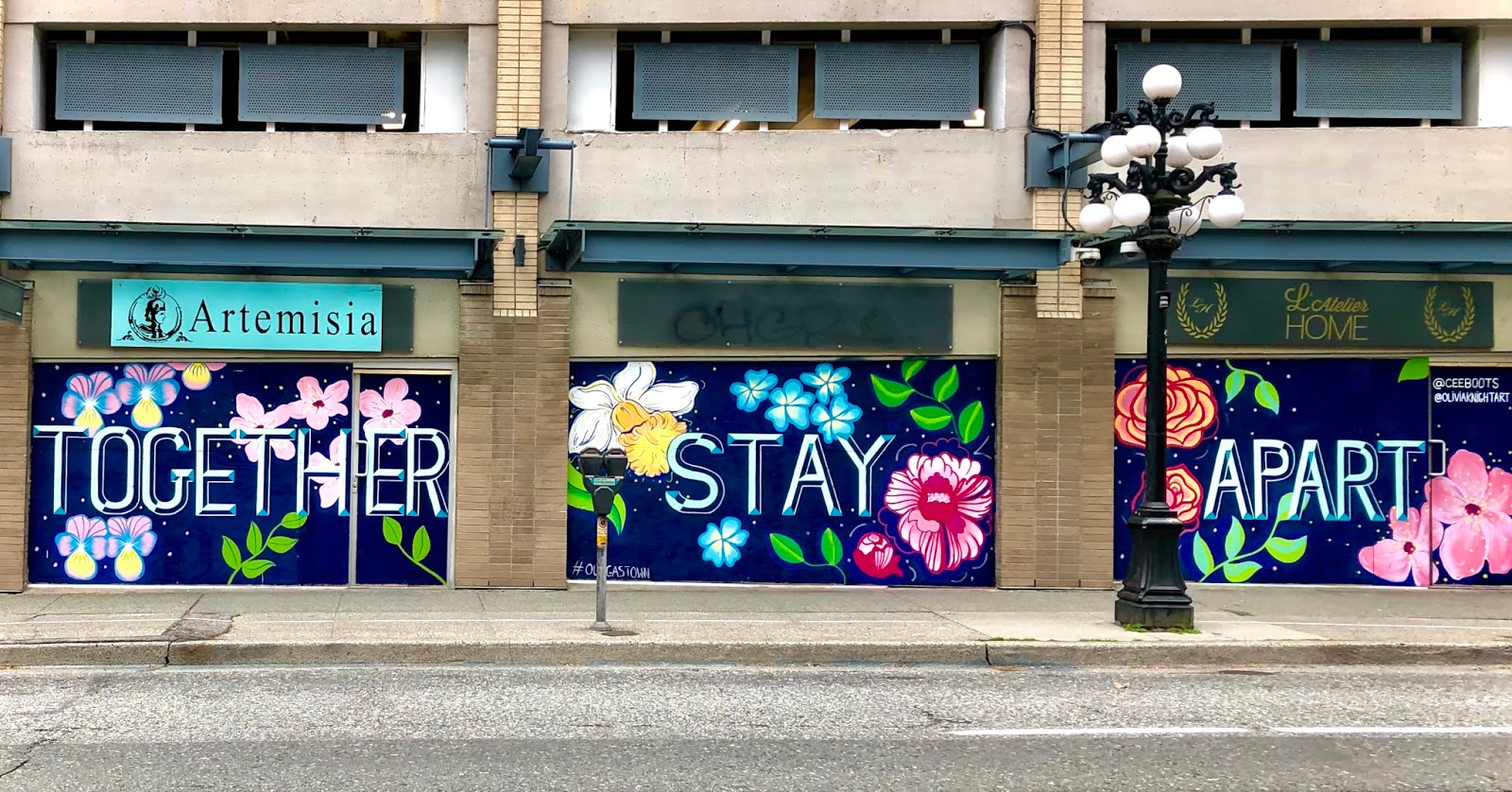
Many business owners in Vancouver’s Gastown neighbourhood have taken to boarding up their windows as an interim target-hardening measure. However, for those who have spent any time in communities where the downtown is failing and businesses are boarded up, you know this can be a very depressing sight.

Photo by Ramachandran Kumaraswamy

One of these Vancouver businesses was less than satisfied with the dreary look of the boards. Local business, Kimsprints, reached out for local artists to paint a mural on the boarded-up shop. The artwork couldn’t be about just anything. It had to celebrate the frontline workers and their incredible efforts to respond to the COVID-19 crisis. Soon after, murals of Dr. Theresa Tam, Canada’s public health officer, and Dr. Bonnie Henry, British Columbia’s health officer were painted over the boards.

The trend continues with several more painted boards, paying tribute to those assisting during the crisis and brightening the appearance of a community in lockdown. While the crisis continues, these beautiful pieces of community art remind us that not only do we need to support our frontline workers – including demanding worker protections and appropriate pay – but we also should remain resilient and connected rather than divided.

Photo by Ramachandran Kumaraswamy

Sunday, April 20, 2014

The city at night

Night time economy in Hoboken, NY - photo Tarah Hodgkinson

GUEST BLOG: Tarah Hodgkinson is a senior researcher in the Integrated Risk Assessment Instrument Research Group in Vancouver, Canada. She is a member of the International CPTED Association and a certified SafeGrowth instructor. She is completing Ph.D in criminology at Simon Fraser University. 

On a recent trip to New Jersey, I had the opportunity to discuss the CPTED concept called activity generators with a local community group. I was reminded of the distinct differences between day time and night time economies. Activity generators (ways of activating spaces for legitimate or positive uses that put eyes on the street) are easy to support during the day time. Examples include food trucks, scheduling outdoor sports games and encouraging community fairs. However, I struggled to think of examples of night time activity generators until I went walking around in the city at night.

Hoboken night time economy

After dinner with friends in Hoboken, we headed back to the train station. Hoboken has a beautiful main street that was bustling. When I think of activity generators for night time, I often think of bars or pubs that might attract people, but not always with positive results. While Hoboken had a few pubs, it also had outdoor fruit markets and late night coffee shops. Legitimately activating their main street, Hoboken businesses encouraged non-drinkers to use the space as well.

Night time strollers in the High Line park - photo Tarah Hodgkinson
The following night another friend took us to the New York High Line. As mentioned in The future of sidewalks, the highline is a well-lit, pedestrian friendly public space that encourages legitimate day and night activity. Through proper lighting, lots of seating, close proximity to homes and shops and incredible design, the High Line draws both tourists and residents alike.

Winter evenings in Vancouver?

While both were great examples of activity generators at night, as a Canadian, I couldn’t help but wonder what to do when the snow falls.

Upon returning home to Vancouver, I walked by Robson Square. In the centre of downtown, surrounded by commercial buildings, this square is largely deserted after five o’clock at night. However, this space is activated with events throughout the summer and is transformed into an ice rink in the winter. Skating takes place both day and night at Robson square with live music, local vendors and tons of people embracing the night and the cold at the same time!

Evening activities in Vancouver's Robson Square 
The possibility for night time activity generators are abundant. We need only look at spaces where people feel safe exploring their neighbourhoods both day and night.