Showing posts sorted by relevance for query the interrupters. Sort by date Show all posts

Tuesday, November 30, 2021

Avoiding whac-a-mole while preventing crime

A violence interruption neighborhood in Syracuse
during our SafeGrowth presentations

by Gregory Saville

A number of years ago I watched an impressive problem-oriented policing presentation about a homicide reduction program in Boston that cut murders in half in a single year. Officially called Operation Ceasefire, it became known as the Boston Miracle and the magician behind it was David Kennedy, one of the brightest criminologists I know, professor of criminal justice at John Jay College in New York.

Ceasefire has evolved into what is now called the CVI method of violence and homicide reduction – Community Violence Intervention. There are two forms of CVI:

  • The first version of CVI is the one I saw from Boston. It goes by a number of names (commonly the “call-in” method where police call-in offenders for a meeting) and it is run through the Center National Network for Safe Communities
        The call-in model is described on the National Network website:    

"Community members with moral authority over group members deliver a credible moral message against violence. Law enforcement puts groups on prior notice about the consequences of further group-involved violence… support and outreach providers make a genuine offer of help for those who want it. A central method of communication is the call-in, a face-to-face meeting between group members and the strategy’s partners."

  • The other version of CVI tends to avoid the justice system, but rather taps into the street knowledge of former street offenders. 

The Cure Violence, also known as The Interrupters, is like the Guardian Angels on steroids. We have blogged on it before. It is described in the 2011 film called The Interrupters and it shows how “Interrupters” are hired directly from the community, sometimes people with a history of gang affiliation. When information arises indicating a potential outbreak of gang conflict, Interrupters visit the neighborhoods and speak directly to those involved. They describe of their own street experience and the consequences of violence and shootings. Their success rate is impressive. 

Cure Violence was the brainchild of Gary Slutkin, an epidemiologist from Chicago.


There are better ways to prevent violence than after-the-fact arrest


Both styles of CVI programs are visiting cities across the U.S. and now Europe and they have an impressive evaluation history. We could certainly use those CVI strategies to tamp down violence in some of our communities in the first few months of our capacity-building work. 


THE NECESSARY INGREDIENT

However, all CVI programs require one essential element in order to function – existing crime! 

That means that, whether police call-in suspected gang members, or if Interrupters visit a potential offender for a shooting, CVI practitioners must already know of a crime underway or about to occur. And these pending events obviously do not happen in a vacuum, they occur in high crime areas or with known perpetrators of violence, shootings and gangs.

In other words, the social, economic, and psychological conditions that led to those risky moments were already in place long before CVI practitioners arrived. There is nothing wrong with preventing violence and shootings. But there is little evidence that intervening with a small group of offenders will do anything to sustainably transform the neighborhood conditions that led to their criminality in the first place. They might get some job offers, training, or perhaps social support for drug addiction. But what about the economic, social, and psychological conditions in the neighborhood where they and their families reside? 

If you tamp down the fireworks, do you address how those fireworks started in the first place so they don’t start again? One published long-term evaluation of the Ceasefire approach concluded “Boston has been challenged to sustain the implementation of the Ceasefire strategy over extended time periods. High profile replications of the Boston approach has experienced similar challenges.” 

What can be done to transform the long-term livability in such places that breed violence in the first place?

Whac-a-mole is a circus tabletop game from Japan 
- photo Creative Commons

WHAC-A-MOLE

It is like going to the circus and playing the game called ‘whac-a-mole’. 

The whac-a-mole game is played on a tabletop with a number of holes filled with plastic moles. The moles randomly pop up and the player whacks each one with a plastic hammer as fast as possible to gain points. The player never knows which mole will pop up, why they pop up, or how to keep them down, other than smashing them with the hammer as fast as they can. 


Prevention programs like CVI require an offender, or offenders, to whack (to deliver CVI programming), but CVI programs have little to say about the root causes why they are violent, why they deal drugs, or from where their criminality arises. Other than individualized programs to help each offender (an important part of prevention, to be sure), CVI programs are not designed to transform the neighborhood so crime-causing conditions no longer create a breed of next-generation offenders.


SafeGrowth addresses many pieces of
neighborhood livability leading to crime


THE DIFFERENCE

That is what SafeGrowth does. By combining 1st, 2nd, and now 3rd Generation CPTED, we help residents rebuild troubled neighborhoods and attack crime at the roots where it grows. SafeGrowth is less about whacking moles, and more about the social ecology and cohesion of a community. CVI is attractive because it works quickly. SafeGrowth takes time. 

Both strategies are important. But without digging at the roots, you hack at the branches and do not fundamentally change neighborhoods where the seeds of crime are planted. We describe this work in SafeGrowth: Building Neighborhoods of Safety and Livability, and in scholarly articles on neighborhoods where we cut crime from New Orleans to Toronto.

We need programs like CVI for effective alternatives to ineffective arrest strategies. But we also need neighborhood transformation programs, like SafeGrowth, to sustain early successes over the long term. 

Otherwise, we find ourselves back to where we started, perhaps one reason the decades-long crime declines are now reversing in far too many cities! 


Monday, October 31, 2011

The Interrupters


Gary Slutkin is another prevention kid with a great program on the block. Despite Newsweek's yellow journalism alleging conflicts between David Kennedy's and Gary Slutkin's different anti-violence programs (and their eviscerating response), they both have the same goal and similar successes. You say tomato, I say tomahto.

Recall Kennedy uses the justice system, targets high risk populations, collects cases on offenders, and uses the threat of sanctions to intervene.

Slutkin takes the public health approach. He blocks violent outbreaks by targeting high risk offenders and uses community "interrupters". Interrupters are savvy street workers who convince family and friends to help offenders see violence is in no one's best interest.

A new award winning film is out called The Interrupters. It describes a year in the life of violence in Chicago. It's a fascinating documentary about Slutkin's program.


I hope the film - and the program - does well.

Still…getting the right program is only half the battle. Staying on point is the other.

Kennedy's CeaseFire anti-violence program cut Boston homicides in half in the 1990s - the Boston Miracle. Now he says they moved away from CeaseFire and crime is on the rise. Streetworker unionization, role change and budget cuts decimated a once proud program.

Oakland too lost the plot. Courts issued gang injunctions without CeaseFire coordination. Then "funds from the city to CeaseFire were interrupted when the number of Oakland police dropped below levels required by the ballot measure."

When will officials learn to keep political fingers off things that actually work in the hood? When will we, the neighborhood dwelling public, wise-up and slap their fingers for it?

Sunday, July 22, 2018

Cure Violence - cutting inner city shootings - Part 2

Safety audit walkabout in Syracuse's high crime neighborhoods
by Mateja Mihinjac

In last week’s blog about Syracuse we introduced the Cure Violence program. We initially introduced Cure Violence seven years ago in our review of the film The Interrupters. Since then the program has expanded considerably.

Cure Violence is a public health approach to violence prevention, targeting at-risk youth to prevent shootings. Its founder, Gary Slutkin, sees violence as a contagious disease problem where violent behavior spreads from person to person as an epidemic with individuals adopting behaviors they observe in their social circles. Cure violence focuses on prevention through interrupting violent behavior and change through treatment and education.

The program shares the same vision as SafeGrowth - building capacity in neighborhoods to interrupt violence within neighborhoods themselves. However, whereas SafeGrowth focuses on a proactive way to plan long-term neighborhood development, the Cure Violence program responds to violence that has already erupted, or is about to erupt.

REPLACING PRISONS WITH PLAYGROUNDS

Slutkin envisions neighborhoods where prisons would be replaced with playgrounds and parks. This vision - reported in the Syracuse projects we discussed in our last blog - helps neighborhoods struggling with high levels of violence. That includes the Near Westside neighborhood in Syracuse.

Cure Violence relies on trained “violence interrupters”, individuals who, due to a similar history of criminality or gang membership, have credibility among the targeted groups.

The model is based on 3 components:

  1. Interrupt transmission – violence interrupters detect and mediate conflicts to reduce likelihood of violent outbursts or retaliation
  2. Identify and treat highest risk to prevent future spread – interrupters assess and refer individuals at high risk of engaging in violence to appropriate social services 
  3. Change group norms – engage and organize community leaders, residents, local organizations and service providers and use outreach and education to denormalize violence.

Near Westside children envisioning a different kind of neighborhood
during SafeGrowth workshop

RESEARCH ON SUCCESS

Evaluation studies support the effectiveness of this approach. In Chicago, for example, the 2009 study reported a 41-73% reduction in shootings across intervention neighborhoods and a 56% decrease in killings in Baltimore.

In NYC, the most recent evaluation reported 27-50% reduction in gun injuries in two NYC communities and 63% reduction in shootings in one community while attitudes supporting violence have decreased and confidence in police increased.

Previous research also reported an 18% decrease in homicide across Cure Violence locations between 2010 and 2013 and 69% in non-targeted locations since the program was first implemented in NYC in 2009.

Cure Violence has to date been implemented in 10 countries across over 25 cities. These include Western cities as well as regions with high levels of violence in South America, Africa, Middle East and zones of conflict such as Iraq and Syria. This year Cure Violence also celebrated a jump in 10th place of the Top 500 NGOs in the world.

The Cure Violence model, therefore, holds a great promise to help reduce violence and victimization from gun violence in cities like Syracuse.

Friday, December 31, 2021

Do the right thing - It will satisfy some and astonish the rest


Walkable, carless, pro-social, and safe. What do future neighborhoods look like?

by Gregory Saville

With apologies to Mark Twain, that quote above is what came to mind as 2021 ends. Such a turbulent year with so many distractions – Covid, mass shootings, increasing crime, social unrest! It’s hard to look back through the lens of the 24-hour news cycle and social media and not conclude that we are going to hell in a handbasket.

Do yourself a solid and have a read of Bailey and Tupy’s exceptional book Ten Global Trends Every Smart Person Should Know. They use those increasingly rare things called facts to soundly debunk the doom-and-gloom-is-everywhere theory.

Bailey and Tupey's book Ten Global Trends - using research and facts to tell the truth. 


When you've read Global Trends, (and after you mask up, vaccinate, and elect better politicians with better policies), then give a thought to doing the right thing for safety in 2022 and learn some state-of-the-art theories in neighborhood crime prevention. There are a few good ones to pick from, but be careful - some only go halfway. 

Here are a few to watch:


SITUATIONAL PREVENTION 

In the 1970s they created electric car alarms to cut auto theft. You know, those pulsing lights and blaring horn alarms (BLEEP...BLEEP...BLEEP) that, nowadays, most people just ignore.

Around the 1980s, they created The Club to lock a steering wheel so thieves could not drive the car. Unfortunately, thieves adapted and learned to hacksaw the steering wheel and slide The Club off. One thief said: “So if it takes 60 seconds to steal a car, it now takes 90.”


The Club auto theft prevention device - photo Wiki Creative Commons

In the 1990s auto manufacturers adopted another situational crime prevention approach to harden the target. They created vehicle immobilizers, electronic devices that prevent a car engine from starting until a proper key transponder is present. Immobilizers prevent hot wiring and also eliminate that annoying BLEEP...BLEEP...BLEEP.

What is the result of situational crime prevention?

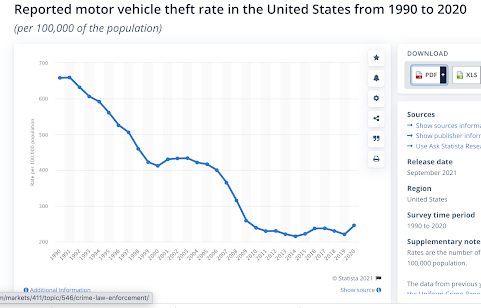
Some criminologists say the increasing adoption of security technologies has cut crime opportunities all over the world. Crime everywhere has decreased and auto theft has plummeted, as you can see on the graph.


Auto theft rates sunk as theft devices were adopted...

Except, there are a few glaring problems with this theory. First, not all crime rates around the world have declined in spite of more security technology! (Latin America comes to mind). 

Second, consider this...

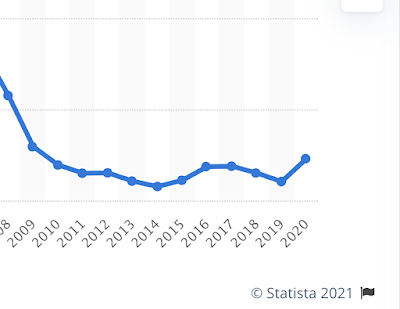
...up until the past decade when rates began increasing.


Even with improvements to auto theft prevention, decade after decade, in the past ten years auto theft rates have NOT declined. In fact, they have started to increase! Look at the reality in the chart above of the past 10 years! How can this be? Security technologies have not vanished.  

Why are auto theft rates increasing? Perhaps the situational prevention theory spends so much time hacking at the branches of crime opportunity, it missed digging at the roots of crime causation?


FOCUSED DETERRENCE

Consider another recent prevention theory - focused deterrence, also known as CVI (community violence interrupters). I blogged on this promising strategy a few weeks ago.


Most modern crime prevention strategies zoom down from the level of the
entire city into specific areas (SafeGrowth), specific situations (situational prevention), or specific offenders (focused deterrence)


In a 2019 article, "There is no such thing as a dangerous neighborhood",  Stephen Lurie says we should not fix broken neighborhoods but rather target the small group of chronic offenders in those neighborhoods who cause most problems. That is how CVI intervenes in the cycle of violence. Says Lurie:

"The notion that public disorder drives criminality can seem an intuitive approach to public safety. But if people understand that most serious violence circles specific interpersonal group dynamics in structurally disadvantaged communities, order maintenance policing seems more like what study after study shows it is: an unnecessary evil."

Regrettably, permanently resolving a complex crime problem is not as simple as intervening with the offender before they rob or shoot. As the late Desmond Tutu warned, "There comes a point where we need to stop just pulling people out of the river. We need to go upstream and find out why they're falling in."  

No doubt we need to do something fast when violence threatens and that is something at which situational prevention and focused deterrence both excel. But there is no hiding the fact that they both hack at the branches - neither one alters structurally disadvantaged communities in any meaningful way. 

Criminologists will tell you there are many seeds to crime causation. But over a half-century of criminological research amply demonstrates that the dysfunction, trauma, substance abuse, and blight in disadvantaged communities provide the breeding ground from where most chronic offenders emerge in the first place. Severely disadvantaged places create an endless supply of chronic offenders and if we want to dig at the roots of crime, and not hack at the branches, we must face those structural disadvantages. That is from where hope emerges and that is how we do the right thing.  


ANOTHER WAY - SAFEGROWTH

Some criminologists and law enforcement officials will complain that it is exceedingly difficult, (and takes a long time) to deal with deep structural problems in neighborhoods. Part of that is because the expertise and professions that deal with such problems are not found within criminology or law enforcement. They are found in economic development, urban planning, neuropsychology, cognitive science, and education. 

That is why SafeGrowth practitioners collaborate with experts in all those different fields and then work with residents to co-develop prevention plans. This kind of deep-dive capacity-building is neither simple nor fast. Ultimately, SafeGrowth marries community development and social prevention with 1st, 2nd, and 3rd Generation CPTED. The method has been successful for decades. Our SafeGrowth book describes how we keep our eyes on the real prize. 

A few other recent examples:

These are only a few of many ways forward. In 2022 let’s do the right thing and not lose sight of the fact that, if we want to build a better society, we actually have to build a better neighborhood.

Happy New Year. 


Friday, September 25, 2015

Our enemies in blue


Our Enemies in Blue by Kristian Williams
This week I heard from two old friends, an ex-police chief and a current chief. Echoing sentiments in our recent book You In Blue, one offered, “there needs to be a new narrative”. The other, surprisingly, referred me to the controversial anti-police book by Kristian Williams,  Our Enemies in Blue: Police Power in America.

Our Enemies attempts to string together a series of violent police incidents like Ferguson and Baltimore into a wider historical chain stretching back decades. According to Williams, links showing up today - zero-tolerance, order-maintenance policing and quality-of-life policing - are but the latest manifestation of an age-old chain.

ALTERNATIVES 

Agree or not, Williams is not the first to suggest alternatives to the criminal justice system. Restorative justice, CPTED, the Interrupters, and SafeGrowth are all modern examples. Williams’ examples are a tad more unconventional and less stable. (The now defunct Black Panthers is one.)

Still, Williams’ central theme has been widely researched in the police literature: “The police do provide an important community service - offering protection against crime. They do not do this job well, or fairly, and it is not their chief function, but they do it and it brings them legitimately.”

Williams curiously ignores decades of collaborative problem-solving in the POP world - no doubt because POP refutes his point. But the fact that most police basic training academies ignore POP, reinforces it.

A WORLD WITHOUT POLICE?

Williams asserts: “it is a bad habit of mind, a form of power-worship, to assume that things must be as they are, that they will continue to be as they have been... The first step toward change is the understanding that things can be different. This is my principal recommendation: we must recognize the possibility of a world without police.”

I’m not sure what that world would look like. But the fact that this sentiment has sizable voice and more listeners than ever before tells us the ripples started in Ferguson are splashing on shores far and wide.

Saturday, December 21, 2013

A perfect storm for Christmas - cutting murders


Last week New Orleans mayor Mitch Landrieu announced early results from their homicide reduction program. Unknown at the conference, this creates a fantastic new opportunity. It all starts with the following hypothesis:

Neighborhoods infused with SafeGrowth will help violence reduction strategies like Ceasefire to cut crime more effectively and longer than neighborhoods without.

New Orleans homicide strategy includes the Chicago-style Interrupters, blight reduction and other SafeGrowth-like programs. It also includes David Kennedy's anti-gang violence program called Ceasefire. It's this latter program that caught my eye.

New Orleans' Hollygrove neighborhood - photo Megan Carr
For years I've been a supporter of David Kennedy's Ceasefire. And David is still on the job in places like New York. Ceasefire tackles neighborhoods wracked by violence by calling-in gang members and giving them a choice between arrest and targeted sanction or job training, counseling, housing, and social help.

The message to gang members: We care about you because you are part of our community, but the violence has to stop! As Mayor Landrieu said at the press conference, "the laws of engagement on the streets of New Orleans have changed."

He credits Ceasefire with a big reduction in homicides.

ALEADY IN HOLLYGROVE

Here's the thing; New Orleans' Hollygrove neighborhood already had a huge decline in homicides when residents and AARP instituted SafeGrowth and other programs a few years ago. Murders declined from over 24 to less than 6 with no Ceasefire whatsoever.

That's not to slam Ceasefire - it's a good program. True, there has been some criticism that Ceasefire doesn't work or just fizzles out. But now we have the perfect storm for a researcher, an ideal opportunity to test the hypotheses that SafeGrowth creates conditions for programs like Ceasefire to sustain lower homicide rates longer than in other neighborhoods!


I gave up my own evaluation research years ago. Practitioner work takes too much time. But I always encourage researchers to dig in. This meets all the conditions for a natural experiment...a perfect holiday gift for an enterprising criminologist. It could help communities everywhere.

Merry Christmas!