Showing posts sorted by relevance for query summit. Sort by date Show all posts

Saturday, November 14, 2015

The Century of the Neighborhood

Taking a break from deliberations at the 2015 SafeGrowth Summit
Engaged citizens from around the world
Four months ago I posted about President Obama’s eulogy following a racial massacre in South Carolina.

This morning we heard news of another massacre, this by terrorists in Paris. In today’s global village a tragedy for one is a tragedy for all. From that view, these are times of storms.

“When you come out of the storm,” said novelist Murakami, “you won’t be the same person who walked in. That’s what this storm’s all about.”

THE SAFEGROWTH SUMMIT

Last week a small group of SafeGrowth advocates and some likeminded friends from around the world mapped a new way out of these storms in the first-ever SafeGrowth Summit.

One of the SafeGrowth work teams - two day of visioning the future
We met encircled by Canada’s Rocky Mountains in Canmore, Alberta. Hailing from different countries and cities small and large, participants included residents, artists, planners, police officers,  architects, criminologist, activists, but mostly active and engaged citizens.

Our task? Search for practical paths that build community resilience and lead away from crime and violence.

Four diverse teams found their own ideal visions. One crafted neighborhood hubs, a 21st Century shared public gathering space far beyond today’s community center. Another began building a tailored style of hands-on curricula to educate a new generation of neighborhood leaders.

Each team resonated with the idea that it is within the geography of the neighborhood where solutions arise.

Local graffiti artists running their first-ever art show for Summit participants
Following the Summit participants shared their ideas with residents of the 12 CSI Neighbourhoods at a social event on Calgary’s International Avenue, an event punctuated by the inspiring art show of local graffiti artists and music from a youth quartet from Calgary's Multiculural Orchestra.

We are writing Summit results to publish a book in the spring. For now teamwork continues; it continues to frame a way out of the storms of violence, crime and intolerance facing us in the years ahead. And it continues to verify, once and for all, the 21st Century belongs to the neighborhood.

Last day performance by a youth quartet from the Calgary Multicultural Orchestra 


Wednesday, October 26, 2022

A desert Summit in Palm Springs - COVID finally eases

2022 SafeGrowth Summit hotel - Hilton Palm Springs

by Gregory Saville

Over the past 7 years, the SafeGrowth Network has met annually at our training Summits to teach each other new concepts and tactics arising through our community-building and crime prevention programs. It’s a time for us to recharge our batteries and recuperate in the company of like-minded, funny, and intensely talented, people (Pina colada’s served with pink umbrellas under palm trees comes to mind). 

We invite others outside the network to participate in our Summits, such as community groups, journalists, business associations, housing groups, police, academics, and other urban design professionals. Then we set aside time to give back to the community in the form of public training, presentations, or workshops. 

All that came to a halt with the COVID pandemic relegating us to online Zoom meetings – a distant substitute for sharing good food, relaxing at the beach, or laughing in person. Finally, after a long wait following our Cancun, Mexico Summit in 2019, we had our first face-to-face in three years in Palm Springs, California last week. 


One of the Palm Springs pathways we examined
during our walking audits

PALM SPRINGS, CALIFORNIA

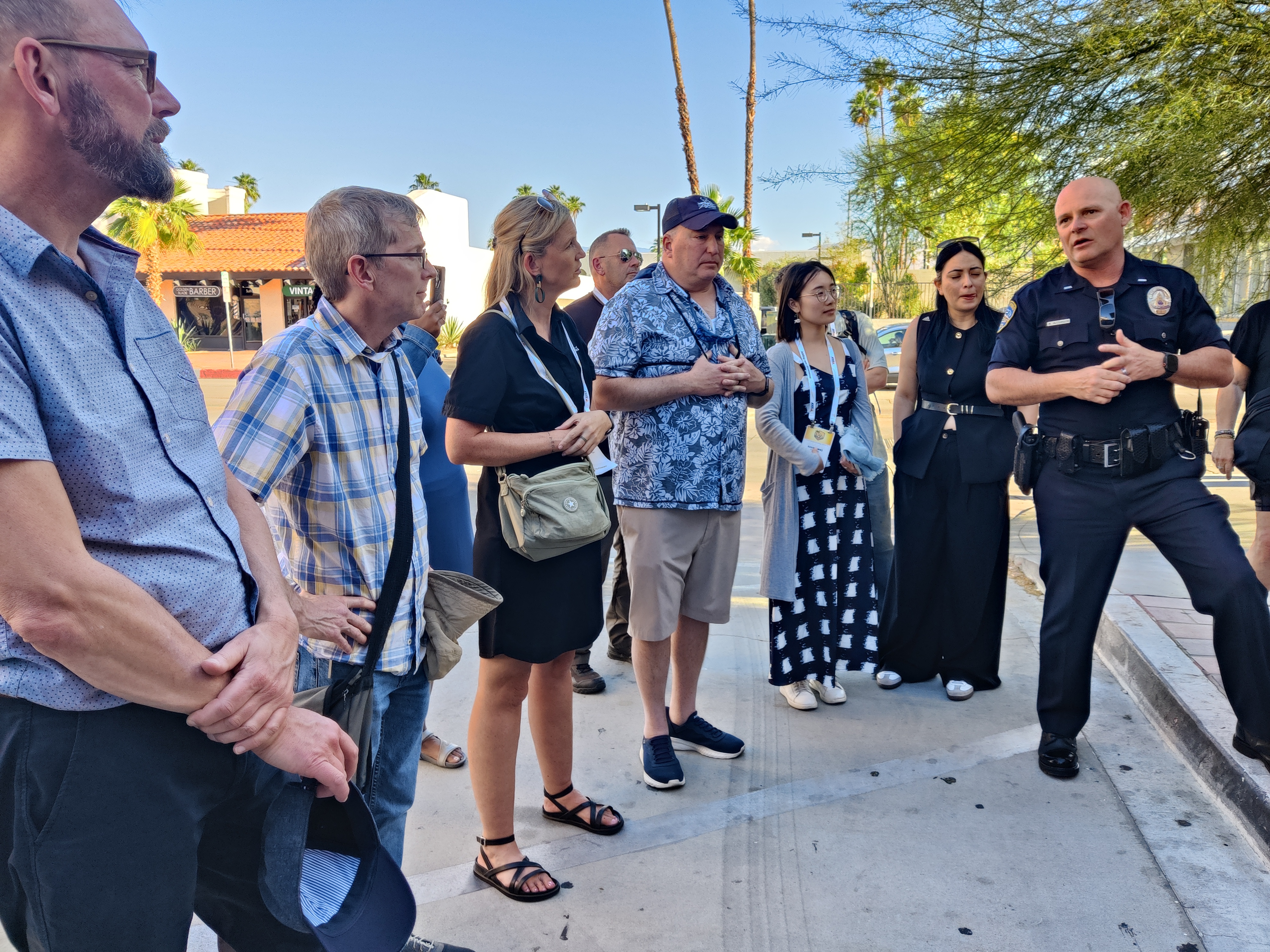
Over the years we have partnered with neighborhood associations, national non-profits, and crime prevention organizations. This year we were delighted when the Palm Springs police department –  in the form of Chief Andy Mills and Lt. William Hutchinson – offered to sponsor our meeting and participate in our 2022 SafeGrowth Summit. 


Palm Springs police chief Andy Mills introduces the
SafeGrowth team to community members


Ten members of our team, (five more virtually) and a half dozen members of the police service, gathered at the Hilton Palm Springs Hotel, the police training facility, and on the downtown streets of the city, to discuss, analyze, audit, and brainstorm different ways to bring safety and livability to neighborhoods of the future. 


SafeGrowth team member Anna Brassard describing SafeGrowth

Mateja Mihinjac outlines a part of model to residents

Harry Tapia explains Livability Academies 


Among other topics, our Summit themes included:

  • a new method for community engagement, 
  • different ways to review crime trends in Palm Springs,
  • next steps for the Livability Academy status in Philadelphia,
  • situational awareness during site visits,
  • SafeGrowth progress in Sweden following the 2022 H22 Smart City Expo,
  • A review of current trends in planning theory,
  • geography of crime theories and community crime theories related to SafeGrowth.

We discussed the situation in Palm Springs and we ran two public sessions on two different days to introduce residents and business owners to different parts of the SafeGrowth model. We gathered 40 community and business residents for presentations on Livability Academies and other programs in SafeGrowth. We toured their city with them so they could show us their concerns and hopes for the future. The local media was terrific in providing accurate and timely reporting on our week in their lovely city. 

THE END OF COVID

Work retreats can be dull and dry affairs, but beautiful Palm Springs did not disappoint with its eclectic street furniture, art, and statues, along with some of the best mid-century modern architecture in the nation (Frank Sinatra and the rat pack lived here). Along the way, we hiked the nearby mountains, went up the gondola, spent time at the weekly street market, and were entertained by the Denver band MOOSGH at the Hotel Zoso

There is no replacement for face-to-face encounters when it comes to SafeGrowth and other forms of community development. It’s great to see the other side of the pandemic.

Best wishes to the many wonderful residents and professionals in Palm Springs, especially Chief Andy Mills and Lt. William Hutchinson. Thanks for the hospitality.  


Thursday, September 19, 2019

Meeting in Mexico


by Gregory Saville

A few weeks ago we ran our SafeGrowth Summit just before the annual International CPTED Association conference. Both events were held at a sunny beach resort in beautiful Cancun, Mexico, and they were a study in contrasts.

The SafeGrowth Summit included an intimate group of a dozen SafeGrowth Advocates who ran informal workshops in person (and online) while the ICA conference featured over 500 delegates in formal presentations. Yet both events brought people from around the world and both were smashing successes.

SAFEGROWTH SUMMIT

This was the 6th SafeGrowth Summit comprising small, brainstorming sessions where those of us in the SafeGrowth network share successes and failures and also develop new strategies to move the concept forward. We reflected on project work this past year and examined the politics of change. We saw architectural renderings of neighborhood hubs designed by one of our Latin American members and we learned the results of a recent beta-test of our new GPS digitized field observation software.

There were inspiring accounts of the Philadelphia Livability Academies now underway and we discussed a new methodology to track our success after neighborhood projects. We talked, discussed, ate, swam, planned and, best of all, laughed.

The 2019 venue offered sunsets and great facilities

CPTED CONFERENCE

The ICA conference followed immediately after at the same venue and produced the largest audience in ICA history. Over 500 delegates came to share successes and failures, but they focused their work on different versions of crime prevention through environmental design. While SafeGrowth uses both 1st and 2nd Generation CPTED, it does this through the lens of planning safer neighborhoods, community development, and social capacity-building.

The ICA conference featured the first-ever, commercial Expo, as well as case studies from cities around the world. Many of our SafeGrowth Advocates delivered presentations at the ICA conference. Best of all, two of our SafeGrowth Advocates, Mateja Mihinjac and Carlos GutiƩrrez, won international achievement awards from the ICA.

Congratulations to all for great work to make neighborhood lives safer and more vibrant.

Monday, June 29, 2015

Coming out of the storm - A SafeGrowth Summit


Announcing 2015 SafeGrowth Summit
****

The post Great Recession years in this first part of the 21st Century carry great change, much of which fires the turbulence we see around us this summer.

A US President sings a eulogy following a racial massacre. American cities simmer in urban discord following police shootings. Broken windows and stop-and-frisk remain incendiary police tactics. And in Britain and Australia, quota-driven policing is seen for the sham that it is.


It's hard to imagine a more apt time to remember Haruki Murakami's words from his book Kafka on the Shore.

“When you come out of the storm, you won’t be the same person who walked in. That’s what this storm’s all about.”

In response to the turbulence we just launched a three-pronged reply:
  1. An upcoming SafeGrowth Summit,
  2. A new SafeGrowth website with a network of SafeGrowth advocates, services, events, and answers
  3. A  police recruit training book by Gerry Cleveland and myself - You In Blue - outlining the shape of  21st Century policing. 
Check them out. We can choose our way out of this storm. That's what it's all about!

Blackstone Mountain Lodge, Alberta - Venue for 2015 SafeGrowth Summit

Saturday, November 5, 2016

Storytelling - A narrative for change

Storyteller Katrice Horsley performing at the New Orleans SafeGrowth Summit
Guest Blog: MATEJA MIHINJAC is a criminologist completing a PhD in CPTED at Griffith University, Australia. She is a SafeGrowth Advocate, a member of the International CPTED Association and the American Society of Criminology.

At our New Orleans SafeGrowth Summit four weeks ago we had the pleasure of hosting a National Storytelling Laureate for the United Kingdom and a storyteller of 30 years, Katrice Horsley. Katrice injected us with warmth, energy, and passion for creating social change through what she refers to as “narrative for change”.

We learned how storytelling can serve as a powerful transformational method for achieving social change to promote empowerment and social justice. Several organizations such as Transformative Storytelling for Social Change use storytelling to form meaning and experience through narrative and do so in a fun and non-threatening way. As Katrice also explains:
“Storytelling is the main way that we make sense of ourselves and of the world around us, both through the stories we choose to hear and the stories we choose to tell. New findings in neuroscience now show us how important narrative is in creating an identity for ourselves and also in experiencing and understanding how others make sense of their worlds.” 
Katrice uses imagery and tools to envision narratives 
Katrice challenged some of our narratives that become beliefs, not only about us as individuals, but also about our neighborhoods. We learned how to express our own stories, and our neighborhood stories, in creative ways that included props like textiles, cards, and threads.

These are powerful methods for creating change through narrative and they equipped us with new skills for neighborhood development. Katrice showed how storytelling can deliver outcomes such as:

  • Building networks 
  • Enabling a just process for all voices
  • Raising political awareness about common problems
  • Serving as a catalyst for change

One of Katrice's sketches for our SafeGrowth narrative
Katrice’s powerful performances during the Summit echoed the SafeGrowth message that, just as we can envision multiple futures for change, there are many narratives for our neighborhoods. Narrative induces particular emotions and attitudes and, if we confront those honestly in stories, we can challenge ingrained beliefs that block progress. That allows us to better tap into new ideas towards some desired future. In Katrice’s words: “If you want to effect a change then narrative is the way forward”.

Katrice helped us see the great potential that transformational storytelling has within SafeGrowth programs for planning vibrant and safe 21st Century neighborhoods.


Tuesday, December 24, 2019

The making of a smarter city


by Gregory Saville

As the year ends, I’m remembering the air of electricity and innovation emerging at the Helsingborg 22, Smart City Summit in Sweden that I attended in November. It was a remarkable event! It triggered a thought that sticks in my mind…

By 2030 over 60% of the entire world will live in urban centers. Most of the leading industrial countries of the world are already predominantly urban: over 80% urban in the U.S., Canada, Australia, UK, Chile, Sweden, South Korea, Mexico, and Brazil.

It’s similar in India, that historically so-rural subcontinent of villages and farms. A decade ago, I recall listening to India’s Minister for External Affairs describe the rapid urbanization of his country, a billion-person behemoth soon to top China as the most populous country on the planet. Today it has some of the world’s largest cities.

Megacities are invariably tall cities
We’ve also seen the eruption of the megalopolis – the megacity once prophesized in Sci-Fi fare. The latest UN statistics now say it’s real:
  • 43 megacities now have over 10 million people, including the metropolitan areas of New York City, London (within the M25), Los Angeles, and Paris;
  • 6 megacities have over 20 Milion - Cairo, Mumbai, Beijing, Dhaka, Mexico City, Sao Paulo;
  • 2 have over 26 million - Shanghai and New Delhi; 
  • 1 has a staggering 37 million - Tokyo, the world’s largest city.
It seems too obvious to state that the key to our future is creating sustainable, livable and healthy cities. Not so obvious is the key to habitability: safety from crime and fear of crime.

Experimenting with lighting a public toilet
in Smart City Helsingborg - Tardis of the future

SMART CITY IN SWEDEN – THE ANTIDOTE?

This brought to mind the H22 Smart City Summit. Unlike the Smart Growth planning program, the Smart City movement is of much more recent vintage. It talks of artificial intelligence, how Internet-of-Things data devices might better manage transport, power, water supply, schools, hospitals, utilities, and even crime. It proposes a new age of connectedness and livability.

Just imagine… no garbage trucks, massive cuts in energy use, increased quality of life, smart LED street lights with sensors to watch street conditions, faster routing for self-driving cars, smart drone shopping that avoids parking lots, automatic air pollution elimination, faster emergency response for medical and fire emergencies, and so forth.

Helsingborg is taking a close look at all this. It is spending time and money to test new Smart City ideas and it plans to take neighborhood quality of life, urban planning, and urban governance to a new level. In 2022 it will show the world in the H22 Exposition.


In November, I joined Ifeoma Ebo from the New York Mayor’s Office of Criminal Justice, to present our work on SafeGrowth and CPTED in 15 high-crime New York public housing projects. The approach of our talented SafeGrowth team members was decidedly low-tech with plenty of community involvement. Summit participants seemed to see a link in our project to Smart Cities of the future.

DEMOCRACY DESTROYER?

Some think Smart Cities are a utopian dream that will destroy democracy.

Maybe that’s true! When we wrote about Smart Cities in our SafeGrowth book last year, the last chapter, A Vision for the Future, described one vision – except that was a dystopian, not utopian, vision.

I’ve also blogged here about another Smart City innovation – computer algorithms that try to predict crime, the so-called predictive policing. Since then, I’ve followed it in two cities that tried, and abandoned, predictive policing - one in California and another in my own home city. It seems we have a very long way to go.

Either way, Smart City concepts deserve careful monitoring and thinking. And given the explosive rate of urban growth around the world, we might have no better choice but to get the Smart City idea right. Helsingborg's H22 Smart City movement gives us a chance to do just that.

Saturday, December 12, 2020

Abolish CPTED?

Is CPTED racist? Does it exclude minorities?


by Gregory Saville

As our COVID ravaged cities impose social isolation, working-from-home, and cabin fever, those who live in high-density apartments and housing developments must be confident they are safe from crime and violence. And, more than ever before, residents must feel their home is a sanctuary. Crime prevention through environmental design - CPTED - is an ideal answer for these difficult times, especially 2nd Generation CPTED and SafeGrowth.

Next Thursday, Dec 17, I and some colleagues are running a free educational webinar for property managers, realtors, and housing groups seeking residential safety. The “Virtual Property Management and Safety Summit” is sponsored by real estate safety expert, Tracey “the safety lady” Hawkins.


THE ANTI-CPTED MEME

All this stands in stark contrast to recent calls for the abolition of CPTED from municipal codes and city planning due to the perception that CPTED can exclude minorities from public life. Consider the Vancouver City Planning Commission website or articles by Bryan Lee Jr in Bloomberg City Lab website.

Keeping residents safe at home - What are the alternatives?

According to Lee: 

“While CPTED principles are said to help discourage crime by orienting building windows and entrances to aid in providing “eyes on the street” that monitor activity, in practice this strategy can end up serving the same suppressive purpose as stop-and-frisk policing — to assure that anyone considered suspicious is made to feel uncomfortable.”

The solution, say these latter-day gurus who would protect us from the current Racial Reckoning, is to abolish CPTED, a crime prevention strategy that has brought safety and security to millions of citizens all over the world – as you will discover by reading some of the hundreds of scientific publications regarding CPTED. 


ABOLITION OR ACCREDITATION?

In my view, CPTED is not the problem. For example, while aspirin has been an effective pain remedy for over a thousand years, improper use can result in overdose and stomach problems. The solution is not to abolish aspirin. Same with CPTED. It is vulnerable to improper use by poorly trained practitioners. No doubt some practitioners indiscriminately lock and fence properties without regard to alternative options. CPTED can produce racial exclusion if placed into the wrong, untrained hands. But the solution isn’t abolition. It’s proper training and certification through legitimate accredited courses – the very thing the ICA has offered for years.

In his 1972 landmark book “Defensible Space”, architect Oscar Newman wrote 

"The question to be asked is how does one initially achieve thoughtful building groupings rather than having to resort to barbed-wire fences and locks after the fact?"

One answer appeared on the International CPTED Association’s “Special ICA Webinar: Exclusion versus Inclusion – In CPTED Everyone Has a role”.

On Thursday, Dec. 17, we will provide another during our Safety Summit

Join us.

Thursday, Dec 17 - free summit on property safety

Sunday, November 10, 2019

Greta, H22 and the time bomb

The climate crisis affects everything - including
crime prevention and city development

by Gregory Saville

Tick tock…the clock is ticking.

I recently watched 16-year old Greta Thunberg glare at global leaders and chastise the United Nations for not doing enough about the Climate Crisis. Record numbers of wildfires burn around the world. Floods, hurricanes, and extreme weather dominate the news. And, says Greta, (and legions of scientists), because of climate deniers, Big Oil, and dallying politicians around the world, time is running out.

Tick tock.

In truth, it isn’t from those living today that the Climate Crisis was born. It was born in the belching factories of the Industrial Age, weaned by a century of exploding (and irresponsible) population growth, and befriended by decades of poor environmental choices. Some of those poor environmental choices emerged in how we built cities – sprawl, acres of parking, carbon eating suburbs.

The result? Tax money spent on sprawl left the inner city vacant, sleepy, and blighted. Downtowns were vacated by shoppers looking for regional malls. The guts of the city were emptied into the box stores of the burbs. Studies about such development show that “living in a city can alter our brain’s architecture, making it more vulnerable to… social stress.”

So not only does pollution and smog harm our lungs and bodies, but
neurophysical research suggests that poor urban living conditions negatively affect our brain biology, particularly the part that affects moods – the amygdala – such as anxiety disorders and mental conditions like schizophrenia.

However, while time runs out and Greta says we aren’t doing enough, it isn't true that we are doing nothing. Some innovations do break through.

Swedish teenage climate activist, Greta Thunberg,
after her United Nations and European Union speeches
- photo European Union, Creative Commons

FIGHTING BACK – H22 IN HELSINGBORG

This week I co-presented our SafeGrowth project work from New York at the H22 Summit in Helsingborg, Sweden, a conference on Smart City innovations and how they combat climate change. Delivered with my colleague Ifeoma Ebo from the New York City Mayor's Office on Criminal Justice, our message showed how tactics in SafeGrowth and community empowerment in high-density housing can humanize residential towers and reduce victimization. If we are to densify in the future, we must know how to do it well.

The conference was in preparation for the H22 Smart City Exposition in Helsingborg. Smart Cities is a concept to dramatically expand data networks and sensors into city operations and embed information and communication technologies via the IoT (Internet of Things) for more efficient use of resources. The idea is if city officials can interact better with residents and monitor city life, they can more efficiently improve infrastructure and services.

Presenting our SafeGrowth work this week at the H22 Summit
in Helsingborg, Sweden - photo Peter Brinch, H22 Summit

It is, in effect, a technical battle against inefficiency and climate change. In the past, I have been skeptical of some smart technologies in policing and crime prevention that have not seemed so smart. So I was curious how the European smart city movement – particularly this one in Sweden -  differed from what I’ve seen thus far. I was not disappointed.

CONNECTING SMART GROWTH TO SMART CITIES 

The earliest battle against the environmental crisis began in the 1960s with the counter-culture warriors, triggered by Rachel Carson’s book Silent Spring on the insecticides poisoning our water.

Silent Spring uncovered how Chemical Industry pesticides
poisoned agriculture

Those early warriors grew into environmentalists who created, among other things, Smart Growth to confront sprawl and reimagine urban villages that offer more friendly places to live, and transit-oriented developments.

Smart Growth is another front in the climate battle. It’s an urban planning rebellion against ecological waste and carbon waste. For 20 years it has promoted new kinds of planning and zoning to improve the environment and create walkable streets. Sadly, most politicians are still ignorant of Smart Growth and few in the public have the slightest idea how it reduces sprawl thereby cutting pollution and carbon emissions.

In the 1990s I worked with a design team on one of the earliest Smart Growth projects in Vancouver – the Collingwood Village community near the Joyce/VanNess Skytrain Station. Touted today as one of Vancouver’s most successful neighborhoods, the Collingwood story has appeared in this blog. Twenty years later we now see how smart growth/transit-oriented development can last.

Vancouver's Collingwood Village transit-oriented development

TICK TOCK – SPRAWL FLOURISHES

In spite of all this, anti-Smart Growth critics hope to turn back the nostalgia clock. They restrict multi-family units, spend billions on expressways, ignore efficient commuter trains, and they fight for low densities. Want proof? Look at the outer suburban rings of Calgary, Toronto, Winnipeg, Phoenix, Atlanta, St. Louis, Dallas, Houston, Sydney, Perth, etc.

I should know; I live in one! An unpleasant fact I learned the hard way is that owning or renting an affordable home requires a wide range of housing options and, in most larger cities in the developed world, those options are limited by decades of single-use zoning that encourages lower densities. Without more affordable choices, we are left with housing from existing housing stock - and that means suburbs.

There is much to be done, not the least of which remains convincing the business-as-usual crowd that, frankly, things have changed and time is running out. Greta is right. We must do better. Sooner!

Friday, September 30, 2016

New Orelans SafeGrowth Summit


Twenty eight years ago a group assembled on the shores of Lake Couchiching, Ontario, 150 kilometers north of Toronto. They met to brainstorm new ways to prevent and analyze crime, deploy community police officers, and build safer cities.

The event was summarized in a book I authored, Crime Problems, Community Solutions - Environmental Criminology as a Developing Prevention Strategy. It was the beginning of SafeGrowth.

Next week a group of AARP representatives, community members, criminologists, planners, and others interested in crime, safety, and vital neighborhoods will gather in New Orleans to continue a journey started long ago. The New Orleans Summit and Search Conference is the first in the south/eastern U.S.

FIRST EVER SEARCH CONFERENCE

The Lake Couchiching event was the first-ever search conference in criminology, a method of community visioning and planning developed shortly after WW2. It set the stage for a different style of crime prevention based on the place and time of crime events - today called situational crime prevention.

The community and police representatives at the event thought cohesive neighborhoods also mattered a great deal. Thus was born the SafeGrowth philosophy of neighborhood planning.

Today SafeGrowth theory is a formal method of crime prevention. In the past few years we've had  more Search Conference events, one in Canmore, Alberta and another in Sacramento, California, to expand the concept. The New Orleans conference is the latest.

Watch our SafeGrowth website for our latest ideas to more forward.

Saturday, June 30, 2018

New SafeGrowth book on Amazon

SafeGrowth book in soft cover and Kindle from Amazon
by Gregory Saville

We are thrilled to announce the publication of our new book, SafeGrowth: Building Neighborhoods of Safety and Livability! This book chronicles a decade of implementing and teaching SafeGrowth, along with methods like 2nd Generation CPTED, to turn troubled places back from the brink of crime.

This is part of the back cover:
"Do we really seek more CCTV cameras on public streets to protect us from the supposed enemy at the gates as we cower behind our doors? When did we agree to a public life with more razor wire, chain-link fences and cops zooming from one call to another, sirens blazing? There is a better way to create safer cities and, while some programs have existed for years, few offer a coherent way to plan cities in partnership with residents. 
SafeGrowth is a new model for building crime-resistant and vibrant neighborhoods in the 21st Century."
While a decade of SafeGrowth training programs (and this blog) represent building blocks, this book frames the latest and most complete version of the model. It is the first full statement of the SafeGrowth theory. I edited and authored the book with others who attended and facilitated three SafeGrowth Summits, starting with our inaugural Summit in Canmore, Alberta in 2015 coordinated by our own Anna Brassard.

A few of the participants from the Canmore, Alberta SafeGrowth Summit, 2015

Part 1 of the book describes recent years as a time of transformation and it places social unrest, crime, and urban development into a larger historical context, especially chapter 2, "Stirrings of a New Idea".

The book then recounts the findings from three SafeGrowth Summits, particularly the first one at Canmore, Alberta where thirty participants created new ideas for planning safer neighborhoods with chapters on “The Hub Concept”, “Urban Villages” “Block Level Development” and “Livability Academies”

CASE STUDIES AND THE FUTURE

Part 3 includes case studies from the cities of Red Deer, Alberta and New Orleans, Louisiana. Another case study includes a chapter by International CPTED Association board member, Elisabeth Miller called, “SafeGrowth in Saskatoon”.

The final chapters of the book, written by Mateja, Tarah and myself, describe four principles of SafeGrowth theory. We hope you enjoy the fruits of our hard work and see how SafeGrowth offers a 21st Century blueprint for anyone who loves safer cities.

You can order the book here.

Wednesday, January 9, 2013

Safe Alex - 21st Century Lighthouse

Prevention will not take root without a holistic approach.
A recent newspaper article suggests Safe Alex is impacting crime
GUEST BLOG

Jacques Roy is the Mayor of Alexandria, Louisiana. In 2010-2011, Mayor Roy and staffers Lamar White and Daniel Smith began working with SafeGrowth. Following the staffers attendance at a SafeGrowth workshop they brought concepts back to Alexandria. Later in the year I presented SafeGrowth at a development summit and was asked to tailor a program with the Alexandria administration. This became the Safe Alex initiative. In this guest blog Mayor Roy offers thoughts about where SafeAlex is today.

Neighborhoods are the lynchpin for sustainable success in preventing crime and tackling blight. A few years ago, a bold editorial in a local paper declared that our SafeAlex program would not take root unless it was police led and police dominated.

While I do not want to simplify this complex issue to an absurdity or add meaningless clichƩs, holistic approaches that make communities take responsibility, I suspect, will beat out the belief that some single government organization or actor can provide all the answers.

The idea that someone else must resolve “my problem” is dangerous on many levels. It is counter to everything we teach kids about self-reliance and how to sustain a successful marriage, job, family, and life. Indeed, society’s overweening belief in “Minority Report,” “Robocop,” and “Judge Dredd,” as what we seek from governments is misplaced. I am not even sure it should be desired.
Downtown Alexandria, LA 
BOOTS ON THE GROUND

Reactive enforcement, saturation, and plain old boots-on-the-ground — to be sure — have a place. Crime is multi-faceted and its reduction, roots, sentinel causes, and its responses seem to work one day and then become inexplicably unresponsive the next. Holistic, neighborhood-based programs, supported by police and city departments, are the way forward. This is the essence of SafeAlex, which not only has taken root, but is showing reduction in several benchmark categories. We are now expanding the program.

The newspaper editorial said: “The idea is laudable, but it will not take root under current conditions. When a house is on fire, you call firefighters and pump water until it’s out. The police should lead the crime prevention effort, not the community.”

Yes, you do. But, when you want to teach fire prevention, you use neighborhood meeting halls and senior organizations to explain the dangers of unmonitored space heaters in older homes. You educate citizens about checking on their elderly family members in cold winter months. You create a strong neighborhood because the fireman cannot be at every house, every minute.

Work still to be done in city neighborhoods
I am a pragmatist; I am suspicious of programming unless you can reproduce results and attach metrics that are reliable. We are doing this right now. As with many of our programs, this was born of necessity, the mother of invention. During the summer of 2009, the city saw six shootings on a particular street (a lot for my city).

LAUNCHING THE PROGRAM

The program started with two very bright assistants, Lamar White Jr. and Daniel Smith, and me wanting to address development and knowing we had to address obstacles to development in these areas. That “hot summer” just gnawed at the staff. I met with those two assistants often to discuss new policy formulation, and then we rolled into a planning and develop summit, SPARC, in December of 2010. By that time, we were working with CPTED and SafeGrowth concepts.

Our policy statement remains the position of the Administration: confronting and reducing crime requires difficult decisions, bold action, and challenging many of our preconceived notions and practices. It requires us to confront some hard truths, not only about the efficacy of law enforcement practices, but also about the responsibilities of parents; the role of teachers, schools, churches, and the courts; and the effectiveness of neighborhood watch groups and other community organizations.

We invite other communities to have a look at what we’ve done. We believe this could be tweaked and used in other communities and we believe your experiences will help all of us promote evidence-based programming in our cities.  We can be a lighthouse for 21st Century American cities.

Program steps on the Safe Alex website


Thursday, June 19, 2025

Beyond the basics: How SafeGrowth and Third-Generation CPTED reimagine community safety


The 2025 CPTED conference and SafeGrowth Summit in 
Palm Springs, California

by Mateja Mihinjac

Last month, we held our 2025 ICA International CPTED Conference in Palm Springs

alongside a SafeGrowth Summit with our global network.

Our conference theme — Community Building and Empowerment: A Holistic CPTED Approach — framed much of the discussion. As Greg Saville and I prepared our conference session months earlier, we identified three essential criteria for CPTED to be truly holistic:

  • It must be proactive
  • It must be integrative
  • It must be grounded in community building.

Both SafeGrowth and Third-Generation CPTED meet these benchmarks — and our session explored exactly how.


Expanding on the latest developments in Third-Generation CPTED at the
2025 ICA CPTED Conference

PROACTIVE 

A proactive approach means tackling the root causes of crime before it happens. CPTED exemplifies this by using strategies that both reduce opportunities for offending and encourage local communities to take an active role in prevention — dissuading potential offenders while reinforcing pro-social behavior.

Thinking proactively about crime problems is powerful because it relies on anticipating the problem by taking proven measures to prevent it in the first place.


INTEGRATIVE

I’ve written about reductionist approaches to understanding and responding to crime in a blog a few years ago.

In that blog, I claimed that crime prevention professionals and researchers need to approach the problem by working together in an integrated way to fit solutions to the context, economy and politics of each neighbourhood. We can achieve this by thinking pragmatically about the problem(s) and integrating physical, social and psychological approaches to the extent each of them is required to respond not only to symptoms of the problem but to also address the underlying reasons that have culminated in the crime problem(s).


Trees, forests, hillsides, meadows, mountains - the bio-physical world integrates ecosystems naturally. The social world needs theories that do the same. 

This element is vital to holistic crime prevention because it brings together different perspectives to better understand the problem — and to craft the most effective, tailored solutions.


BASED ON COMMUNITY-BUILDING

People from communities that are cared for, care for each other. This is why investing in neighbourhood communities – both financially and through building social capital – pays major dividends in the long run. This is nicely demonstrated in Larry Leach’s blog in which he writes about the importance of strong bonds between the residents to help address addiction, a major issue that affects many neighbourhoods and may manifest in an overflow of drug-related crimes.

Community building that is both engaging and empowering is therefore a key element of holistic crime prevention because it ensures that those most affected by the problems in their neighbourhood get empowered to play an active partnership role in addressing those problems.

How well do CPTED and SafeGrowth satisfy these criteria? 


Conference participants worked on designing CPTED elements 
into a local park during site visits

CPTED

Greg and I conceptualised the theory of Third-Generation CPTED as a holistic and integrated approach. 

With this we intended to demonstrate CPTED can contribute powerfully to safer and more liveable neighbourhoods that move beyond merely satisfying basic biological and safety human needs, which First-Generation CPTED can be effective in securing through its proactive nature in addressing crime problems. 

We also argue that Second-Generation CPTED, has the power to address the social level needs and build neighbourhood capacity. This is done collaboratively with those within the neighbourhood and with other stakeholders to address local problems, but it still falls short at the “integrative criterion”. 

By adding a psychological dimension to CPTED’s established physical and social layers, we aimed to address the complexity of modern neighbourhoods — places where safety and livability go hand-in-hand with deeper human needs like self-actualization and transcendence. We propose this can be achieved through four pillars of sustainability: health, social, environmental, and economic.


Lt William Hutchinson, Palm Springs Police, is fully trained in the SafeGrowth/CPTED method.
He helped facilitate site visits for conference participants

SAFEGROWTH

As a neighbourhood safety planning method inclusive of CPTED, SafeGrowth has a strong foundation in all three elements.  

By planning safe neighbourhoods where local residents take an active and empowering role, proactivity and community building are the heart of SafeGrowth. Neighbourhood safety teams learn how to identify problems and develop solutions to existing problems. That is how they build a long-term plan of priorities to prevent problems from occurring in the first place.


Integrative crime prevention planning must, by definition,
involve residents from the neighbourhood


The integrative nature of SafeGrowth happens by embedding CPTED at all levels of safety planning and by using scientifically-proven crime prevention and social programs that align to each neighbourhood’s problems. There is no cookie-cutter approach in this method. Any program the neighbourhood adopts is directly tailored towards addressing that neighbourhood’s needs. 

The integrative power of SafeGrowth lies in its fusion of CPTED with science-backed prevention and social programs tailored to each neighbourhood’s unique challenges. These aren’t one-size-fits-all solutions — they’re built from the inside out, by and for the community.

I can no longer imagine addressing complex crime issues through unilateral responses. My hope is that holistic thinking — about both problems and solutions — becomes the new normal, so we can create responses that last.


Thursday, October 27, 2016

SafeGrowth Summit in New Orleans


Search Conference participants enjoyed the French Quarter after sessions
GUEST BLOG - TARAH HODGKINSON
Tarah is a senior researcher in the Integrated Risk Assessment Instrument Research Group in Vancouver, Canada. She is a certified SafeGrowth Advocate and is completing her PhD in criminology at Simon Fraser University. 

Two weeks ago, the ever expanding SafeGrowth program, in partnership with Louisiana AARP, held our third SafeGrowth Summit. Six teams from across the country joined us in New Orleans, including Chicago, Los Angeles, Birmingham, Baton Rouge, Los Angeles and of course New Orleans.

Our week included a very special visit from Nobel Laureate for Storytelling, Katrice Horsley from the UK, who was an incredible addition to our team (this will be the focus of an upcoming blog). Suffice to say, many of us walked away with a plethora of new skills for neighbourhood development.

One conference participant presenting preliminary SafeGrowth plans 
As always, the search conference involves a stage of visioning. Sometimes this part is as important as the action plan. Participants envisioned a future where people could work, live and play in their neighbourhoods. They envisioned places that were no longer car dependent. They envisioned extensive public transit networks, renewable energies, and neighbourhoods full of festivals, diversity and acceptance.

The results of this session were inspiring and resembled similar results from other search conferences. We realize that today, when groups are asked to envision a desirable future, what emerges are ideas for walkable, diverse, multi-use, and sustainable neighbourhoods.  The results of the planning stages of the search conference included numerous plans for changing each of the neighbourhoods represented at our event.

Additional work occurred throughout to refine plans
In one city, discussions focused around expanding community engagement strategies on a new metro transit system. In another, engagement included safety on possible shuttle service and a Rails-To-Trails project. On yet another, sidewalk and intersection safety initiatives are leading to the possible development of a cross-city neighborhood exchange program to help build social cohesion between different neighborhoods in the city.

FUTURE PROSPECTS

By the end of the event the teams began to incorporate tactics to work with neighborhoods, residents, and stakeholders early in the planning stages. They saw the value in directly involving neighbourhood organizations before moving forward with any changes.

The concept small is beautiful resonated throughout. Finally, the conference highlighted the storytelling skills of Katrice who entertained with her unique way to share lessons of change and hope. We agreed that this will definitely become an important feature of SafeGrowth in the future.


Thursday, November 23, 2017

Pop-up placemaking - activating spaces with locals

SafeGrowth's Brad Vassallo demonstrating how to create pop-up placemaking
near Penn Station, New York
by Greg Saville

We are frequently asked in our seminars how to activate unsafe places with fun, lively and safe activities. In CPTED the generic term used for this is called ‘activity generation’, but that term hardly describes it nor what works in one place over another. For years our SafeGrowth programs have turned to urban placemaking for answers.

Placemaking began, some claim, with the 1970s research of William H. Whyte, especially his book The Social Life of Small Urban Spaces.

It was Whyte who inspired the development of New York’s PPS - the Project for Public Spaces - still an active placemaking group today. A few years ago we worked alongside PPS in New Jersey and found placemaking directly relevant to CPTED, particularly 2nd Generation CPTED.

More recently our friends at Portland’s City Repair movement have been an inspiration. Members of City Repair attended our first SafeGrowth Summit two years ago and we often feature their guerrilla architecture on this blog.

NEW YORK POP-UP

This week we conducted training for community leaders in New York. SafeGrowth Advocate Brad Vassallo joined our training team and ran a terrific session during our training called POP-up placemaking, which is the process of directly engaging local residents and passers-by at a public spot where place activation may help.

Once one team started unpacking supplies, dozens of passers-by began joining with
their POP-up theme, What are you thankful for?


The public quickly contributed comments both candid and profound
POP-UP

POP-up placemaking has the advantage of requiring few funds and simple planning. Because it will not last long, it may have only short-term impact. However, a regular program of POP-ups may well provide a planner or community practitioner a great tactic to engage locals in a fun and easy way to start the long process of building relationships and reducing fear.

On the streets outside Penn Station in New York, our 4 teams spoke to dozens of New Yorkers, enticed them to use simple materials (blue interlocking rubber tiles, tape, chalk, colored string), and construct some simple and fun placemaking activities. Within minutes people stopped to participate, write, dance, talk, laugh, and co-create spaces around a bus stop, a subway stairway entrance, and along a public wall.

It took less than 30 minutes to complete the entire activity using about $100 of material. Obviously, space activation need not be complicated, expensive, or permanent. In a class exercise, this was simple enough. In a real-life community project, this can launch a transformation. 

One team discovered the simple act of taking out the material and starting to build
was enough to attract passers-by to stop and begin chatting