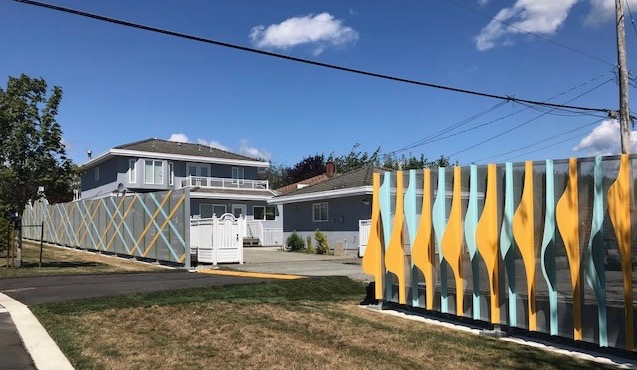
On a recent walk in Burnaby, British Columbia, what was normally an uninteresting and car-dominated street, offered a surprise. As I turned a corner, I was delighted to see a major change since my last visit. The city had built a vertical park! A beautiful walking space including bike lanes, areas to sit, green spaces and artistic architecture.
What was most interesting was the way in which they city had treated the neighboring houses. Along this vertical park, the city had installed decorative visibility fences. Essentially these fences are neither wooden fences with no visibility nor chain-link fences with visibility but a hideous look.
Presenting the street with a more attractive, look
These fences are particularly interesting because they address an important issue for corner homes and homes on edges of land-use changes, in this case, residential to commercial. Homes in these locations are often at increased risk of burglary and vandalism.
Tall wooden fences can simply block the external view of an intruder once they are over the fence, making it easier for these individuals to commit a crime. Additionally, residents cannot see if a threat exists on the other side of the fence. Chain link fencing, however, often gives the impression of “fortress” mentality and can increase feelings of fear, making the neighborhood appear hardened. Chain link fences are also quite easy to climb.
Vibrant colors make a difference
These decorative visibility fences provided visibility to both residents and surrounding eyes. At the same time, they create a beautiful linear space for folks to walk through. They are also difficult to climb.
This vertical park and the accompanying decorative visibility fences are a great example of finding beautiful ways to address privacy and safety in neighborhoods on the edges of commercial use.
GUEST BLOG: SafeGrowth Advocate Anna Brassard recently mentored a high school student about design and safety and encouraged her to submit her project here. Sophia Marchenko is a grade 9 student at Calgary’s Master’s Academy and College. We congratulate Sophia on her exceptional work and welcome her contribution to SafeGrowth.
by Sophia Marchenko
In grade nine this past year, I had the opportunity to participate in the Professional Initiatives Program at my school, Master’s Academy and College. As part of the program, I was matched with a mentor in a field of my interest and was challenged to create my own research project. I was fortunate to be matched with Anna Brassard, an urban planner. The central question of my research project became “What if public art could serve a second purpose?”
I asked: What if public art could also be a bird sanctuary? A way to improve safety? A crime prevention system? An electric vehicle charging station? A way to generate electricity?
Public art and street furniture in Christchurch, New Zealand container village
I found many examples of public art serving a functional purpose within Calgary and beyond. There were examples in Calgary, such as the public transit bus stops currently being built with art pieces, and artistically designed stormwater filtration systems. I looked into musical swings in Montreal, Quebec, and Chicago’s multimedia Crown Fountain. All of these examples display messages of beauty, culture, environmental stewardship, and community, while serving a practical purpose.
Since my school is located right beside the newly constructed Flander’s Bridge, I’ve seen how reckless drivers can get in that area. There is a plan for a new piece of public art for that area and I wondered whether a piece of public art could contribute artistic elements to the bridge while also helping to slow down traffic and improve safety.
I was put in contact with a transport engineering at the City of Calgary and he described the existing traffic volume is 94,000 vehicles per day at that location, a very large amount of road traffic. There were many schools in the area that have kids crossing Flanders Bridge every day.
Flander's Bridge in Calgary, site of potential public art project - photo City of Calgary
FLANDER'S BRIDGE PROPOSAL
I decided that my public art would have speed signs incorporated in an artistic way, showing drivers their current speed and encouraging them to slow down. It would also have artistically-integrated solar panels to generate the needed electricity. I liked the idea of using strips of copper for most of the design and having the whole design illuminated with soft light at night.
By the end of my research project, I realized that I had learned a lot about public art and how an artistic element on a key piece of Calgary’s infrastructure could also contribute to a safer environment for both drivers and pedestrians. It was an eye-opening experience to learn from an urban planner, an architect, students at the University of Calgary’s Faculty of Environmental Design, where Anna had years ago taught a SafeGrowth program, as well as planners and engineers from the City of Calgary. Many thanks to my mentor throughout this program, Anna Brassard, for opening my eyes to the field of urban planning.
Plans for a POP-up market in Philadelphia - diagram by Brad Vassallo
GUEST BLOG: Brad Vassallo is a SafeGrowth Advocate having taught POP-up placemaking and community development as part of a SafeGrowth team. He has worked in community development in Philadelphia for the past few years and offers here a case study from that city.
****
Philadelphia is a city of 40,000 vacant lots. Like many post-industrial cities, it fell victim to a mass exodus of middle-class residents in the mid-20th century. Unfortunately, the 40-plus-year drought in tax revenues has taken its toll, with neighborhoods in North and West Philadelphia ailing from high crime rates and rampant vacancy. These conditions have had a torturous effect on neighborhood quality of life.
As a former student at Temple University in community development, I witnessed first-hand the effects of this multi-generational disinvestment. Asociacion Puertorriquenos en Marcha (APM) is a neighborhood nonprofit serving residents of all color and creed, with a mission of helping families. This is no easy task in a neighborhood commonly referred to as "the Badlands" due to its high frequency of violent crime.
TACKLING THE BADLANDS
As part of my degree, I found myself working with APM during the beginning of a new creative placemaking grant. The goal of the Pop Up Market Place (PUMP), was to reactivate a vacant lot at the corner of 6th Street and Susquehanna Avenue. The 11,000-square-foot lot was slated to become a youth housing facility with ground-floor retail, but the development cycle often takes five or more years. Our task was to reimagine the space as a gateway for a downtrodden stretch of Germantown Avenue. The project involved several layers:
Using 3-D modeling during design charrettes - photo Brad Vassallo
Engage the local community in a conversation about the future of Germantown Avenue using the PUMP site as a centerpiece. Similar to the SafeGrowth model, we operated on a To-For-With-By model; each level represents a greater level of civic participation, with the pinnacle being those projects that are done with or by the community. We assembled a diverse steering committee and arrived at three focus areas: Crime and Safety, Jobs, and Youth Engagement.
Using feedback from the Steering Committee, we offered regular programming on the site to draw foot traffic and build awareness. Our events included an end-of-school summer block party, neighborhood potluck, and movie nights. Children flocked to the site for water balloon fights and piragua on a hot summer day. Neighborhoods like this have endured a great deal of trauma. By holding a small community event on the project site, we began to strip away some of the negative association people had with that location.
Mapping survey and data collection areas
We led entrepreneurship training to build capacity. In a neighborhood like ours, educational attainment is low, making traditional employment difficult for most residents. Starting a small business is a more attractive option for first-generation immigrant families. By offering free training we were able to tap into our neighborhood's entrepreneurial spirit and offer an alternative income stream.
The final step was to identify a few promising candidates from our training with whom we could launch a business incubator on the site. Brick-and-mortar businesses have significant overhead expenses. By repurposing a few recycled shipping containers for micro-retail, we could lower the barrier to entry for these new business owners and provide a safe haven for residents to shop locally and explore.
Activating spaces at night - photo Brad Vassallo
Despite problems moving this version of the project forward, we learned how to revive vacant land and encourage business activities. We also learned that this unique design style was easy to mobilize, it could move from parcel to parcel, and it provided a beta-test for local businesses as an alternative form of entrepreneurialism.
Safety audit walkabout in Syracuse's high crime neighborhoods
by Mateja Mihinjac
In last week’s blog about Syracuse we introduced the Cure Violence program. We initially introduced Cure Violence seven years ago in our review of the film The Interrupters. Since then the program has expanded considerably.
Cure Violence is a public health approach to violence prevention, targeting at-risk youth to prevent shootings. Its founder, Gary Slutkin, sees violence as a contagious disease problem where violent behavior spreads from person to person as an epidemic with individuals adopting behaviors they observe in their social circles. Cure violence focuses on prevention through interrupting violent behavior and change through treatment and education.
The program shares the same vision as SafeGrowth - building capacity in neighborhoods to interrupt violence within neighborhoods themselves. However, whereas SafeGrowth focuses on a proactive way to plan long-term neighborhood development, the Cure Violence program responds to violence that has already erupted, or is about to erupt.
REPLACING PRISONS WITH PLAYGROUNDS
Slutkin envisions neighborhoods where prisons would be replaced with playgrounds and parks. This vision - reported in the Syracuse projects we discussed in our last blog - helps neighborhoods struggling with high levels of violence. That includes the Near Westside neighborhood in Syracuse.
Cure Violence relies on trained “violence interrupters”, individuals who, due to a similar history of criminality or gang membership, have credibility among the targeted groups.
Interrupt transmission – violence interrupters detect and mediate conflicts to reduce likelihood of violent outbursts or retaliation
Identify and treat highest risk to prevent future spread – interrupters assess and refer individuals at high risk of engaging in violence to appropriate social services
Change group norms – engage and organize community leaders, residents, local organizations and service providers and use outreach and education to denormalize violence.
Near Westside children envisioning a different kind of neighborhood
during SafeGrowth workshop
RESEARCH ON SUCCESS
Evaluation studies support the effectiveness of this approach. In Chicago, for example, the 2009 study reported a 41-73% reduction in shootings across intervention neighborhoods and a 56% decrease in killings in Baltimore.
In NYC, the most recent evaluation reported 27-50% reduction in gun injuries in two NYC communities and 63% reduction in shootings in one community while attitudes supporting violence have decreased and confidence in police increased.
Previous research also reported an 18% decrease in homicide across Cure Violence locations between 2010 and 2013 and 69% in non-targeted locations since the program was first implemented in NYC in 2009.
Cure Violence has to date been implemented in 10 countries across over 25 cities. These include Western cities as well as regions with high levels of violence in South America, Africa, Middle East and zones of conflict such as Iraq and Syria. This year Cure Violence also celebrated a jump in 10th place of the Top 500 NGOs in the world.
The Cure Violence model, therefore, holds a great promise to help reduce violence and victimization from gun violence in cities like Syracuse.
A few months ago I visited Syracuse, New York during a workshop organized by SUNY’s Center for Community Design Research. The workshop was part of the Center’s Visioning Voices Speaker Series, an outreach program aimed at finding collaborative solutions for safer and healthier neighborhoods.
During a safety audit with residents, police, and others – and despite hearing about high levels of violence in Near Westside neighborhood – the neighborhood was quiet with few people occupying the streets. In some parts, we observed gang members controlling their territory, but the most obvious clue to violence were signs calling to end violence.
Syracuse anti-violence programs
SIGNS AGAINST VIOLENCE
The first sign was positioned in a community garden: “OG's Against Violence” (O.G. = Original Gangsters). Clifford Ryans established this NGO 15 years after his son, then aged 17, was killed in a shooting. He now advocates against violence and walks the streets of Syracuse to interrupt potential violent altercations across the city. He is on a life mission to prevent fatal shootings in his city.
The second sign was on the windows of a now-closed Inn with large posters saying “stop the killing” and “cure violence”. These posters were in response to the death of a 21-old man who was shot on the adjacent street on an evening in April 2017. This event had shaken neighborhood residents. The city of Syracuse had celebrated 83 days without a homicide in a city where homicide from shooting is rampant, and this shooting broke that record.
Community safety walk in Near Westside
NEAR WESTSIDE
The Near Westside neighborhood is known for high levels of gang-related violence and deadly shootings. Estimates show that the neighborhood has been experiencing levels of crime above national, state and city average.
With 72 deaths and additional 453 injuries resulting from gunshots in Syracuse between 2009 and mid-2015, gunshots clustered in Near Westside. In response to that gun violence, Syracuse implemented an anti-violence program called “Operation SNUG” (SNUG = "guns" backwards) in 2010, which operated for over a year until its money ran out in 2011.
The program showed great promise although there were suggestions for modifications for a program to better suit the needs of Syracuse community.
Syracuse Police participated in the Safety Audit
In 2014 operation SNUG was reintroduced in Syracuse, which became one of the 7 sites across New York State that received a grant to implement a coordinated, community-based strategy modeled on the well regarded Cure Violence program.
Next blog: The Cure Violence solution to gang shootings.
“The Smart City is the latest addition to the urban planning lexicon. Smart cities - also known as digital cities or wired cities - encompass the idea that new information technologies will transform city services by better managing urban affairs.
It is, as yet, unclear how the Smart City will impact safety, inequality or crime neighborhoods. Advocates speak glowingly of the Smart City vision, such as how digital technologies might lead to a new form of e-governance. Already there are signs this is coming to pass. Ubiquitous CCTV security cameras on public streets already require police monitoring and response.
In cities like London, England, there are over a half million CCTV cameras pointed at streets, sidewalks, and parks, and the trend is worldwide. In Calgary, for example, there was an 80 percent increase of CCTV cameras on public streets from 2011 to 2016. Now over 1,100 integrated cameras point at buildings, sidewalks and streets throughout the city, all monitored at the city’s Integrated Security Centre.
Canada's 18th Century parliament in the background.
The modern Museum of Civilization in the foreground.
NEIGHBORHOOD WATCH IN CYBERSPACE
Another Smart City innovation is neighborhood-networking websites, a social network for neighbors via websites that focus on specific areas. This allows neighbors to share information and plan events, such as block parties. It is a 21st Century version of Neighborhood Watch that fosters neighborliness (or just old-fashioned nosiness). Because network members must live within the designated neighborhood, and identify themselves to others on the website, these websites tend to avoid some of the rancor that plagues other social networking sites.
Neighborhood-based social media do have safety and security advantages; residents can monitor and report nearby break-ins, car thefts, or even organize block parties to get to know each other in real time. It’s easy to imagine how SafeGrowth neighborhoods, where residents work together to tackle local problems, might relish a cyber version of Neighborhood Watch that needs no police management, is accessible 24/7 on tablets and cell phones, and requires no neighborhood meetings that otherwise clutter busy schedules.
"Habitat" at Expo 67 - Montreal's World Fair. World-renown architect
Moshe Safdie's vision of 21st Century housing.
Yet both Smart City innovations come with drawbacks. In spite of claims for protection from crime, civil libertarians complain that constant CCTV surveillance on public streets invades our privacy. And evidence is inconsistent whether CCTV in public streets works better than human-based systems, like Jane Jacobs’ eyes-on-the-street. Further, private neighborhood social networking services are not easy to monitor for cyberbullying, in spite of claims to the contrary and there have been complaints about racial profiling. How does one decide what to do?
Will the Smart Cities movement hinder or hamper SafeGrowth neighborhoods? As yet, there is no clear vision of what Smart Cities will become. Perhaps we should worry less about the technology and more about educating the Digital Generation on how to build a SafeGrowth city in the 21st Century?”