 Clean, efficient design with great sightlines, yet empty streets.
I spoke to Elisabeth Miller, a planner friend from Saskatoon, this week who told me about the pending publication of some CPTED and Design Guidelines for developers and architects. She is a planner with the city of Saskatoon and last fall I researched and crafted these design guidelines, which Elisabeth and I then wrote into a Guideline document, from best practice around the world.
Could a similar approach work at a larger scale, for example in urban zoning?
If you study different types of zoning it is clear that most forms of zoning align with architectural design guidelines. Then I realized there is a problem with zoning.
In Death and Life of Great American Cities Jane Jacobs says, "No amount of police can enforce civilization where the normal, causal enforcement of it has broken down."
Jacobs used the ideas of territoriality and social capital as part of her equation for safe streets. Unfortunately early CPTED used only half of that equation - urban design.
As all new students of CPTED soon learn, basic 1st Generation CPTED involves urban design and architecture to reduce crime opportunities. There are three components:
1. We See You: Natural surveillance is lighting and landscaping that puts eyes on the street. The purpose is to see offenders or to signal to offenders they will be seen.
2. You Are In Our Place: Access control is gates, fences, roadway barriers, or walkway placement to limit the number of people into or out of an area. It allows people to see who is entering or to signal to visitors - we live/work here.
3. You Can't Get Away With That Here: Territorial reinforcement divides public space to semi-private or semi-public areas - for example, paving patterns and floral landscaping to demarcate a building entry. Clean-ups are another way to signal someone cares. These make it difficult for offenders to offend with impunity.
All three components hinge on one simple (and debatable) idea: It's our turf and we care. Design guidelines fit perfectly into this part of the equation. Zoning – not so much.
Here's the problem
In the absence of social capital, territoriality doesn't just happen. It is not necessarily true that people care simply because their space encourages it.
There are plenty of places where access control, good lighting, and natural surveillance provide a very poor sense of territory. Urban mega-projects like sports stadiums and casinos are notorious for plenty of crime (pick pocketing and robbery come to mind).
Large box stores are another example where there may be many eyes on those streets, all sorts of branding, signs, and territorial markers and yet crime can flourish (auto theft comes to mind).
Territoriality can help but it cannot ensure crime is absent. The intimate personal space of a residential living room or bedroom is already "owned" and controlled yet that is precisely where most domestic violence occurs.
The fact is territoriality does not work without social capital.
Next: How zoning can help.

 Bottle Bank Fun
 Graveyard at Wounded Knee - Entranceway to the past
 Monument at Wounded Knee
 Clean, good sightlines, territoriality - What is this bus stop missing?
 Proper analysis is the first step to prevent crime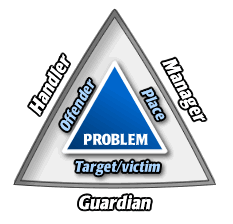
 Motive is a key piece of the puzzle
 Night-time lighting in many cities is awful
 New LED technology is so efficient it can light up sports stadiums