Showing posts sorted by relevance for query crime theory. Sort by date Show all posts

Monday, June 22, 2020

The Atmospheric Theory of Crime

Hurricane Isabel, 2003, from the International Space Station
- photo courtesy of NASA

…and now for a short distraction from the awful news of late...

by Greg Saville & Gerard Cleveland

Once upon a time, crime plagued the nation. Violence flared, year after year, like a wildfire of human suffering that cities could not extinguish. Cops did their thing, and then some. Prisons were filled. Downtown blight grew and fear split the nation into racial and economic camps like never before. And nothing seemed to work.

Then the crime wave changed direction. No one knew why. Nothing was different to account for the turnabout. Criminologists went to work to explain why and one tiny group came up with an answer, an answer so simple and elegant that the theory quickly became the talk of the theoretical end of town.

The geniuses who created the concept call it the Atmospheric Theory of Crime and they described it as follows:

There are three necessary elements for crime to occur: air, water, and land. When those three elements converge, crime chances increase. Remove one of them, and you prevent crime.

Air - the first principle of Atmospheric Theory

Let us begin with air! People cannot breathe without air. If you remove air from a room, burglars have no chance of stealing anything. If you freeze air to 100 degrees below zero, like at the South Pole, murderers are unlikely to find a victim outside. Sure enough, if you need proof, South Pole crime rates are almost zero. In fact, as lung tissue freezes, offenders themselves will perish. Even a dullard can see that burglary and murder rates in airless places are almost zero. We say almost because the dastardly cur Jacques Yves Cousteau figured out how to travel through underwater airless environments.

And in doing that the scoundrel Cousteau invented his scuba gear as a modus operandi for coral reef graffiti and underwater arson. True, those are rare. But still...

Then there is water.

Water - the second principle of Atmospheric Theory

Setting aside for a moment submerged arsonists, water blankets the planet and we see it every day in clouds, rain, rivers and lakes. But our clever environmental theorists noticed that if we increase the quantity of water to a certain percentage, eventually we pass the threshold when crime becomes impossible. Our statisticians can even measure the amount of water it takes to prevent crime.

Take for example a hurricane. Granted, plenty of looting occurs AFTER a hurricane, but just try stealing a car during the torrential 150-mile an hour winds, lashing rains, and the 10-foot storm surges. Even if you can get in the car to steal it, just try to drive it through flooded roads. Same problem in a Tsunami. How many muggers ever successfully mugged a victim on a beach as they and their victim were pummeled by a 100-mile-an-hour, 30-foot high wave. Our research shows us that you will not find a safer environment from muggers than on an empty beach as the Tsunami shows up.

That leaves land as the final pillar in our trifecta of crime-busting. You must have land to have crime. People live, walk, work, and play on it. If no land exists to walk upon or to build our homes on, we immediately eliminate domestic violence. Of course, DV may occur in the air or underwater but those statistical anomalies remain quite rare in our beta tests. Earth is the equalizer and without it, crime has no chance to worm its way into our communities. Mother Earth – that lovely Gaia preventer of crime!

CONFERENCES, JOURNALS, STUDIES

There you have it – the Atmospheric Theory of crime. Remove any one of those factors – air, water, or land – and crime everywhere falls quickly onto the scrap heap of abandoned human behaviors.

So now we need to spread the Atmospheric Theory of Crime far and wide. We need to create all kinds of sophisticated criminological tests for the theory while spending plenty of conference, journal, and research time arguing for the genius of A-TOC! (We must not forget the appeal of cool abbreviations for marketing purposes.)

In the future, we can wonder, “Gosh, why didn’t we think of A-TOC earlier?” Think of all the crime we could have prevented and misery and loss we could have avoided. Remove the air from robbery locations? “Geeze,” we can retort, “great crime prevention idea!” Flood cities and high crime areas with 30 feet of water! “Ha!” we will exclaim with glee, “now, let those arsonists just try…”


Land - the third principle of Atmospheric Theory

The hue and cry from within the orthodox criminology schools would howl their displeasure and shower disdain upon the upstart A-TOCs. False equivalency charlatans! – imagine claiming that crime and nature are interchangeable?  Or they may take a lawyerly approach and decry the environmental school of crime as reductio ad absurdum wherein the contention of those A-TOC types reduces serious and complex issues of human criminal behavior to mere naïve states of weather. We can already hear the chorus of complaint in the inevitable defense of modern criminological theory and the tried and true explanations for the true reasons for crime.

Pretty silly, huh!

ROUTINE ACTIVITY THEORY 

Now, take the Atmospheric Theory of Crime and replace it with an actual criminological theory – the Routine Activity Theory of crime (RAT) – and you have the same theory. In the case of Routine Activity Theory, air is an ‘absence of a capable guardian’, water is a ‘motivated offender’, and land is a ‘suitable target’ like a victim. Remove any of the three RAT principles and you – according to RAT – reduce the opportunity for crime.

But compare RAT to A-TOC in actual criminology journals and they would be filled with comments like this: "It might sound a bit like A-TOC but any such comparison to RAT only serves to highlight….blah, blah, blah."

As we have blogged before, RAT assumes a steady supply of motivated offenders, just like Atmospheric theory assumes a steady supply of air and water. RAT predicts that crime opportunities wane when you remove motivated offenders and Atmospheric Theory predicts crime vanishes when you remove land.

RAT does not try to explain the historical or societal contexts of “why” offender motivation occurs or “how” you might reduce those motivations, regardless of the number of potential victims. It simply takes a short cut and says figuring out the fundamental “why” factor becomes an unnecessary consideration once we remove the opportunity, offender, or victim. Others, too, have raised alarms about RAT as a pseudo-scientific truism, for example Professor Mike Sutton's article on Crime and Opportunity.

The same argument holds true with Atmospheric Theory – it does not try to explain why Tsunamis or hurricanes deter criminals, but rather posits through common, observable evidence that they do. And – in spite of William of Ockham’s philosophy that simple, not complex, usually explains the truth of things – the world of crime gives rise to social issues pregnant with complexity and uncertainty. Crime and simple rarely share the same space!

So, your takeaway for which criminal theory to apply in your city becomes a choice of which fantasy to support. The only difference between Atmospheric Theory and RAT is that the former is a fantasy made-up just now.

SO SAY WE ALL

Clearly, Atmospheric Theory takes logical leaps of absurdity to the point of comedy and requires nothing more than blind faith to believe its truth. Similarly, RAT – a contemporary theory and the subject of many studies – lacks any root-cause-of-anything explanation, unless you consider crime opportunity itself a “root cause” (the bizarre cart-before-the-horse logic that RAT proponents now suggest). Yet, the best criminology journals continue to proselytize on behalf of the holy trinity of guardians, offenders, and targets in spite of it explaining everything, and nothing, at the same time.

And so, we end our Atmospheric Theory of Crime story by remembering that wonderful science fiction fantasy Battlestar Galactica. During a key funeral scene, the actors all join in unison and declare solemnly that they will follow the orthodoxy of the times with faith, purpose and commitment. In closing, we mouth their choral sentiments of blind faith with the hopeful chant, “So say we all”.

Wednesday, April 28, 2010

Sin-city and crime generators

What I learned in Vegas...

A funny thing happened to me in Las Vegas last week. No, it's not what you're thinking! It's not really about clear-headed thinking at all. It's about some fuzzy thinking that replaces coherent understanding about preventing crime.

I've said before the CPTED and Design Out Crime folks don't talk much about the theories behind their work. A few of those thorny theory issues showed up in my blogs last year, such as ROTO (Research-On-The-Obvious).

There is another side to that coin. I'm referring to the fuzzy thinking of some academicians who study crime-and-place and their kin (crime mappers, police crime analysts).

Let's remember the main purpose of theory, at least in the empirical sciences, is to provide a plausible and testable explanation of why something happens, in this case crime. Events surrounding that explanation - where and when crime occurs - are merely descriptive symbols of the main event, not the actual theory that explains "why" the event happens in the first place.

From this point of view, CPTED and Design Out Crime have very few actual theories - only descriptive symbols.


DOES IT MATTER?

Descriptive symbols are useful. Describing where malaria starts killing people may help us isolate the outbreak and target treatment. Symbols may point us in the right direction toward explanation. But they do not explain the biology of malaria - and that is what kills us! Mosquito nets may help us and we need them. Ultimately, we need to be working toward a cure. We mustn't rest with nets. Same with crime.

What about gambling, casinos, and sin-city?

As I walked around Las Vegas last week I began thinking about all the casino's, the craziness, and all the activity. In Advanced CPTED there is something called "crime generators". These are locales in the city that tend to generate crime opportunities. Large casinos fit the crime generator tag. If mappers scoured the crime patterns, no doubt they'd find lots of hotspots with pick-pocketing, assaults, drug dealing, and fraud in and around the casinos. Or perhaps casino security displaces it to venues just outside the Strip? Either way, no doubt someone would come up with a "theory of casino crime locations", which isn't really a theory at all.

This is exactly what happened with the Broken Windows "theory". Crime went down in New York. Unfortunately for Broken Window Theory, as Professor Zimring showed in his book, The Great American Crime Decline, crime went down in places with no Broken Window programs. That's because descriptive symbols won't really stop crime in the long run. Only prevention based on sound theories can do that.

Yes, theories matter.

Does that make casino's crime generators? Casinos no doubt "generate" direct and indirect crime. But if we could calculate per capita crime rates around casinos, would they be any more crime-prone than other high activity places?

Do activity generators = crime generators?

Probably not in the case of large political rallies (except if you find yourself in Thailand this week). How about in the case of large football games with thousands of drunken fans? Those probably do generate similar (or more) assaults, except if we limit alcohol sales and the home team wins.

That's the problem with descriptive symbols versus real theory. They tell us something about where, and little about why.

THE CASINO CRIME GENERATOR?

It might be simple to conclude sin-city Vegas is also crime city. But FBI crime stats don't show that. We can argue all we want about unreported crime, gambling impact on family life, and so forth (those things are true and serious). Yet according to the 2008 FBI crime rates, Las Vegas wasn't even in the top 20 cities for total violent crime nor in the top 50 for total property crime cities.

So much for crime generators.


Personally, I'm no fan of the Strip in Las Vegas. There are no doubt many tragic realities that arise in that famous (infamous?) epicenter of self-absorption.

Whatever those realities, we must not confuse descriptive symbols that plot when and where with actual theories explaining why crime happens. Descriptive symbols may help us target crime and temporarily reduce it with 1st Generation CPTED and Design Out Crime. But they won't help us prevent it in the long run. Nor will they replace proper and robust theories that help us build safer places - including entertainment meccas like Vegas - in the years to come.

Thursday, November 25, 2021

Blinded by the light

The Greek philosopher Aristotle created the scientific method - knowledge proceeds through evidence, objective analysis, and logic.
Photo Creative Commons

by Gregory Saville

As Bruce Springsteen writes in his song, it’s easy to get blinded by something you are passionate about. That especially applies to crime theory.

It’s hard enough to implement crime prevention without having to constantly check whether the prevention theory itself is under attack. Of course, prevention practitioners should know the strengths and weaknesses of their programs, including theory veracity. But when theory itself remains unchallenged by scientists, even when emerging data contradicts that theory, it makes the practitioner's job much more difficult. 

When that happens, practitioners are unsure whether it is the theory that is wrong or the implementation. 

Take crime displacement theory. When a crime happens in one location, will preventive measures move it somewhere else? Traditional displacement theory says crime will not necessarily move elsewhere. Or if it does, it might create benefits in other ways (the so-called diffusion of benefits theory).

Most likely, we are told, the displaced crime will reduce in impact – it won’t get worse! We are told dozens of studies confirm this theory over a number of years. 


WHAT IF IT IS WRONG? 

Then a British undergraduate thesis on displacement uncovered some disturbing patterns in the evidence.

Catherine Phillip's analysis discovered, “that displacement may, in fact, be more common than is widely claimed, particularly in the case of studies with offenders. Furthermore… the findings of the Kirkholt Burglary Prevention Project, which purport to demonstrate a diffusion of benefits, are shown to be based on questionable evidence.”

Curiously, this was met with deafening silence in the situational crime prevention community. Phillip's referring specifically to the scientific evidence would, one would think, sound alarms to scientific theorists. Not so.

A few years later, Tarah Hodgkinson, myself, and Martin Andresen, conducted a detailed study on displacement over a multi-year timeframe using extensive ethnographic/statistical research in a city where we had delivered CPTED for over a decade. We combined the best qualitative and quantitative research. Our research discovered that, indeed, displacement was not benign, there was no diffusion of benefits, and alarmingly, we uncovered clear evidence of malign displacement in which crime got much worse in two different areas. 

We published our study in one of the most prestigious journals in the criminological community – the British Journal of Criminology.

Again, from the displacement research crowd… crickets! Apparently, data and evidence, even in a thorough crime study, were also not enough to sound the alarm about troubles with displacement theory. 

Why?


Marc Brackett's Permission To Feel


CONFIRMATION BIAS

For many years, Gerard Cleveland and I have taught our police students emotional intelligence (EI). EI was created by psychologists in the 1970s and 1980s, particularly the work of Yale University’s professor Peter Salovey and his colleagues. The best recent book on EI is Marc Brackett’s, Permission to Feel.

The role of emotions, it turns out, is poorly understood among professionals and, I would add, researchers. Emotions explain why researchers get attached to their theories and, when it comes to criminology, why they refuse to accept new theories or abandon old ones.

The methodology of science suggests that researchers should carefully manage their emotions and follow the data. In displacement, at least, it seems that may not always have been the case. The attachment to theories – this clinging to something when contradictory evidence arises – emerges from poor emotional intelligence and the inability to detach from a theory and look at alternate theories with a clear eye. 


Avoid theory blindness by looking carefully at the data,
self-awareness, and detaching from bias


SECOND GENERATION CPTED

Take, for example, 2nd Generation CPTED! For years, Gerry Cleveland and I heard complaints from traditional crime prevention practitioners that “if it’s not about changing the physical environment, it’s just not CPTED”. 

When we pointed out that the founders of CPTED – Jane Jacobs, Oscar Newman, C. Ray Jeffery – did not limit their discussions to architecture; they also spoke of the interconnectedness between theories, of the role of neighbors in crime prevention, and of social cohesion in neighborhoods. Getting locals to create a sense of defensible space was the mantra in authentic CPTED, yet those practitioners attached to physical target hardening ignored this part of the theory. 

This is theory-blindness! It is often triggered by emotional attachments to a particular view and it is known in psychology as confirmation bias – the tendency to search only for information that confirms your prior beliefs of something. It is not surprising we are sometimes blinded by the light of a theory to which we are attached. We are all, after all, human. But ignoring data and cherry-picking evidence that supports only one particular theory is not only unscientific – it obstructs our work to help create safer places. Our communities deserve better.

POSTSCRIPT

I spoke too soon in regards to crickets from the criminological community. The situational theory cluster inside the movement might ignore, but not so the mainstream criminology community. The American Society of Criminology just awarded our own Tarah Hodgkinson the prestigious Robert Bursik Award for the displacement study I referenced above that Tarah, Martin Andresen, and I co-published in the British Journal of Criminology. Congratulations Tarah.  


Wednesday, September 17, 2025

An Odyssey - Searching for the cause of crime


Ancient Greek vase (480 BC) of legendary King Odysseus hearing the Sirens whose songs lure sailors to shipwreck - self-mastery and constraint led his ship to safety.
Similarily, in criminology, theories of social and situational control can lead us safely away from crime - photo Wiki Commons

By Gregory Saville

Note: To theory-averse readers – I apologize. We usually do not write long blogs. We offer real-life examples, stories of people doing great things, and ideas for change. We don’t delve deeply into theory. Now and then, however, I am reminded that theory is the foundation for good practice and that sometimes stories take time. This blog explains why.

Last year I re-read Homer’s Odyssey and thought: perfect blog arc. I drafted an outline—but life intervened. Last week, thumbing through notes from my first crime-theory classes in graduate school many moons ago, it hit me: these weren’t lecture summaries—they were maps of an odyssey —a long voyage across generations, full of rival schools, wrong turns, and breakthroughs. 

Like Odysseus, criminologists kept sailing from one island of ideas to the next, each promising an answer to why crime happens and how to prevent it. And, like Odysseus, each landfall changed the quest.

Class #1 Individual Pathology — “Look inside the person”

The theory voyage in criminology was launched inside the human brain in the 1800s. Italian physician-criminologist Cesare Lombroso hunted for the “born criminal”. Early-1900s eugenicists chased ‘feeblemindedness’ and eugenics boards forced sterilizations on the “unfit” — grim policy on flimsy claims.


Some tried to pin crime on IQ. Ultimately criminologist Edwin Sutherland wrote intelligence was not an important cause of delinquency, and more recent studies suggest any existing IQ/crime link reflects school struggles and social frustrations.

Today the spotlight has shifted again. Trauma, psychopathy, sociopathy, and malignant narcissism are the buzzwords. In our field, third-generation CPTED captures this emerging research. New studies by Indian psychologist Meenakshi Shukla
and Australian psychologist Natalija Djakovic
dig into the Dark Triad —narcissism/Machiavellianism/psychopathy—showing deficits in both cognitive and emotional empathy.

Socio-biology theories remain a viable explanation for at least some crimes, especially neurological research on aggression and the amygdala. Trauma-based prevention programs capture this research.

Other theory captains took new routes. German/British researcher Hans Eysenck’s Crime and Personality (1964) mapped “criminal personalities.” Neurological researchers explored aggression and the amygdala; endocrinologists tested chemical castration for sex offenders. And yet, research indicates that most people with risk factors don’t offend. None of these pathologies are silver bullets. 

The emerging field of sociobiology has rebooted with wiser tools—twin studies, behavioral genetics, brain imaging—pointing to a gene–environment duet. Biology matters; context decides. Whether biomarkers become crime depends on the social world where predispositions meet opportunity. Neighborhoods matter.

Class #2 Social Psychology — “We learn our way into crime”

By mid-century, the odyssey turned outward. Instead of asking what’s wrong in the brain, we asked how people learn morals and rules. Lawrence Kohlberg 
mapped moral development, and Albert Bandura showed we lean toward rewards and away from punishment—kids learn kindness or bravado from caregivers, from TV like Sesame Street, and from crime-glorifying media. 

In the 1970s, my old friend C. Ray Jeffery argued these learning “environments” should be woven into one integrated theory—a thread that fed CPTED thinking.

Much of that evolved from Chicago’s Edwin Sutherland who said it plainly: crime is learned from others—differential association. His students Sykes & Matza added techniques of neutralization, the justifications offenders use: “nobody really got hurt” or “the system is corrupt.” Culture-conflict and subcultural theories showed why immigrant and lower-status youth might reject mainstream rules: remove status and respect, and people build their own codes. In prison, a single “diss” can trigger violence.

Which begs the question: if crime is learned, why don’t more people do it? I once attended Professor Travis Hirschi's criminology class years ago where he answered that question: strong social bonds in families and school hold people back. Later, in A General Theory of Crime with Michael Gottfredson, he argued that low self-control—impulsivity and present-mindedness—explains much deviance across life.

A few decades earlier, in the1960s, radical criminology had flipped the script. Howard Becker
and labeling theorists asked who gets to define crime. Being from “across the tracks” or “the bad side of town” are labels we still see in SafeGrowth work. Stigma can create careers in deviance; diversion programs try to interrupt that path. Modern restorative justice pushes further: repair harm, include victims, reintegrate people, and rebuild relationships so communities can heal. Vancouver, Canada is the latest city to scale this up as a Restorative City.

Restorative Vancouver - photo courtesy of the peacemaking group Peace of the Circle led by Dr. Evelyn Zellerer

Class #3 Structure & Ecology — “Place shapes possibility”

The third cluster steered theory into bigger waters: neighborhoods, cities, the social fabric. In the 19th century, French sociologist Émile Durkheim called it anomie when shared expectations fray and meaning is lost. Working in Boston and New York, Robert Merton wrote “Social Structure and Anomie” (1938), turning that into strain theory: if we celebrate success but block lawful means, people will innovate—sometimes illegally.

Chicago researchers Clifford Shaw & Henry McKay mapped delinquency across the city. Crime radiated in zones from the core; neighborhood conditions mattered more than individual traits—a theme that still resonates in SafeGrowth work. In the 1930s, they launched the Chicago Area Project to build cohesion and youth capacity; decades later a RAND corporation evaluation confirmed that it worked—delinquency fell and community organizing improved.

Neighborhood conditions affect social cohesion, collective efficacy, and crime

Richard Cloward & Lloyd Ohlin’s book, Delinquency and Opportunity, 
saw gangs as the street’s answer when legitimate paths are closed. Robert F. Kennedy read their work and helped channel it into Great Society programs to unblock pathways—jobs, training, education.

Conflict theorists added sharper edges: law can reflect the push-and-pull of groups; others, leaning on Marx, tied crime to class domination and surplus labor. These theories led to stormy seas—often more political than operational—but a needed reminder that power, inequality, and law are braided together.

Then came a three-point compass: Routine Activities Theory. Felson and Cohen argued crime happens when a motivated offender, a suitable target, and no capable guardian converge in space and time. Paired with British criminologists Clarke and Mayhew’s situational prevention, that changed practice: reduce temptations, harden targets, add guardianship, design better settings. In 1981, Canadian criminologists, Patricia and Paul Brantingham's environmental criminology, put crime theories into geography. 

In the mid-1980s, British criminologists Ronald V. Clarke and Derek B. Cornish crafted their prevention studies into a new twist on a very old idea - many offenders make rational decisions to commit crimes - the Rational Choice Theory.  I recently wrote a blog memorial to my friend, the late Ron Clarke (and his co-author Patricia Mayhew) for their tremendous theoretical contribution to the field. SafeGrowth taps into some of these ideas in early phases of prevention; and then extends them in later phases by using community capacity-building.

From the 1960s, Jane Jacobs’s ‘eyes on the street’ in urban planning and architect Oscar Newman’s defensible space in the 1970s, through to Robert Sampson’s collective efficacy in the late 1990s, the through-line is clear: urban design + neighborhood trust + willingness to act = effective prevention. SafeGrowth broadens this ecology of crime into long-term neighborhood capacity and livability.

According to legend, King Odysseus left Troy on a voyage home to Ithica following the Trojan War. Crime theory over the decades resembles that journey - photo courtesy of Tungsten, Wiki Commons

Final Class – Coming Home

Looking back, criminology’s odyssey isn’t about crowning one victor; it’s about integrating what each island on the Odyssey taught us. C. Ray Jeffery's desire for an integrative theory was right all along - albeit in a more expansive form. Pathology showed that bodies and brains matter—in context. Social psychology showed how we learn, belong, and are labeled—and how restoration can replace stigma. Structure and ecology mapped how inequality, environmental opportunity, urban design, and cohesion set the neighborhood stage where all those human stories play out.

That synthesis is where prevention lives. Biology supplies tendencies; peers teach habits; place turns risk up or down. This is the true ecology of crime—not a buzzword, but a practical way to braid the human, the social, and the spatial into strategies that work.

Odysseus doesn’t return the same man who left Ithaca. Neither do we. The destination isn’t a single, final theory. It’s a way of working together—scholars, residents, planners, cops, and city builders—to make safer, more livable neighborhoods that grow and flourish. That is our Ithaca: not a port where the voyage ends, but a place strong enough to launch new journeys and welcome people safely home.

Monday, August 9, 2010

The crime triangle - a veneer

Proper analysis is the first step to prevent crime
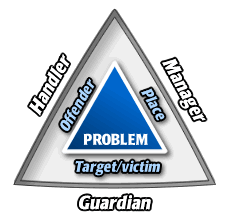
I like the crime triangle. It is popular among crime analysts. It helps analyze crime hotspots. It is also part of problem-oriented policing. Sometimes too it is part of the prevention practitioner’s toolbox. It has elegant utility and simplicity.

The crime triangle emerges from "routine activity theory" (RA) in the early 1980s. RA explained some behavior quite well, like predatory crime (stalking). It did so with a simple premise: crime converges at the intersection of likely offenders, suitable targets and an absence of guardianship (or, more recently, "handlers").

In lay terms, picture the three sides of a triangle with an offender, a victim, and a target/place. When those things come together, so the theory goes, crime goes up.

The crime triangle is useful. Break the triangle and you prevent the crime. Want to increase guardianship? Get property managers to keep better control of their properties. Improve bar management in bars that over-serve. Simple. Elegant.


So far, so good. Except for one thing; that is where it typically ends in the RA world. The crime triangle does not dig deeper into the causes of crime.

Why? Because routine activity (and its crime triangle progeny) is one of those crime and place theories.

RATIONAL CHOICE

RA is less a causal theory explaining why and more a descriptive symbol predicting when, where or how. It ignores why someone becomes motivated in the first place. RA assumes an endless supply of motivated offenders. They are motivated for some reason; we just don't know why. The only "explanation" of motive falls back to rational choice theory.

Rational choice assumes offenders are rational actors who weigh risks against rewards. From the window of RA (and the crime triangle), crime looks like a "normal" condition of life.

True, some criminal behavior is “normal” in the sense that as events, products, and social affairs change, so too do crime opportunities. But as a causal theory, that’s rather trifling. It’s a bit like saying with enough water, sun and moderate temperature, certain environmental conditions will produce rain.

Then again some criminal behavior is not normal at all and RA just doesn’t work. Consider the story of the Connecticut mass murder in the news today.

As the NY Times says, this is “the latest in a series of American workplace tragedies”. It is a sad story about a workplace shooter who killed numerous workmates and then himself. He may have snapped from perceived workplace injustice. Perhaps he was clouded in a drug stupor. Maybe he was insane.

Routine activity theory might suggest how to remove opportunity for future incidents like this. That is a good start. Baby steps.

But RA theory will never actually know why because it will never ask. In cases such as this, the risk and reward assumptions of crime-and-place theories look rather silly. What does a suicidal shooter “risk”? What “reward” was this shooter gaining? Vengeance? (If so, we’re back to motive.)

Motive is a key piece of the puzzle

WHAT CAN THE TRIANGLE DO?

What will the crime triangle tell us in cases like this?

1. Capable guardians - cameras, plentiful supervision, and so forth. Unfortunately this shooting occurred at shift change when there were lots of employees and supervisors about. As for CCTV, how often do we watch nighttime news clips of robbery/shootings on corner-store CCTV? Cameras don’t stop shootings.

2. The time/workplace environment – preventing guns in the workplace. Will metal detectors work? Perhaps, but how difficult is it for shooters to become bombers. What then? Bomb sniffing dogs? At some point Orwellian paranoia replaces civility. Where do we stop? Body cavity searches?

3. The offender – modus operandi (not motive. Remember, RA is motive-neutered). The crime triangle asks if "handlers" like armed security might have intervened (that actually might have helped). Or maybe we could have prevented the shooter from getting guns in the first place? Others can argue 2nd Amendment rights. I won't bother here.

Crime triangle questions just don't do it. Instead, we must also ask this: Why did the shooter shoot? What can we learn about motive to prevent such tragic events in future?

The crime triangle is a useful and elegant baby step. I like it and I use it. But it is veneer. It is short term. It is not enough.

Our analysis of neighborhood crime must include a more robust analytical dialogue. If our analysis does not encompass action to move social life forward, it is not robust. Ultimately, if our theory fails to include motive, we are cluttering our dialogue with junk and the analysis of junk.

Friday, September 22, 2023

Elements of Crime Patterns - A review of a breakthrough

Deborah Osborne's new book, Elements in Crime Patterns, delivers a long-overdue typology for crime investigators, researchers, and prevention specialists

By Gregory Saville

When you think of the study of crime and its prevention, perhaps you imagine that, after a century of criminology, elementary crime patterns are well understood in the academic literature. You would be mistaken! True, we do know plenty about some crime types, as well as the geographical patterns of crime events. But studies about the actual patterns of offenders and offenses are seldom collated together into a coherent, practical dictionary of elementary crime patterns – what scientists call typologies.

For example, in biological science Scottish botanist Patrick Matthews outlined the entire theory of natural selection after years of classifying different types of trees into a typology. Thirty years later that led others, like Charles Darwin, to build more classifications (and claim the theory as his own). Darwin’s bird typologies from the Galapagos Islands, along with Matthews's original work, eventually led to one of the most powerful theories in science – the evolutionary theory of natural selection. 

This method of constructing elementary typologies is so well understood by historians that it usually stands as the introductory chapter on virtually every book about the history of science. 

Crime science, by comparison, has barely scratched the surface of this type of basic typology. This is an alarming fact since that is how robust theories of explanation and prediction emerge in the first place. It is almost like crime science got ahead of itself and developed theories without the essential first steps of theory building. 

Until now!


PRACTITIONER-BUILT TYPOLOGIES

Deborah Osborne is an author, retired U.S. Secret Service intelligence analyst, retired crime analyst with the Buffalo police, and former co-chair of the International Association of Crime Analysts. She is also one of my former students from a short crime mapping and analysis course I ran out of our research center at the University of New Haven 20 years ago. To be clear, by the time she took our training, Osborne was already an established crime analyst with considerable experience. 

This week Osborne published her book Elements of Crime Patterns.

I was excited to read her book, especially when I learned that she used a form of AI – ChatGPT – to help her collect data. To my knowledge, Osborne’s book is the first published criminological work to tap into the power of AI as a tool to build a robust database for a criminological text. That itself is an achievement. 


Scientific theories emerge from detailed observations and typologies


CONTEXT IS CRUCIAL

Elements of Crime Patterns is a field guide to identifying crime patterns, a practical toolkit that offers “the kind of knowledge about the crime pattern domain that is learned only on the job through experience” (p. 310). In other words, this is (finally!) the kind of fundamental scientific research that normally precedes theories and prevention programs. 

Osborne’s approach is not to provide explanations or theories accounting for where and why something happens. She takes another tack:

“The solution to crime pattern detection cannot be solely data driven. The informal exchanges of information through conversations, explorations, and intuitive perceptions are crucial in investigative casework, but researchers and policymakers often do not acknowledge this. It is important to understand that conversations between law enforcement staff are [the means by which] some crime patterns get recognized, especially those involving separate records system in other jurisdictions…Context is crucial.” (page 21)


Crime patterns in criminology are often associated with geographic maps of crime hotspots -
there are many other equally useful patterns 


TYPOLOGIES OF CRIME

I did have a few issues with the book. It could use an index and a bibliography (although to be fair, each chapter had endnotes with some references). I was also not as keen on a few earlier chapters on lifestyle, tools and equipment, and routine activities compared to later chapters. Those earlier topics seemed to me too generic and all-encompassing to be of much value in analysis. The routine activity theory has been criticized as an untestable theory and as suggested by criminologist Michael Sutton, wrong.  

Those points pale in comparison to the impressive 30 chapters on specific crime types. She includes robbery, counterfeiting, sexual assault, murder, drugs, human trafficking, hate crimes, and vehicle crimes, among others. There are also surprises with crimes that make only rare appearances in the criminological literature – wildlife and forest crimes, cultural property crimes, and intellectual property crimes. 

The patterns she identifies include methods of different crimes, offender planning and target selection, the aftermath of crimes, and factors that influence crime opportunities. CPTED practitioners should take note there is an especially succinct summary of the opportunity factors that contribute to crime conditions. I wish I had access to information like this long ago in my crime prevention and investigation career. It would have made the work so much easier.

This book is a breakthrough for the science of crime and prevention and for the criminological enterprise – both academic and practitioner. Osborne has made a contribution of considerable weight. This is a book you should read.


Tuesday, July 30, 2024

Do we know enough about crime to prevent it?


Preventing crime has much more to it than cameras

by Gregory Saville

Recently, I was asked whether we know enough about crime to prevent it. Simple enough, you would think. Isn't the study of crime "scientific" and, if so, doesn't that provide a simple answer? Turns out, it isn’t that simple.  

Criminologists are concerned directly with the well-being of everyday people and their families, their property, and their safety. Scientists, of course, are as well – especially medical researchers searching for cures to diseases or meteorologists who want to warn you to stay away from bad weather. 

Yet scientists often study elemental phenomena with seemingly little direct impact on daily life. That is not always true, but the gulf from science theory to practical application can be wide. In criminology, it can be a very narrow gulf from theory-to-effect. Criminology speaks to the lives of everyday people (at least some criminology). In pure science, there are many branches where that is not so, particularly in theoretical research.

Consider titles of scientific studies: Non-Reciprocal Coupling in Photonics, Lightwave-driven electrons in a Floquet topological insulator, or Verification of Toronto temperature and precipitation forecasts for the period 1960-1979

[Disclosure: On that last study my name appears as one of eight co-authors. It was my first scientific publication as a young climatology student. I got my academic start in the physical sciences, hence my obsession with the science in social science.] 


Using the scientific method comes with some basics - hypothesis-testing is one

THEORY BASICS

The reason for this gulf is simple – pure sciences start with theoretical basics. What is atomic structure? What is the life cycle of living organisms? Long before science gets to apply anything to the real world, basic theoretical questions must be answered. Laws of nature are identified.

In criminology, that step has been difficult. Consider the most fundamental theoretical question in criminology: What causes crime? That question still remains elusive. There are disagreements about whether the cause of crime is biological, sociological, cultural, economic, psychological, political, or some weird recipe of all of them. 

Imagine an aeronautical engineer without a basic law of flight and aerodynamics? There would be no jets! Imagine a medical doctor without a basic law of biochemistry and anatomy. There would be no medicine. 

How can criminology proceed without such basic laws or answers to theoretical questions? 


What causes crime? Even this simple question does not have a simple answer 


PROCEEDING WITHOUT BASICS

Sometimes criminologists adopt a theoretical position and then test that against research data. Theory testing is a long-proven method of science and there are criminologists who call themselves “crime scientists” who advocate for this. Crime science is a kind of overlap between environmental criminology and experimental criminology.

Crime science aims directly at the crime event itself and those who commit it with the intent of preventing it. It claims the scientific method at its core. 

These are all laudable goals. So if science is at the core, then the scientific method demands theory-testing. That means the very first step in theory-testing is clearly stating a hypothesis, something quite rare in criminological studies. 


The methods of science have some basic steps to follow
Image courtesy of Brian Brondel at English Wikibooks, CC BY-SA 2.5

Unfortunately, when I read a few recent issues of the journal Crime Science, I could not find a single clearly stated hypothesis. Hardly a recipe for science! Science always attempts to measure things, and that usually means statistics and formulas. However, none of that matters if the hypothesis is not based on a logical chain of linked concepts (or not stated at all).

Am I nitpicking by seeking hypotheses with a clearly stated formula? After all, many authors simply write out their hypotheses in more descriptive text, something I’ve done many times. But keep in mind that if scientific veracity is the goal, then stating a clear hypothesis is not a minor quibble.

None of this is meant to take anything away from Crime Science. Read the journal. It has some fascinating studies such as the relationship between lush tree canopies on city streets and nearby crime rates (one of the same predictions we make in our Third Generation CPTED theory).


Biologists classify tree types before posing hypotheses
- a classification method that creates typologies


TYPOLOGIES – CLASSIFY THE DAMN THING

Typologies are the things that basic sciences employ during the founding of any field. Typologies are those things like Darwin’s famous charts of finches in the Galapagos Islands as the foundation of evolution (or tree typologies by botanist Patrick Matthew long before Darwin).

Typologies are the first step to mapping out the different categories of a phenomenon such as crime and that is how you begin to understand it. They are things on which hypotheses are constructed. One building block provides the foundation for the next and eventually, a theory emerges that is tested in experiments. 

Criminology has very few typologies. Some criminologists may take exception to that statement. However, when challenged to produce some, they seldom produce more than whether criminals are abnormal versus normal, expressive versus instrumental or professional, petty, or white collar.

Sometimes criminologists provide their own typologies within their own studies. That’s the beginning. But there is a big difference between typologies shared by an entire field and one made up on the spot. There really are very few overarching, agreed-upon classification typologies within the criminological enterprise. One exception might be the maturation effect (the stoppage of crime as offenders of specific genders age). But that too has fallen from grace in criminological theory


Doing science is more than stating hypotheses or conducting random tests


DOING SCIENCE?

Some publications make a valiant effort to classify the phenomena of different crimes. A good example is Martin Andresen’s books on environmental criminology. If you have not read Martin’s latest version of environmental criminology, do yourself a favor. Read it!

Another great effort to create crime typologies is the book I reviewed by crime analyst Deborah Osborne: Elements of Crime Patterns

Osborne's book is possibly the first thorough attempt to create a typology of different crime types, modalities, tools, and signature behaviors. Her book was published last year, over a century after the criminological enterprise began, suggesting that existing crime theories are akin to the cart before the horse.


THE EVIDENCE-BASED (EB) CROWD 

Now there is a new crowd on the criminology block – the evidence-based coalition. This is the latest version of the search for crime patterns using science that has always been embedded within criminology. For example, Robert Merton the famous criminologist (and former street gang member), called for scientific thinking in his writing almost a century ago (earlier European criminologists did the same). 

There is now a federal website dedicated to evaluating crime policies with EB methods. The premise is that programs will improve only through the gold standard of scientific testing called the randomized controlled trial (a standard that some criminologists like Malcolm Sparrow consider impractical). So while evidence-based methods wear the crown of the scientific method, they do that to test programs and evaluate strategies. That may not have anything to do with criminological theory. Testing programs is not the same as testing scientific theories. 

Remember the definition of the scientific method:

“the scientific method is critical to the development of scientific theories, which explain empirical laws in a scientifically rational manner… it is the technique used in the construction and testing of a scientific hypothesis.” 


"Doing science" in crime prevention means working
with the community, using science, and collaborating with others


WHERE DOES THAT LEAVE US?

Do all these claims of scientific respectability in criminology mean we truly know enough about crime to prevent it? Are all these efforts enough? 

On one hand, they are probably not enough, but they are a work in progress. On the other hand, they show an emerging field with committed researchers who dedicate themselves to improving this thing we call criminology. I have no idea whether the current state of criminology can be properly termed a “science”, but I applaud the effort to reach that goal. 

What about the prevention of crime? We have known since the ancient Egyptians that ingredients in some tree saps can alleviate pain. When German chemists figured out how to manufacture that into aspirin, it became the pain reliever we know today. Science perfected those ingredients and we learned that too much aspirin can cause stomach ulcers, but the right amount is one of the best pain relievers in history. 

We can prevent many types of crime and improve livability. We know that from our experience and research in SafeGrowth. There is, hopefully, a gradual movement today toward authentic scientific methods – decent evidence, proper typologies, better hypotheses, practical and ethical tests, in collaboration with the very public we are trying to help. Combining that with the experiences and input from those in the community who suffer from crime, will help us refine the aspirin that comprises the crime prevention programs of today. 

This is the path that will allow us to create livable and safe neighborhoods that our kids can inherit. 


Tuesday, January 24, 2023

The return of broken windows and other stopgaps


Broken windows theory, often confused with CPTED, is a police strategy to cut crime
- photo by Smallbones, Creative Commons

by Gregory Saville

Last year, in frustration over increasing incidents of violence, the NYPD returned to their broken window theory to cut crime, a much-criticized program from the past.

Can cops really prevent crime? There is a big difference between responding to emergencies and apprehending offenders, versus preventing crime. They are not the same. 

If you ask the Frustrated or the Cynical, they say no! Crime goes up and down regardless of police actions. Even people like urban writer Jane Jacobs said that police, while important, are not the main way to prevent crime – people in the community are. 

If you ask the Supporters or the Optimistic, they say yes! Problem-oriented policing seems to cut crime, at least in some cases. But it is a rare strategy in policing nowadays.

What of other strategies? Consider predictive policing and especially hotspot policing, a tactic that goes back decades. When I was a cop we called this showing-the-flag in troubled areas. Flag showing put cops into high crime areas at just the right time.

Some researchers, like criminologist David Weisburd, are big hotspot policing advocates. He points to research that shows early success. Still, there are plenty of questions. When Denver police tried it, they cut gun crime in 3 of 5 hotspots, but citywide gun crime increased anyway.


POLICE CRIME PREVENTION

What about crime prevention officers? Crime prevention specialists do some good work, but they are a tiny fragment of the total police roster. They split their time between a myriad of disconnected programs and they seldom work within the operational goals of a neighborhood-based safety plan. 

What about technology? The research is not convincing. CCTV in public places, for example, has a spotty record with dubious results. We have blogged on CCTV before. We've also blogged on the problems with Shotspotter Acoustic Gun Detection technology. The NYPD domain awareness system is the latest technology in this regard. Unfortunately, crime in NY is still increasing.

What about tough-on-crime like zero-tolerance enforcement, stop-and-frisk tactics, and broken windows policing? Does it work? The research is inconclusive. In fact, parts of the NYPD stop-and-frisk strategy were ruled unconstitutional by the US Supreme Court. 


TOUGH ON CRIME? 

Tough-on-crime programs rely on what criminologists call deterrence theory – strict prison sentences, mandatory sentencing, and other punishments. Deterrence theory has one of the longest research histories in criminology. It shows that deterrence does not prevent much crime! It might work on minor infractions like speeding. But for hardcore criminals, substance addicts, gang members, and others, it does little. 

Jail is also part of deterrence theory and while it may incapacitate an offender for the duration of the sentence, without intensive programming (like Colorado’s horse whisper program) and post-release supports, results are discouraging. If a convict exits prison and returns to the same blight, poverty, and desperate conditions that led him or her to prison in the first place, not much will change. 

Great programs exist but they are too few and too underfunded. 


Fire prevention...not the same as crime prevention. But close enough!
- photo Hungryogrephotos Creative Commons


FIRE PREVENTION

In the final analysis, stop-and-frisk, hotspot policing, CCTV, tough-on-crime, and many others are little more than stopgaps. They calm the winds, but the hurricane continues. 

Fire prevention takes a whole different approach. Fire officials learned long ago that driving around blindly on random patrol waiting for the fire was futile. They might send fire specialists to places where fires often break out – fire hotspots (pardon the pun), and then dispatch the engines. But those are nothing but stopgap measures.

Instead, they learned about the root causes of fire, the materials, and the types of situations where fire was likely. They developed preventive education about risky situations, like smoking in bed. They created building codes with fire-resistant materials and regulations requiring extinguishers in new construction. That is how they prevent fire. They dug at the roots and used scientific knowledge about the causes.


Paradox: noun - par.a.dox [a statement that is self-contradictory or logically untenable] 


THE CRIME PREVENTION PARADOX 

It may not be exactly the same as crime, but it is close enough! And that leads to the conclusion that all the stopgap measures above have one simple paradox: In order to work, those measures need already-committed crimes. There can be no crime hotspot unless existing crime already makes a place hot. Crime prediction is impossible unless you already have an existing pattern of crime from which to make your predictions.

The paradox gets even worse when you deploy stop-and-frisk, showing the flag, or tough-on-crime, all of which show up in the hotspots where poverty, inequities, blight, and fear already exist. Stopgap programs are unlikely to prevent those things that have existed for decades. You cannot prevent something that already exists. You can mitigate it once you discover it and stop it from recurring. That is all fine and good. But it is not prevention, per se. 

The fire people are right that to prevent something, you must understand and diagnose it. You must have a local, long-term plan with specific goals. 

This deeper and more comprehensive fire prevention method is more difficult with crime because the causes of crime are complex and multi-faceted. Of course, that is no excuse to stay confined within the walls of stopgap measures. There are more collaborative ways to build communities out of crime. 


WHAT NOW?

One answer is to get the police to collaborate with neighborhoods on the kind of community-building we describe in SafeGrowth: Building Neighborhoods of Safety and Livability. This method has been well-established and previous books have outlined early versions, such as Paul Grogan and Tony Proscio’s Comeback Cities: A Blueprint for Urban Neighborhood Revival.

Another answer, also linked to SafeGrowth, is Bill Geller and Lisa Belsky’s Building Our Way Out of Crime. That too describes deeper ways out of stopgaps and towards more comprehensive prevention. 


Bill Geller and Lisa Belsky published their summary of community transformation. An abbreviated summary is at POP Center Library. The full book is available online


All this points toward one particular answer to the question: Can police prevent crime? There are ways for police to prevent crime and all of them start and end with collaborations directly with the community. 


Wednesday, August 5, 2020

Uncovering a message from our past

Excavations at the cave of Santa Ana
Photo Creative Commons Mario Modesto

by Gregory Saville

I came across an interesting artifact while digging through some old conference files this week. It brought to mind a story…

He was already a legend when he attended A Crime Prevention Workshop, the 1975 Toronto event that introduced CPTED to Canada. He had been a one-time cat-burglary (until his arrest and prison term) and he was a former Hollywood stunt man on the original Mutiny on the Bounty. University of Alberta’s Professor Gwynn Nettler delivered what must have been the most provocative paper at the event – he questioned how it was possible to do crime prevention with such poor quality science within the social sciences – a topic that would later come back to haunt today’s social sciences. 

By all measures, Professor Nettler, a Stanford trained sociologist and arguably Canada’s most pre-eminent criminologist, was a charismatic, academic iconoclast. Time magazine once called him “a wonderful burglar” and later, the American Society of Criminology awarded him its highest award.

Nettler's classic text: Boundaries of Competence:
How Social Studies Make Feeble Science

In his eulogy, the American Sociological Association wrote he “cherished music, from opera to Ellington, and cut a dashing figure with his presence, the sports cars he drove, and especially the ladies he loved.” He was the Indiana Jones of the criminology world - at least in my quarantine-deprived imagination. 

SEARCHING FOR THE HOLY GRAIL


Nettler often wrote about the impotence of science within social research. “The first part of becoming a scientist…is to be able to recognize rules that merely draw circles and rules that are so phrased that everything that happens confirms them and nothing that happens disconfirms them.” As we outlined a few blogs ago, this is the essential flaw in the Routine Activity Theory of crime. 

Arthur Hughes 1870 painting "Sir Galahad,
the Quest for the Holy Grail" - Photo Creative Commons

Theoretically trained scientists are taught how to recognize the error of logic circles – which is why the holy trinity of a motivated offender/capable guardian/suitable target cannot predict anything with accuracy. And without prediction, Nettler reminds us, it is neither science nor a theory. If we are to move forward in crime prevention, we must have legitimate theories on which to base our work!

For example, it might be attractive to surmise that poor lighting avails criminals to commit strongarm robberies at night when unsuspecting victims walk by. It might – if it were true. But if turning on more lights makes it easier for the crook to locate his victim, (in other words, the motivated offender adapts to the suitability of his target) then lighting provides neither the answer nor the prevention. 

Or worse, as suggested recently in the Black Lives Matter movement, if CPTED controls access into some urban areas in the hope that excluding “outsiders” will prevent crime, it may end up targeting some races and income groups from others. Exclusionary crime prevention theories will not make things better, as we see in today’s racial protests.  

Exclusionary crime prevention?
Even the Great Wall of China didn't work
Photo Jakub Halun

CRIME PREVENTION MUST DO BETTER


While Nettler described some neighborhoods as triggers for crime, he was sceptical of standalone causes, like poverty and ghetto housing. The Indiana Jones of the 1970s knew enough of science to insist on clarity and reliable observations to support concepts. So what does such a theory look like within the crime prevention world today?

I have insisted at each step in our SafeGrowth work that we seize on a well-established concept of social cohesion called neighborhood collective efficacy

Consider for a moment a neighborhood suffering from poverty, inequity, poor relations among residents, dilapidated infrastructure and housing, and hopelessness. It will be of little surprise that in such places you find yourself facing high crime and victimization risks. Incidents of street violence and fear will outstrip other areas in the city, and demands for social services will produce an exorbitant strain on municipal coffers. Locations like this are not the only place of crime, nor do they house all kinds of crime. But there is little doubt crime concentrates in such places. 

Crime concentrates in specific city neighborhoods

Walk a short distance and you will discover neighborhoods with average incomes, adequate basic services, friendliness among neighbors, functioning infrastructure and decent housing, and some degree of happiness. Here you will uncover a fairly safe place with low crime and victimization. Incidents of street violence will be rare and municipal service providers will rarely visit such places. 

Nettler described such places in his classic text Explaining Crime. Research from the geography of crime shows these patterns all over the world; crime hotspots cluster in the first type of neighborhood, not in the second. The consistency of these observations provides a sound basis to build a crime prevention theory. 

So, we have. 

HOW?


In SafeGrowth we put this theory into practice through community development and social cohesion. Our work predicts and produces safer and more livable neighborhoods. This occurs from Christchurch, New Zealand and Toronto, to Hollygrove in New Orleans, New York, and in  Philadelphia.

This is a robust theory of crime prevention that comes close to what Nettler described in his search for the building blocks of a good theory. Few social theories of any kind approach the precision of the general theory of relativity in physics. But collective efficacy and SafeGrowth are among those that aim for that quality.  

When the pandemic threats and racial unrest that plague our streets begin to subside, we will search for ways out of our collective mess. Like the archaeologist seeking answers to long lost questions, we will need answers about how to rebuild safe and livable neighborhoods.

We need not look very far.