Showing posts with label NYPD. Show all posts

Wednesday, December 7, 2022

A post-Ferguson wake-up & recovering lost memories - Part 2


Police patrol cars in New York - crime prevention
is considered a primary goal of policing. 

by Gregory Saville

The problem-oriented policing (POP) model has been around for decades successfully teaching police officers how to solve problems in partnership with communities. As I mentioned in last week's blog, years ago I chatted with POP founder, Professor Herman Goldstein, and asked him: When will police adopt a fundamentally better way to work with the community and solve problems?

The Ferguson riots unfolded in 2014, along with subsequent protests about excessive force and racism in dozens of other cities, but few remembered that POP had already pointed to better police methods. Eight years ago we knew very well there was a better, and proven, way forward. 

Yet, it seems that POP faded from police planning and development so much that by the time the federal government published the President’s Task Force on 21st Century Policing a year after Ferguson, there was not a single reference to the POP movement. It is as if the Task Force authors had collective amnesia. It did not mention the successes of POP as a crime-fighting or as a community-building tactic. 

Instead, authors conflated “problem-solving” as a catch-all term under community policing. “Problem-solving” is a ridiculous term that means everything and nothing at the same time. Without a clear definition and coherent steps, the term is meaningless.

Clearly, they lost the plot. 


Finding, and responding to, crime hotspots in parks, apartments, businesses,
and other places is the latest and greatest in police tactics


NEW WINE IN OLD BOTTLES

Why did this happen? Police had already figured how to implement problem-oriented policing. They already knew how to make it part of their regular duties.  And yet the evidence did not sway police leaders and their political bosses. 

Since 1979, when Professor Goldstein first introduced POP, we have seen the emergence of dozens of tactics for police effectiveness:


Each tactic has admirers and detractors, but none have survived the test of time like POP. Many have already been debunked or, at least, challenged on questionable ethics and constitutional grounds. For example, critics claim SQF can exacerbate the crisis of legitimacy and trust. In another example, predictive policing is criticized for “perpetuating systemic racism through the use of biased data”.

 
Hotspots are often locations where crime opportunities flourish,
such as vacant and unsupervised downtown parking lots


And then there are outright failed strategies like the ‘put-a-cop-on-every-corner’ idea. Consider Philadelphia Police who ran “Operation Safe Streets” in 2002 and put over 200 cops on the worst drug dealing intersections 24-7 in the hopes it would stem the tide of drugs and violence. Like all methods that hack at the branches, it did not go as planned. 

One scientific evaluation put it bluntly: There were no city-wide impacts on drug crime, homicides, or violent crimes. 


START SMALL, FINISH BIG

Luckily, some approaches like hotspot policing are re-discovering problem-oriented policing. Hotspot policing is not really a prevention strategy. It is not what police do, but rather where they do it. Crime analysts and patrol supervisors locate small areas of repeat crime and violence and then have officers target that spot. By focusing on micro-locations at apartment buildings, local bars, troublesome parks, or risky parking lots, the eventual goal is for crime to drop across the city at the macro level. 

Arguably, the unstated motto of hotspot policing is: start small, finish big. Of course, there is no guarantee small starts will do the trick, but that’s the goal.  

The concept of hotspots in criminology emerged a long time ago. Studies on auto theft in Peel Region and the Minneapolis hotspot experiment emerged in the 1980s, but not until fairly recently did police do anything with that knowledge. Unfortunately, the fact that one of the worst examples of excessive use of force and racial conflict in recent years arose in Minneapolis, suggests that hotspot policing is not really an answer to some important bigger questions. 

Today hotspots are the popular prevention-kid-on-the-block. There is a flood of studies on every aspect of hotspots: how to find robbery hotspots; how to calculate the “hottest” part of a hotspot; or how to find hotspot schools. Criminologists are renaming whole areas of criminology the criminology of place or place-based policing. Perhaps the best review of the topic is Martin Andressen's exceptional book “Environmental Criminology: Evolution, Theory, and Place”.


Simple prevention signs are one preventive tactic in hotspots  


Insightful researchers are also careful to describe hotspot policing as a deployment tactic, not a community crime prevention strategy. Interestingly, in some hotspot projects police use POP with great effect. 


HAPPILY EVER AFTER?

This brings problem-oriented policing back into the limelight and returns us to 
my conversation with Professor Goldstein in the last blog. I don’t know what he would say about this recent bevy of policing tactics. He seldom publicly aired his views about such things without prudent analysis and careful thought. 

I do know Goldstein was enormously proud and impressed by those officers who, through creativity and perseverance, worked with others in the community, used thorough crime analysis, and made places safer with POP. He loved hearing their stories and talking to them about how they found inventive ways to work with communities. 

And that is as good an ending to this story as I can imagine.

The International Problem-Oriented Policing conference for 2023 will be announced on the POP Center website. Watch for it. 

Monday, November 28, 2022

Police triumph and amnesia - Part 1

NYPD officers are watched by teens. Where is the future of police crime prevention?

by Gregory Saville

Once upon a time, I sat with famed police reformer and law school professor, Herman Goldstein, and chatted about the future of policing. 

“You know, Greg,” he started, “the more change I see in policing, the more it looks like things stay the same.”

“It’s just old wine in new bottles,” I replied, hoping my trite metaphor would impress (it didn’t).

“Will police ever adopt a fundamentally better way to work with the community to solve problems?” I asked aloud, wondering what kind of response I might expect.

We were talking, of course, about the Problem-Oriented Policing movement (POP) a so-called mid-range strategy to prevent crime that Professor Goldstein founded decades earlier. As Professor Goldstein described the program in his writing, “it places a high value on new responses that are preventive. It is not dependent on the use of the criminal justice system, and [it] engages other public agencies, the community, and the private sector.” 

Goldstein's 1990 book, Problem-Oriented Policing, and
his 1979 article by the same name set the stage for successful police strategies  

Echoing urban writer Jane Jacobs a few decades earlier, Goldstein wrote about the need for police to engage the community: “A community must police itself. The police can, at best, only assist in that task.” That is why community engagement is at the heart of the SafeGrowth philosophy.


TRIUMPH IN POLICING 

Professor Goldstein and I noted the ample evidence for POP success and how it offered a powerful crime prevention strategy. Even now, years later, researchers at the Center for Evidence-Based Crime Policy confirm that POP continues to have success in cutting street violence and drug crimes.

Researchers found that most prevention success emanates from a targeted approach at a local micro-level. They analyzed 31 projects of the latest and greatest prevention strategies at a micro-neighborhood scale and discovered half were POP oriented (13 of them had outright successful interventions and the last two were focused on tactics, not crime). 


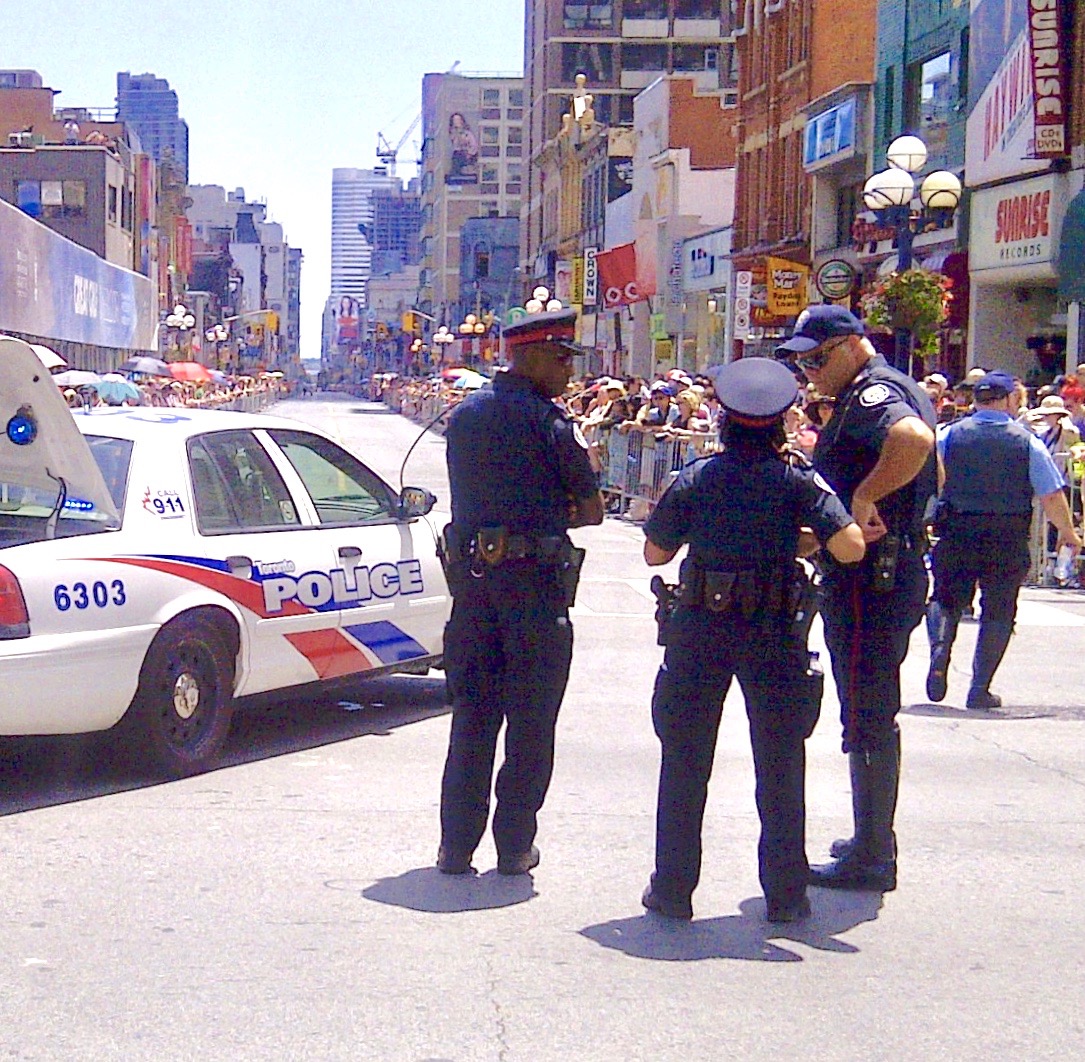
Toronto police at a public event. Have police in Canada (with a few
notable exceptions) also dropped the ball on problem-oriented policing?

In the 1980s and 1990s, the signposts for police triumph were clear. Hundreds of police agencies were trying bits and pieces of the model and reporting good results.

  • Police Chief Jerry Sanders and his agency led the country with POP innovations in San Diego, California
  • Police Chief Darryl Stephens had similar success in his North Carolina city of Charlotte/Mecklenburg
  • The International POP conference drew over a thousand delegates with stories of reduced robberies, assaults, gang shootings, and others
  • Canadian POP projects triggered Canada’s first Problem-Oriented Policing conference in Vancouver in 1995
  • In Britain, a similar POP movement grew (and continues to this day).

Surely, after decades of cutting crime and building community relations, this triumph should lead to positive reform in police service delivery?

You would think.


WHERE IS THE TRIUMPH TODAY?

Somehow, in the intervening years, those efforts fell on deaf ears. Police executives I meet today seldom mention POP as one of their strategies. While the POP movement continues, and the POP conference remains vibrant and relevant, many other POP efforts faded. 

The Canadian POP conference vanished. Police academies rarely teach POP in any meaningful way (or at all). When police leadership in San Diego changed, they eventually dropped POP as an embedded approach, as did many other police agencies. 

In a recent SafeGrowth project we trained 35 NYPD officers alongside community residents. Mindful of the alignment between SafeGrowth and POP, I was disappointed to learn that few of those officers had any experience in POP. In fact, most didn’t know anything about problem-oriented policing. 

It was a sad statement, especially since the annual POP conference, with dozens of innovative crime reduction strategies from around the world, was held later that year a short 3-hour drive north of New York City. 

Of the 40,000 officers in the NYPD, I saw none at that conference. Neither did any of those 35 officers in our training attend and when I asked their Sergeants to drive up, they too were told by supervisors it was not going to happen. That is not to say other police agencies are any different or that others did not attend - they did! At least the progressive ones. But it does make you wonder why success like this does not cling to police organizations?


Disney’s Jiminy Cricket – When you ask about the future of police,
you don't want to hear the sound of crickets
- Image Creative Commons

After four decades, hundreds of POP cases reported on the POP Center website, thousands of officers attending the conferences, dozens of books, and proof of success, when I ask police trainers and leaders today about POP, I get crickets. 

Chirp, chirp. 

It’s a lovely sound on a warm summer night on freshly mowed grass. But in answer to the question of whether police will ever adopt a fundamentally better way to work with the community to solve problems, it is the malady of cultural amnesia.

Why do we find ourselves here? 


NEXT BLOG: A POST-FERGUSON WAKEUP, HOTSPOTS, LEVERS, AND RECOVERING LOST MEMORIES

Thursday, May 10, 2018

New York returns the cop to the beat

With towers as a backdrop, New York is a city of neighborhoods
by Mateja Mihinjac

Once considered a breeding ground for crime and violence, today New York City is one of the safest large cities in the USA. While this cannot be attributed to any single strategy, there is no doubt establishing close and positive relationships between public and police promises effective problem-solving and quality of life in the long run.

It was not always so! In the past, the NYPD employed a number of strategies to improve public safety. Some of the best-known and controversial tactics include broken windows policing and stop-and-frisk. Between 2005 and 2013, the NYPD relied extensively on stop-and-frisk. Unfortunately, in 2013 the way they applied the tactic was ruled unconstitutional.

In addition, research found no correlation between this tactic and crime rates and, given increasing tensions between the public and police, NYPD rethought their approach.

NEIGHBORHOODS ARE THE KEY 

In 2015 NYPD introduced a neighborhood policing model. The focus of the approach is permanently locating an officer - an NCO - within a neighborhood and building personal relations with residents on a daily basis. While this echoes earlier, often criticized, forms of community policing, the New York NCO  program attempts to take advantage of the intense personal knowledge of local areas.

It also provides officers with "sector integrity," allowing them time within their beat away from calls for service and assigning them to that neighborhood long enough to develop personal relationships.

NCOs focus not only on developing leads to tackle serious crime, but they also partner with residents for long-term problem-solving. As the NYPD website says: “sector officers play the role of a generalist cop who knows and feels responsible for the sector, and who provides the full range of policing services there.”

Before radio was used, beat policing and
call boxes were the norm in neighborhoods

In effect, this is a resurgence of the local beat cop of pre-radio days, except with a problem-solving focus and without the old style police call box. The NCO program also resonates with our methods in SafeGrowth where we teach residents how to partner with police, create planning teams, and target unsafe activities to create neighborhood safety plans.

NCOs - NEIGHBORHOOD COORDINATION OFFICERS

The cornerstone of NYPD neighborhood policing are the NCOs - Neighborhood Coordination Officers whose daily presence within the assigned neighborhood and respectful demeanor help build relationships.

New York NCOs and residents team up to solve problems

I witnessed the positive effect of this approach on several occasions while in New York: residents would greet their NCOs with hugs while NCOs would share their personal phone number with the residents should they need assistance with crime-related issues. The goal is for officers to be part of the community and be seen as an ally as opposed to an enemy.  

According to the New York City Police Foundation, in neighborhoods implementing neighborhood policing since 2015, shootings have declined 58% faster and the number of arrests declined 10% faster compared to the rest of the city. In the past two years, NCOs on foot patrol have met thousands of residents in hundreds of meetings, thereby building deeper local relationships in neighborhoods throughout the city. 

As NCO policing continues to expand to precincts across all five New York City boroughs, the approach has been recently applied to transit. NCOs will patrol the same subway stations and train lines to provide safety and build relationships, in this case with frequent riders. The beat cop, so common in another era, has now returned to the neighborhood.

Monday, July 23, 2012

A thousand small sanities

 NYPD's hotspot tactics & Compstat are controversial - but effective
[Photo: Ianqui Doodle/Flickr]
Readers of SafeGrowth know certain high crime properties are incubators for gangs and violence. That isn't destiny, it's reality. If SafeGrowth (and approaches like it) prove anything, it proves residents are not doomed to a life of mayhem. Environment can be changed and streets transformed.  

It also proves we can do it with coherent planning, mobilized neighborhoods and intelligent anticrime strategies like hotspot policing.

Case in point: crime declines in New York.

I recently read Frank Zimring in the New York Times:  "The 40% drop in crime that occurred across the U.S. from 1991 to 2000 largely remains an unsolved mystery. Even more puzzling then is the crime rate drop in New York City, which lasted twice long and was twice as large. This 80% drop in crime over nineteen years represents the largest crime decline on record."


Zimring studies New York's crime declines - A book worth reading.
A mystery?

I'm not big on mysteries that aren't. It's like watching a Hollywood flick and expecting some magical, non-formulaic finale. Not going to happen!

That 40% drop nation-wide followed a decades-long demographic metamorphosis that swept North America more than anywhere else since WW2. Since the 1990s crime-prone cohorts aged out of crime in record numbers. Those crime declines continue today.                                                          
Then New York built on that perfect demographic storm as NYPD added crime suppression tactics like proactive street stops and controversial (but clearly effective) quality-of-life enforcement.               
Intensive street stops increased the risk of getting caught with an illegal gun. That led to a 39% drop in gun toting criminals from 1993-1995. Is it really a mystery that kind of informal gun control cut violence?

FEWER PRISONERS?

It's what Greg Bergman calls A Thousand Small Sanities (another excellent read).

During the peak crime declines fewer arrestees went to prison. Why? Bergman describes the vast network of incarceration alternatives evolved in New York - drug courts, mental health courts and community courts providing meaningful community alternatives like drug treatment and restorative justice.

Says Bergman "there needs to be a continuum of non-incarcerative interventions for offenders with the most intensive options reserved for populations that are both high risk and high-need."

Hotspot policing, neighborhood justice courts, and targeted suppression. Anchor that with permanent SafeGrowth planning and neighborhood capacity building and voila -  a finale that makes sense.


Friday, March 16, 2012

C-3PO: Civic Protection, Privatization, Policing

This is policing in the 21st Century?
After my last blog I'm fighting the urge to quote the Star Wars droid Threepio: "We're Doomed!"

The story of cooked books in NYPD seems the symptom of a much larger crisis. CompStat is an excellent idea. What went wrong? The opportunity to truly change service delivery was at hand. Did they blow it?

Now the Great Recession has changed the game. Declining budgets. Rapidly changing police roles. Private security filling gaps. Systematic problem-solving lost in the dust. Combat policing on the rise. Community policing on the decline.

Clearly, policing faces the single greatest challenge in a half century.

You can imagine my surprise yesterday when I saw the agenda at the inaugural US version of the International Conference for Police Law Enforcement Executives next month in Seattle. Here's part of the program. Find Waldo...

* Terror sleeper cells
* Internal corruption
* Special interest groups
* Negative press and malicious accusations
* Union non-confidence motions
* High tech cyber crime

What's missing? How about the single greatest challenge in a half century! These conferences are important and necessary for executives. However I do think, respectfully, that our eyes need to be on the prize. This agenda suggests otherwise.

Thomas Cahill said economic crises create "hinges in history". We are not doomed, of course. But we are at such a hinge right now. I have started a LinkedIn discussion group to talk about alternative types of accountability, measuring success and failure, and new models for public safety. Find it here:

Civic Protection in the 21st Century - Policing, Privatization and Public Safety

Saturday, March 10, 2012

Time for a change in policing?


This week The Wire came to life. I much prefer blogging successes vs wrongdoing. Every now and then though something comes along. It happened Wednesday, an ugly echo of the Serpico affair 40 years ago.

If you're not into policing, Serpico was the NYPD detective who retired after blowing the whistle on corruption in the 1960s and 1970s. His revelations led to a government inquiry, the Knapp Commission, and the Oscar nominated film Serpico starring Al Pacino.

This Wednesday Village Voice published NYPD Crime Stats Manipulation Widespread. Written by two criminologists, it summarized their scientific research, internal reviews and news accounts of a whistle blower. It confirms that NYPD is cooking their crime books, engaging in questionable arrests and reclassifying crime reports all in the name of proving that CompStat cuts crime. The irony is CompStat was intended to enhance accountability and improve police leadership, not the reverse.

Perhaps the most shameful part of this sordid tale (one that decent and hardworking NYPD street cops themselves probably cannot believe) is the story of officer Adrian Schoolcraft. Like Serpico, Schoolcraft uncovered police wrongdoing, this time by secretly taping conversations of his bosses.

The NYPD precinct where Officer Schoolcraft's secret tapes were recorded 
Lamplighters like Serpico and Schoolcraft are often ostracized (in Serpico's case he was shot by druggies when his backup didn't show; in Schoolcraft's case he was dragged in front of a psychiatrist to prove he's insane). Schoolcraft ended up filing a federal lawsuit against NYPD.

The study confirmed Schoolcraft's allegations. In later reports the criminologists (one a former NYPD Captain) claim that NYPD has become a place of "relentless pressure, questionable activities, unethical manipulation of statistics. We've lost the understanding that policing is not just about crime numbers, it's about service."

Service indeed! That demand should be made of everyone in charge of public safety.

All which leads me to wonder: How widespread is this fuzzy math? Are there better models for accountability and measuring success and failure? Perhaps it's time to rethink an entirely new model of police services?