Showing posts with label Housing First. Show all posts

Tuesday, May 28, 2024

Homelessness in a European city

An underpass in Ljubljana - homelessness is everywhere


by Mateja Mihinjac

We’ve reported on the issues of homelessness several times although rarely from the European perspective. While not a new phenomenon, it appears the problem of homelessness – especially the most visible part that includes what Europeans call “rough sleepers” – is becoming more prevalent in the capital city of Ljubljana. At least this is the perception of many living here in Slovenia's capital city where it is now common to see a rough sleeper on the main city streets and the underpasses.   


THE PREVALENCE OF THE PROBLEM

Statistics on homelessness in Slovenia are currently lacking. The researchers Filipovič Hrast and colleagues report that the Statistical Office of Slovenia shows an almost triple increase in individuals without a home (from 4.252 in 2011 to 11.524 in 2021). In the same period, the number of individuals registered with the Centre for Social Work doubled from 1.426 to 3.085. 

The residents of Ljubljana increasingly report feeling less safe due to the perceived increase in homelessness and they have been contacting the Mayor’s office pleading to urgently address the issue.

They’ve been calling for the city to provide affordable housing for the homeless and the city is planning to respond by building a new shelter. Is that enough? Could we do better?


POOR DATA

One of the issues in dealing with homelessness in Slovenia is a lack of systematic monitoring of homelessness patterns and a poor understanding of the many pathways that lead to individuals losing a roof over their heads.

While the public often generalises and argues that homelessness is caused by personal choice, research shows there are many underlying reasons. This includes unaffordable housing, mental illness, domestic violence, substance abuse, loss of a job, financial difficulties, and others.

There is also no national strategy on homelessness. The Resolution on the National Social Protection Programme partially addresses the issue, mainly through social assistance programs. But that lacks a holistic approach to identify workable solutions that are not so limited.  


Signs of the unhoused are everywhere

WHAT NEXT?

Homelessness is becoming a major issue across Europe, possibly triggered by immigration waves from wars in Ukraine and elsewhere. 

Slovenia is not exempt from this trajectory. It is refreshing to see that the non-governmental humanitarian organisation Kralji ulice (“Kings of the Streets”) already adopted a Housing First approach in 2008. This program has been demonstrated the  most effective in addressing homelessness. It is also recommended in a White Paper of the International CPTED Association.


Finland has extensive Housing First programs and special housing facilities, such as the Kenttätie homeless shelter and a service center in Myllytulli, Oulu - photo Creative Commons Wiki


Building yet more shelters reminds me of another limited strategy – responding to crime by building more prisons. In both cases, nothing is truly fixed. It is a band-aid approach that does not address the underlying issues. 

A better strategy is to use the method we apply in SafeGrowth - work in partnership across various sectors. It is far more effective for the government to partner with non-governmental organisations, based on a comprehensive national strategy. That is the path to a much more effective response. 


Wednesday, January 31, 2024

Is This The World We Created? Part 2


From 30,000 feet, the city hides many blemishes. On the ground, not so much.

by Gregory Saville

In my last blog Is This The World We Created? I discussed the growing problem of street homelessness in cities around the world. I presented facts and listed some responses. Most of those responses use a continuum of care in which people who are homeless must climb a staircase of supports with housing at the top as the final step.

Perhaps that is wrong? Maybe it should be the other way around in which care follows housing as in the Housing First program?


CRIME = HOMELESSNESS?

While there is not necessarily a connection between homelessness and crime, the public makes the crime/homelessness connection. Take for example recent media comments by a British Columbia citizen group Save Our Streets:

“Drug addictions and drug trade, mental health challenges, law enforcement, judicial reform, homelessness, are all factors…while governments have a long history of announcing policies and programs meant to respond to these issues, the desired results have not been realized.”

So in the mind of the public it seems one issue relates to another. Further, there is growing discontent that current government programs are ineffective at solving the problem, a view supported by some of the research I discussed in the last blog. What can be done?


FINLAND


In Canada and the U.S., we have homeless rates of .8 and 1.7 per thousand people respectively. It’s much worse in other European countries. 

What would it be like if we could reduce that to 0.1 of the total population? In other words, in the U.S. over 600,000 people live without shelter or food each night. If we cut that to 0.1 we could virtually eliminate most of the homelessness in our cities. 

Why 0.1? Because it has already been done in Finland.

The video above explains how the country of Finland used a modified and expanded version of the Homes First program to accomplish precisely this result. Finland’s success is not based on a staircase, but rather by starting with housing and then adding intensive and sustained supports later.


WALLS MUST FALL

Of course, this is not a simple proposition and there are many walls in the way. 

First, the Finnish response is not simply to house people but rather to provide intensive, and sustained, services immediately upon housing people. When the city of Medicine Hat, Canada tried the Housing First method they had initial success. Sadly, they did not follow up with the intensive and sustained servicing that was available in Finland. Thus, five months after housing people, the problems and homeless rates returned.

Then there is the city of Wheat Ridge, Colorado. They shut down homes for the homeless in motels due to ongoing crime concerns, thereby forcing those residents back onto the street.


Clearly, the Finns understood the importance of intensive and sustained in-home support (in-house security, substance abuse counselling, mental health services, financial support, etc). They understood what would happen without that support.


HOW MUCH WILL IT COST?

Finally, there is the issue of cost. This is not a trivial obstacle. However, as Charles Marohn reveals in his book Strong Towns, there is already tremendous wasteful municipal spending on zero rate-of-return municipal projects. 

I made this point 15 years ago in my blog Give me a $1,184 inch…and I’ll make me a mile. In that blog, I unpacked a $2.67 billion highway connector project in Houston that cost $75 million per mile, or $1,184 per inch (in a city that already had between 14,000 to 30,000 homeless people). 

Just imagine... giving up a single mile of that roadway connector could create over $75 million for homes. And since former SafeGrowth blogger Tod Schneider tells us they have developed Conestoga Huts for homeless people that cost $1,500 each, that means a single mile of Houston’s connector could free up over 50,000 homes, far more than enough to house every single homeless person in Houston. 

This back-of-envelope (and admittedly simple) calculation ignores many other more sophisticated ways to make enhanced Housing First a reality. It also ignores other walls, like figuring out where to locate those small homes without triggering the ire of the Not-In-My-Backyard crowd (a crowd that, incidentally, is already being encroached on by uncontrolled tent cities and unsanitary encampments).

Surely we can create a better world for those most in need.


Wednesday, February 8, 2017

Reducing homelessness - Tiny house villages (Part 2)

Impression of tiny houses - photo by Tiny Homes Foundation
by Mateja Mihinjac

Not long ago we blogged about Dignity Village from Portland, the first organised tiny housing homeless community. Similar villages have expanded elsewhere across the US and, together with Housing First strategies, have contributed to a drop in homelessness.

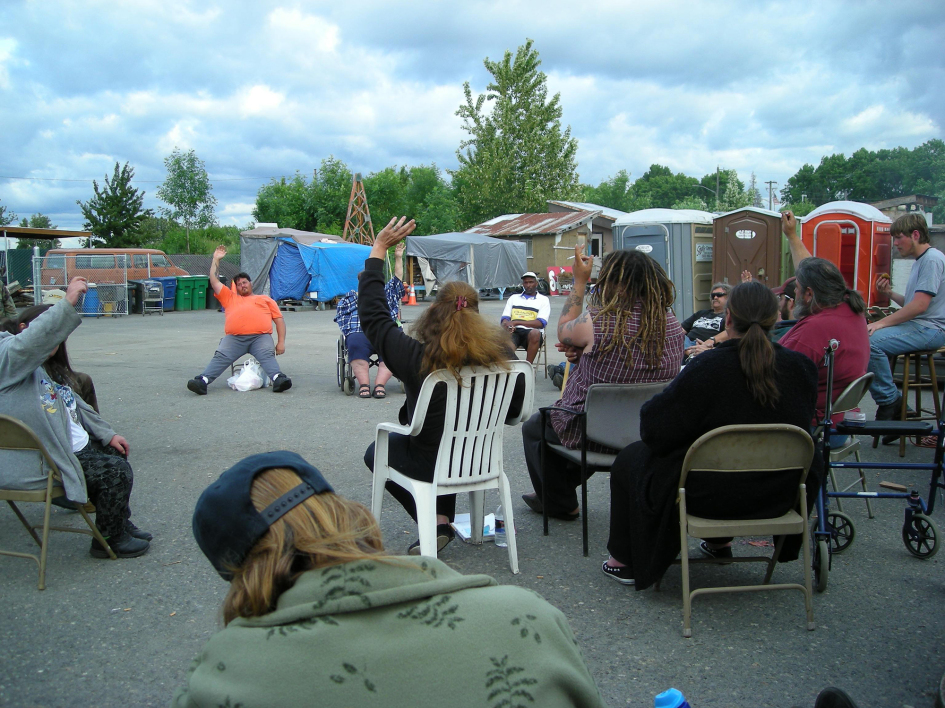
These villages offer more than just housing. They also foster a sense of community within a supportive, respectful and usually self-governing environment that empowers the homeless to rebuild their lives. Social cohesion emerges from respect for shared goals and each other’s well-being. Connectivity helps to integrate the homeless with the local community and outside service providers.

Volunteers and local community are integral to success - photo by Kwamba Productions 

Australia has recently introduced its first homeless village projects. The Tiny Homes Foundation from NSW received an approval for a 2-year pilot project to build 4 self-contained houses and communal areas while the Victoria-based Launch Housing announced it will build 57 tiny homes on a currently unused VicRoads land.

Tiny Homes Foundation is a blueprint for other Australian projects. It has forged strong collaborative relationships with service providers, volunteers, and local communities and it helps homeless people transition to permanent housing, employment, and society.This will ensure that the project remains true to “housing first, not housing only” approach.


LESSONS LEARNED 

Experience from existing projects provide some lessons as a step for solving the homelessness crisis:
  • community-driven groups with mixed expertise are integral to planning, delivering and running the project such as charities, non-profits, and other social groups
  • engage local residents in the process to avoid NIMBYism
  • charities, volunteers, private donations, fundraising, and crowdfunding represent the most common project initiators and supporters 
  • close relationships with local government to secure special zoning arrangements and building code restrictions
  • villages should be integrated into the society with easy access to the city, work, and social services
  • aesthetically pleasing architecture of the structures secures public support
  • media and publicity can be effectively used to draw donations and secure ongoing public support 
The community works together to create homeless shelters – photo by Kwamba Productions

FINAL THOUGHTS 

Homelessness is a human rights issue. It should not exist in the first place or be allowed to progress. Social policies need to reflect this if Australia (indeed countries everywhere), wishes to reach the goal of halving homelessness by 2025. Support for tiny house villages is the first step towards realising that goal.